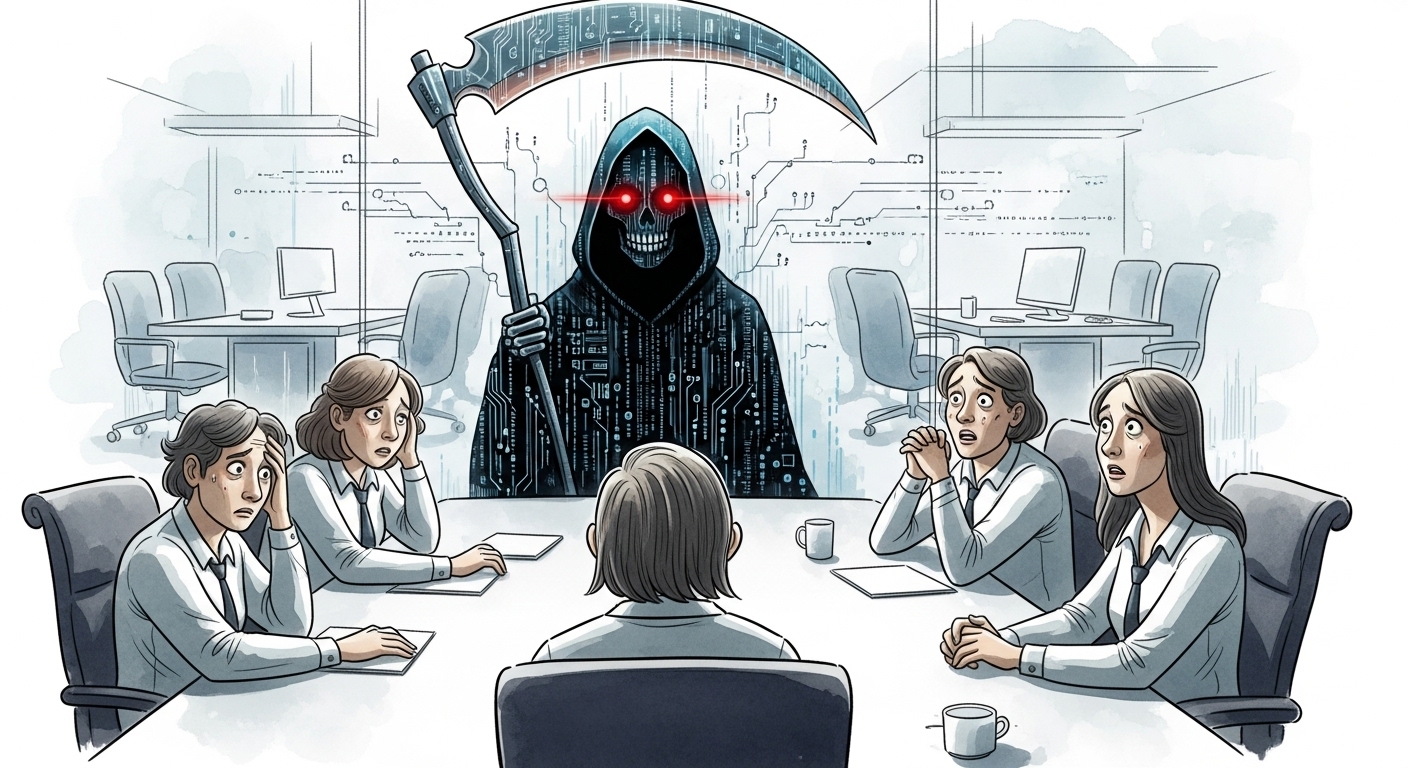

Widespread fears that artificial intelligence will replace human labour are directly undermining public confidence in democratic institutions, according to a major new study published in PNAS.
Researchers from the University of Vienna and Ludwig-Maximilians-Universität München (LMU) conducted a comprehensive analysis of over 37,000 respondents across 38 European countries. The findings reveal that in the majority of these nations, the prevailing public sentiment is that AI technologies are destroying more employment opportunities than they create.
This economic anxiety was found to have distinct political repercussions. The data showed that individuals who view AI as a “job killer” are significantly less satisfied with democracy’s functioning. Crucially, these individuals are also less likely to participate in political discourse or engage in the democratic co-design of technology policy.
“The actual impact of artificial intelligence on the labour market is still limited,” said Armin Granulo, study author from the LMU Munich School of Management. “Nevertheless, many people primarily perceive artificial intelligence as replacing human labour. This perception is remarkably stable and particularly widespread in economically developed countries.”
Contrasting futures
To determine if this link was causal rather than merely correlational, the research team conducted additional representative experiments in the UK and the US. Participants were presented with contrasting future scenarios: one framing AI as a substitute for human labour, and the other as a creator of new roles.
The results confirmed the hypothesis that participants exposed to the job-replacement scenarios expressed significantly lower trust in democratic institutions and a reduced willingness to engage politically with the technology compared to the control group.
“When people feel that artificial intelligence replaces human labour, they express doubts about the political system – they are less satisfied with democracy and its institutions,” said Christoph Fuchs, study author from the University of Vienna.
The study highlights that the societal impact of AI begins with public expectations, long before actual employment shifts occur. The authors warn that this trend comes at a critical time, when democratic legitimacy is already under challenge in many established democracies.
“The very way we talk about artificial intelligence as a society can influence democratic attitudes,” said Andreas Raff, study author from the University of Vienna. “If public debates focus heavily on job losses, this can have unintended side effects for democracy.”