
A new wearable device that tracks human flatulence has revealed that the average person passes gas roughly 32 times a day — more than double the figure often cited in medical textbooks.
Developed by researchers at the University of Maryland, the “Smart Underwear” system consists of a small, 3D-printed monitor that clips discreetly onto the waistband of the wearer’s undergarments.
Using a metal-oxide gas sensor, the device continuously detects hydrogen — a byproduct produced exclusively by gut microbes during food fermentation — allowing for a precise, real-time log of intestinal activity.
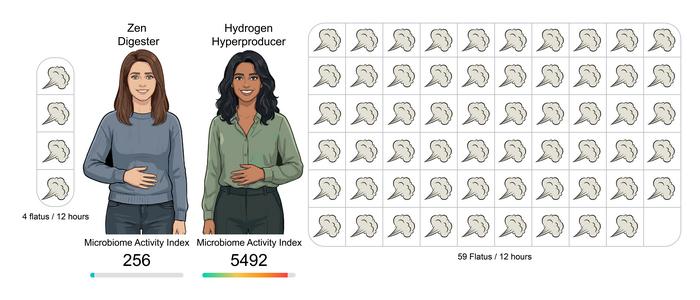
In a pilot study involving 16 healthy adults aged 18 to 32, the technology upended long-standing medical assumptions regarding digestive frequency. While the literature typically estimates a daily average of around 14 events, the new data showed a mean of 32.2 events per day, with individual totals ranging from 4 to 59.
‘Fitbit’ for farts
Current methods for diagnosing gut issues, such as breath hydrogen testing, only provide a “snapshot” of microbial activity and can often miss fermentation occurring in the lower colon. Self-reporting is similarly unreliable, as patients frequently fail to notice smaller events or those occurring during sleep.
To validate the accuracy of the new system, the researchers conducted an “inulin challenge,” feeding participants 20 grams of the prebiotic fibre to stimulate fermentation. The device successfully captured the subsequent spike in gas production, demonstrating a sensitivity of 94.7 per cent in detecting flatus events compared to manual logging.
The sensor works by measuring the “flatus cloud” — the concentration of hydrogen expelled from the body — and calculating the “Area Under the Curve” (AUC) of the signal to estimate relative volume. This allows scientists to differentiate between a minor release and a significant fermentation event.
“We don’t actually know what normal flatus production looks like,” says Brantley Hall, an assistant professor at UMD and the study’s senior author. “Without that baseline, it’s hard to know when someone’s gas production is truly excessive.”
The team is now expanding their research to create a “Human Flatus Atlas,” recruiting volunteers nationwide to categorise digestive profiles. These include:
- Zen Digesters: Individuals who consume high-fibre diets yet produce minimal gas.
- Hydrogen Hyperproducers: Those who produce excessive amounts of gas, potentially indicating specific microbial overactivity.
While the device focuses on hydrogen and does not currently detect methane or hydrogen sulphide — the gases responsible for foul odours — it offers an unprecedented window into the metabolic function of the gut microbiome.