
If you want to teach teenagers about the brutal realities of global migration, you might need to stop showing them statistics and start letting them play video games. According to a new study from Uppsala University, putting students in the digital shoes of a refugee significantly increases their social understanding and empathy towards immigrants.
Published in the journal Computers & Education, the study investigated whether interactive computer simulations could improve standard classroom teaching methods, which typically rely on dry international migration statistics.
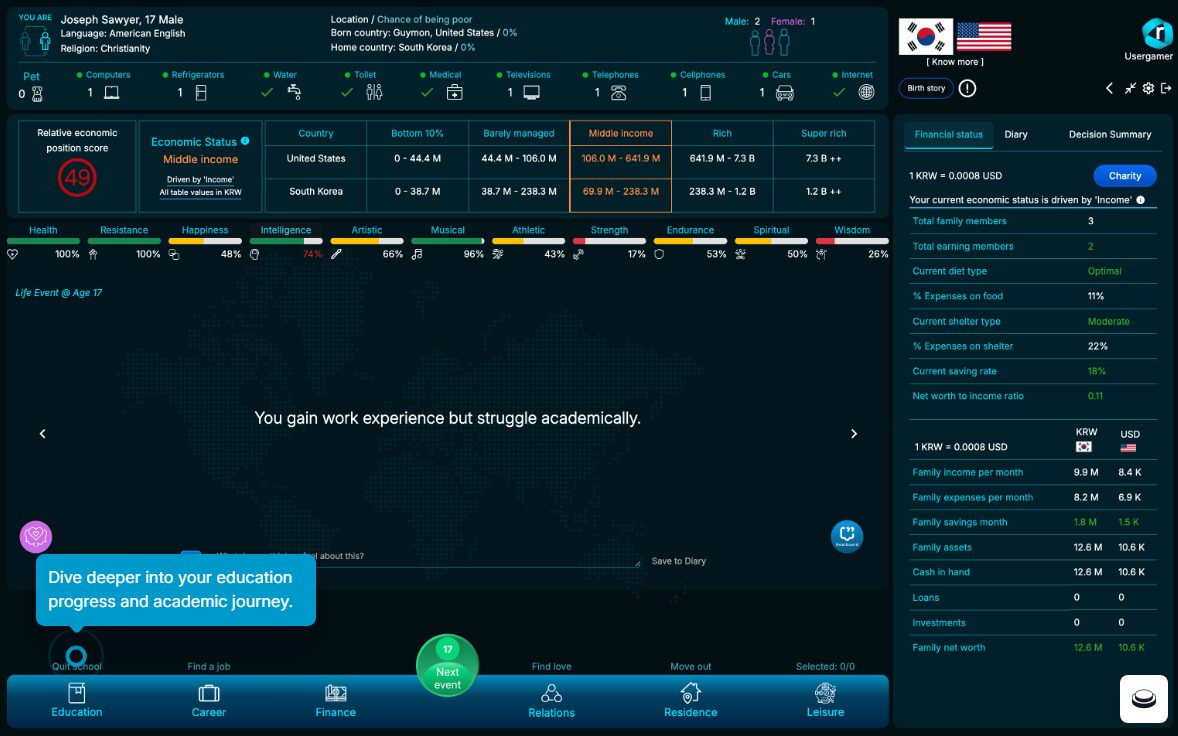
The researchers tested 148 students, aged 14 to 19, across five Swedish schools. Each participant was assigned a randomly generated digital character born in the Middle East or North Africa. The students had to navigate their character’s life from birth to death, trying to survive unforeseen world events, improve their living conditions, and ultimately attempt to migrate to a target country of their choice.
A brutal reality check
The simulation, based on accurate research data, proved to be a harsh wake-up call for the teenagers. Around 25 per cent of the participants completely failed to reach their target countries, with their digital characters thwarted by extreme financial constraints, illness, death, or restricted travel options.
Markus Al-Afifi, the study’s lead author, explained: “It’s not really surprising that many students were unable to migrate their characters. In reality, migration is often difficult to achieve, particularly from certain parts of the Middle East and North Africa, where many people live in great economic deprivation. You need favourable conditions, such as money and good health.”
Because the game forced students to actively build the wealth and health needed to flee, the researchers noted that the simulation served as a profound lesson in global inequality.
“This game is likely to be an eye-opener for many students who believe that the opportunity to migrate is wide open to everyone, regardless of their circumstances,” Al-Afifi added.
Changing minds, but not politics
Before and after the game, the researchers measured the students’ attitudes towards migration. Grounded in “intergroup contact theory” — which suggests that contact between different groups reduces prejudice — the study found that the digital simulation successfully acted as a form of indirect experience.
The analysis revealed that the students exhibited significantly greater social understanding and empathy following the simulation, though the exact outcomes varied with their prior knowledge of global affairs.
Professor Thomas Nygren, study co-author, said: “We demonstrate that students can develop a deeper understanding of migration by experiencing a simulated migration journey for themselves. At a time of polarised debate on migration and widespread disinformation, this offers new opportunities to address attitudes in an evidence-based manner. It’s like Hans Rosling’s models for tackling fact resistance meeting computer games.”
However, the researchers noted a distinct limit to the game’s influence. While the teenagers became much more empathetic to the plight of migrants, their fundamental political views regarding immigrants’ rights remained completely unchanged.
“By using structured and fact-based information, this type of simulation can give students a nuanced and data-driven understanding of global migration patterns. Having said that, the results show that political views on immigrants’ rights are more stable and do not change so easily as a result of a single intervention of this kind,” said Al-Afifi.