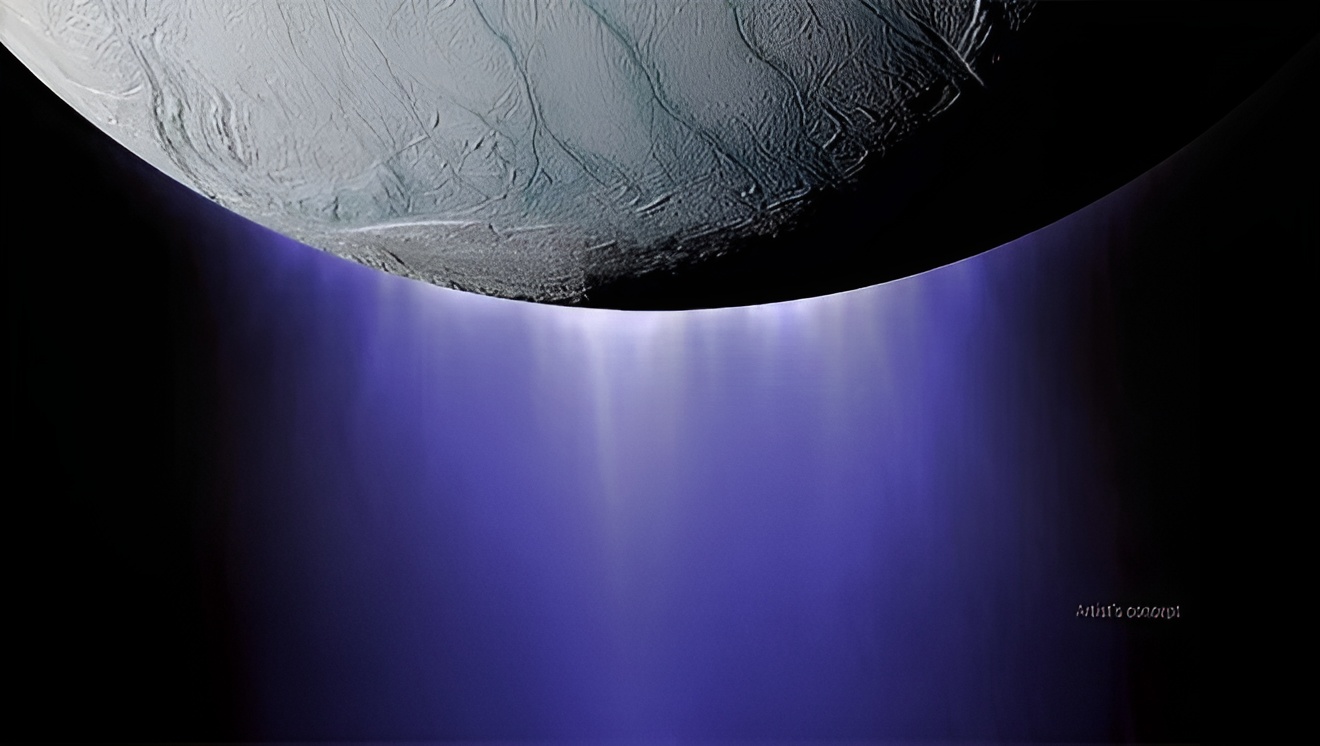

New findings from NASA’s Cassini mission show that Enceladus, one of Saturn’s moons and a top contender for extra-terrestrial life, is losing heat from both poles, indicating that it has the long-term stability required for life to develop.
Researchers led by Oxford University, Southwest Research Institute and the Planetary Science Institute in Tucson, Arizona, have provided the first evidence of significant heat flow at Enceladus’ north pole, overturning previous assumptions that heat loss was confined to its active south pole. The findings were published in Science Advances.
Enceladus is a highly active world, with a global, salty sub-surface ocean believed to be the source of its heat. The presence of liquid water, heat and the right chemicals means that its sub-surface ocean is believed to be one of the best places in our solar system for life to have evolved outside Earth.
“Enceladus is a key target in the search for life outside the Earth, and understanding the long-term availability of its energy is key to determining whether it can support life,” said Dr Georgina Miles from Southwest Research Institute and Visiting Scientist at the Department of Physics, University of Oxford, lead author of the paper.
Until now, direct measurements of heat loss from Enceladus had only been made at the south pole, where dramatic plumes of water ice and vapour erupt from deep fissures in the surface. In contrast, the north pole was thought to be geologically inactive.
Radiated into space
Using data from NASA’s Cassini spacecraft, the researchers compared observations of the north polar region in deep winter in 2005 and summer in 2015. These were used to measure how much energy Enceladus loses from its warm subsurface ocean as heat travels through its icy shell to the moon’s frigid surface and is then radiated into space.
By modelling the expected surface temperatures during the polar night and comparing them with infrared observations from the Cassini Composite InfraRed Spectrometer, the team found that the surface at the north pole was around 7 K warmer than predicted. This discrepancy could only be explained by heat leaking out from the ocean below.
The measured heat flow of 46 plus or minus 4 milliwatts per square metre is about two-thirds of the heat loss per unit area through Earth’s continental crusts. Across the whole of Enceladus, this conductive heat loss totals around 35 gigawatts: roughly equivalent to the output of over 66 million solar panels or 10,500 wind turbines.
When combined with the previously estimated heat escaping from Enceladus’ active south pole, the moon’s total heat loss rises to 54 gigawatts: a figure that closely matches predicted heat input from tidal forces. This balance between heat production and loss strongly suggests that Enceladus’ ocean can remain liquid over geological timescales, offering a stable environment where life could potentially emerge.
“Understanding how much heat Enceladus is losing on a global level is crucial to knowing whether it can support life,” said Dr Carly Howett from the Department of Physics, University of Oxford and Planetary Science Institute in Tucson, Arizona, corresponding author of the paper. “It is really exciting that this new result supports Enceladus’ long-term sustainability, a crucial component for life to develop.”
According to the researchers, the next key step will be to determine whether Enceladus’ ocean has existed long enough for life to develop. At the moment, its age is still uncertain.