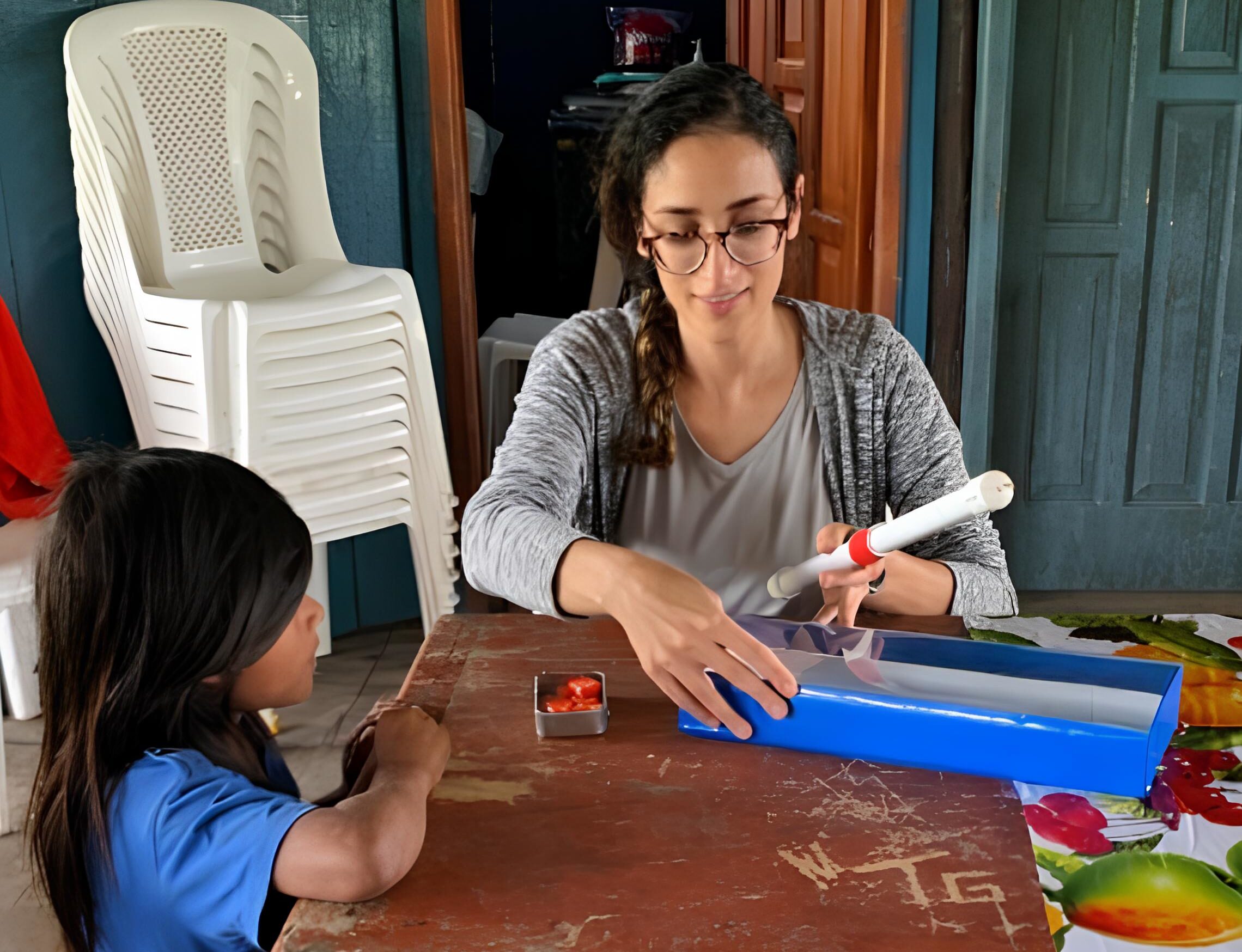

Children everywhere start life motivated by self-interest, but by the time they reach “middle childhood”, they have learned to cooperate in ways that are distinct to their specific culture – a major international study has found.
Research published in Science Advances involving more than 400 children from five different societies – the United States, Canada, Peru, Uganda and the Shuar communities of Ecuador – suggests that the “universal” rules of childhood development are heavily influenced by local norms.
“We wanted to try and map the regularities and variation in how cooperation develops… [and] uncover the roots of human cooperation,” says Dorsa Amir, an assistant professor of Psychology and Neuroscience at Duke University.
Universal selfishness
To measure concepts such as fairness, trust, honesty, and forgiveness, researchers set up simple games for children aged 5 to 13. For example, they decided how to share “resources” – in this case, Starburst sweets – often at a cost to themselves.
The team found that younger children across all five cultures shared a similar trait: they were largely “self-interested”, making choices that maximised resources for themselves.
However, between the ages of eight and 13 – a period defined as “middle childhood” – their behaviour began to diverge significantly as they started to mimic the values of the adults around them.

The study revealed that what is considered “fair” depends entirely on where you grow up.
In the US and Canada, children were more likely to cooperate with strangers, a behaviour that reflects the norms of industrialised societies.
In contrast, children from the Shuar hunter-horticulturalist communities in Amazonian Ecuador focused on avoiding waste rather than distributing resources equally.
“In those areas of Ecuador, where resources are sometimes scarce, it may be more important for people to minimise waste than spread resources out equally,” the researchers explain. “In places like Ecuador, these behaviours aren’t breaking a norm, they are the norm.”
While fairness and trust shifted across cultures, one trait remained constant across all five societies: forgiveness.
“Our lab has done a lot of work on punishment behaviour… Yet, here, both adults and children seemed to endorse forgiveness over punishment,” says Katherine McAuliffe, an associate professor at Boston College. “It’s possible that, in past work, we have overestimated how much people want punishment.”