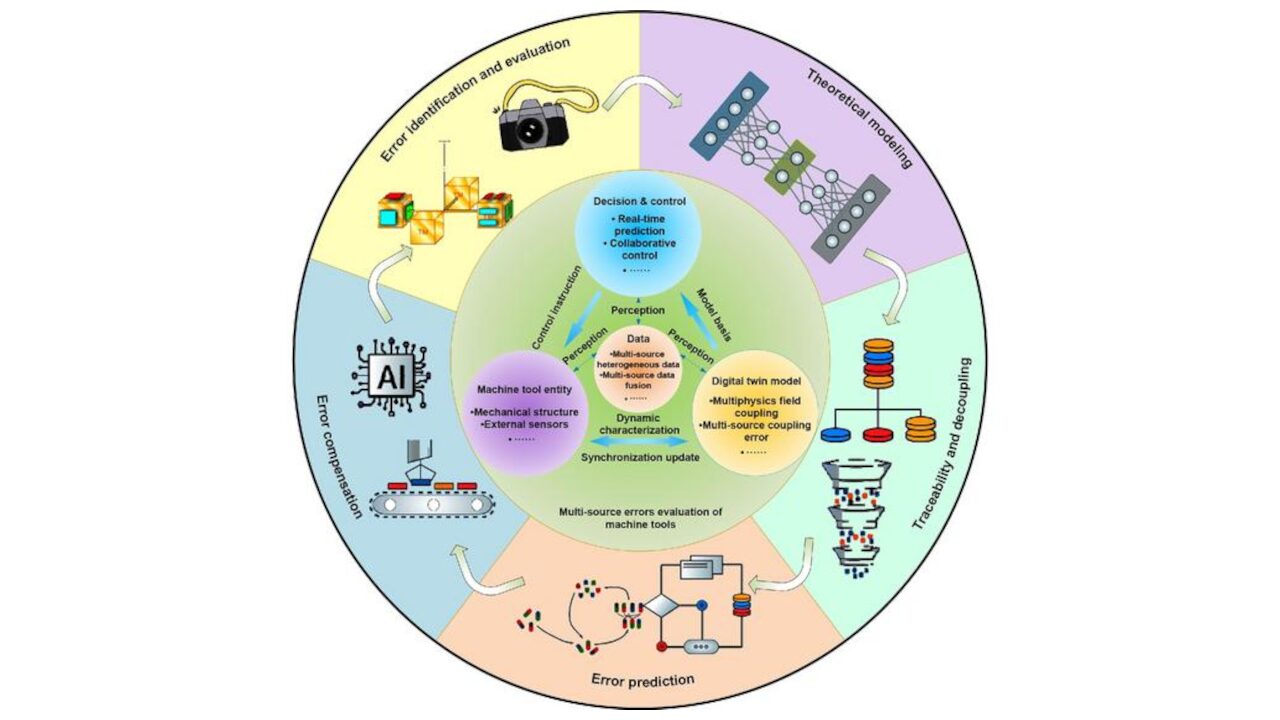

Precision engineering is hitting a wall as traditional error-correction fails to keep pace with the complex realities of modern manufacturing, prompting a shift toward machines that can diagnose and fix themselves.
A review by Prof. Changhe Li’s team at Qingdao University of Technology, published in the International Journal of Extreme Manufacturing, argues that the “single-source mindset” of fixing one error at a time is obsolete.
For decades, engineering has focused on correcting individual issues in isolation. However, modern machine tools operate under fluctuating temperatures, varying loads, and tightly coupled mechanical–electrical–thermal interactions.
Consequently, errors no longer behave predictably; they interact, evolve with time, and amplify one another, rendering single-point corrections ineffective for modern production systems.
“By bringing together current knowledge and outlining what still needs to be solved, we hope to provide a useful foundation for building much more accurate, reliable, and smart machine tools that can understand their own errors and keep themselves accurate under real industrial conditions,” said Dr Sun.
Intelligent error management
The researchers propose an intelligent error management system that links identification, modelling, decoupling, and predictive compensation into a cohesive lifecycle management strategy.
The team suggests combining traditional geometric models — based on heat transfer and mechanical deformation — with data-driven artificial intelligence to create systems that adapt to changing conditions.
While traditional models often struggle when conditions fluctuate, AI models adapt well but can lack transparency; combining them offers both accuracy and interpretability.
By leveraging digital twin technology, these models can update in real time, enabling machines to trace error sources and automatically apply adjustments to maintain accuracy throughout the tool’s lifecycle.
The review highlights that advanced measurement techniques, such as laser interferometers, multi-sensor systems, and vision-based detectors, are critical for capturing error information quickly and clearly.
Looking ahead, integrating networked machine platforms and advanced sensors could enable tools to predict changes before they affect performance, ensuring stable production quality throughout a machine tool’s working life.
However, the authors note that significant challenges remain. Models built from simplified assumptions cannot always represent the real behaviour of a machine tool. In addition, collecting and processing large amounts of sensor data in real time requires fast computing, which is currently difficult to achieve on the factory floor, alongside the challenge of ensuring that different machines and control systems work together smoothly.