
Scientists have developed a wireless device that uses light to beam information directly into the brain, bypassing the body’s natural sensory pathways in a breakthrough that could restore lost senses.
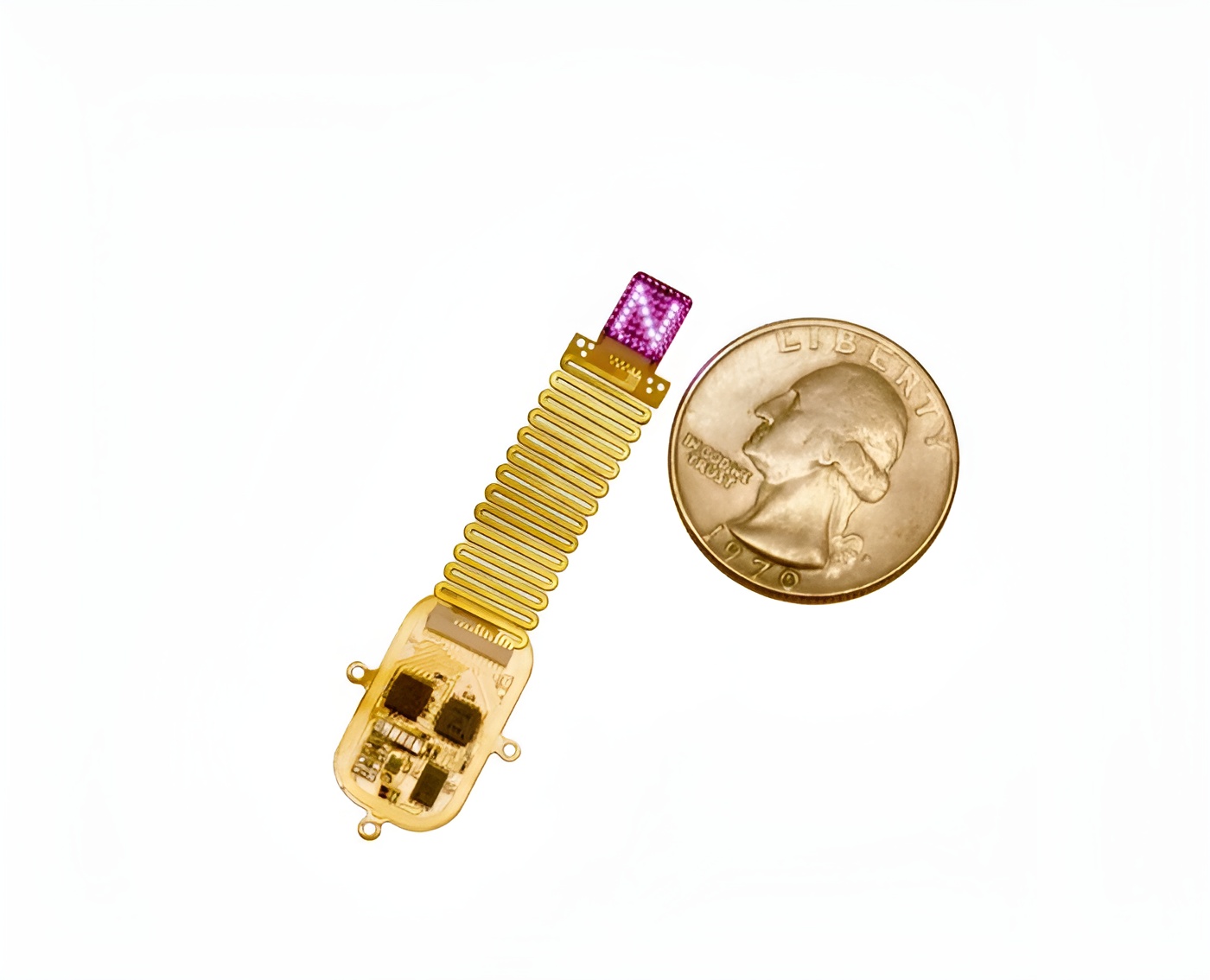
Northwestern University researchers created a soft, flexible implant that sits on top of the skull and delivers precise patterns of light through the bone to activate neurons across the cortex.
In experiments published in Nature Neuroscience, mice quickly learned to interpret these light patterns as meaningful signals, using the information to make decisions and complete tasks without any touch, sight or sound input.
“Our brains are constantly turning electrical activity into experiences, and this technology gives us a way to tap into that process directly,” said Yevgenia Kozorovitskiy, a Northwestern neurobiologist who led the experimental work. “This platform lets us create entirely new signals and see how the brain learns to use them.”
Genetically modified neurons
The device is roughly the size of a postage stamp and thinner than a credit card. Unlike previous optogenetic tools that required fibre-optic wires penetrating the brain, this wireless system sits beneath the skin but outside the skull, shining red light through the bone to activate genetically modified neurons.
“Red light penetrates tissues quite well,” said Kozorovitskiy. “It reaches deep enough to activate neurons through the skull.”
The implant features a programmable array of up to 64 micro-LEDs, allowing researchers to send complex sequences that mimic the distributed activity of natural sensations.
“The number of patterns we can generate with various combinations of LEDs — frequency, intensity and temporal sequence — is nearly infinite,” said Mingzheng Wu, the study’s first author.
The technology holds potential for various therapeutic applications, from providing sensory feedback for prosthetic limbs to modulating pain perception without opioids.
“It represents a significant step forward in building devices that can interface with the brain without the need for burdensome wires or bulky external hardware,” said John A. Rogers, a bioelectronics pioneer who led the technology development.