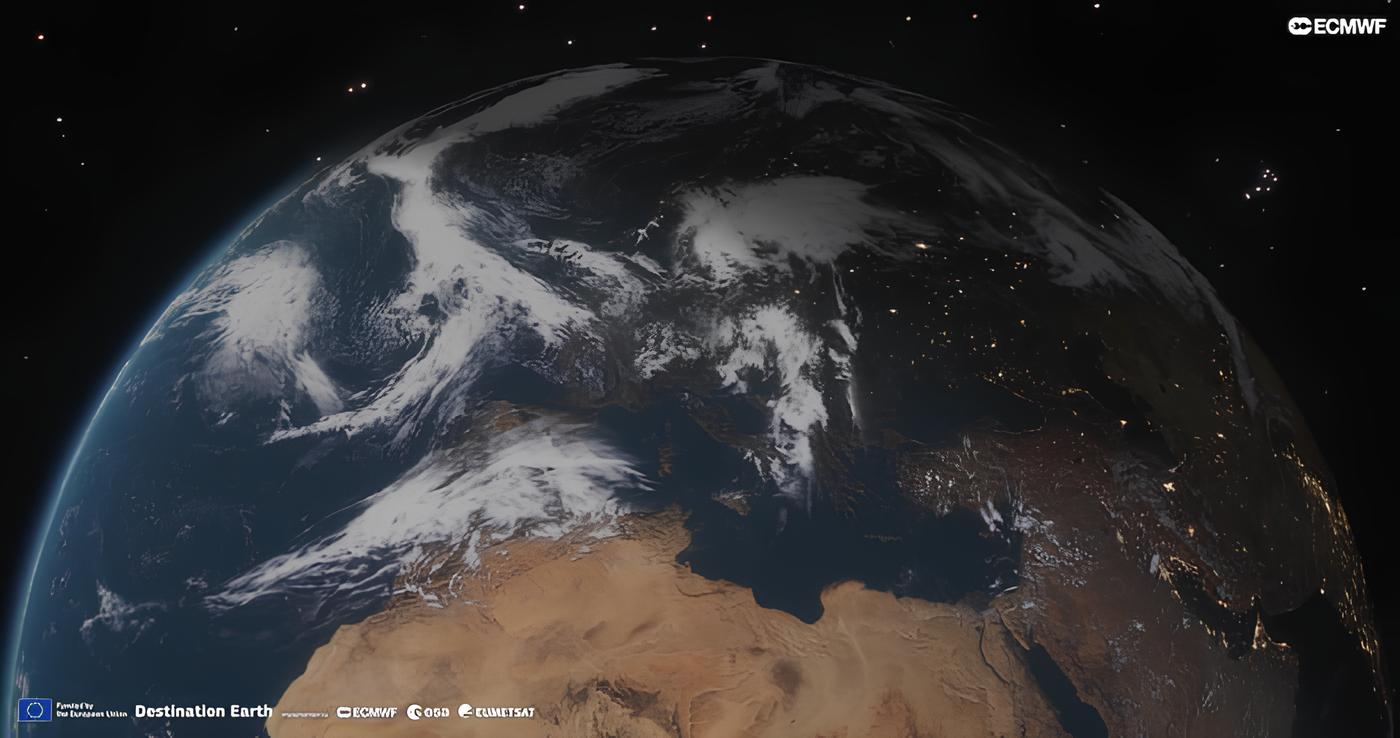

The European Commission has greenlit the third phase of “Destination Earth” (DestinE), an ambitious initiative to build a highly accurate “digital twin” of our planet.
In a new agreement signed with the European Centre for Medium-Range Weather Forecasts (ECMWF), the project will move into its next stage from June 2026 to June 2028. The initiative aims to simulate past, present, and future climate conditions with unprecedented precision, helping nations prepare for extreme weather events.
Digital twin technology allows scientists to run tailored “what if” scenarios — such as replaying historical weather disasters to see how they would unfold in a world 2°C warmer.
AI Earth System
Since 2024, the project has increasingly integrated artificial intelligence, developing machine-learning components for various Earth systems, including land, oceans, sea ice, and waves.
In Phase 3, the focus will shift toward creating a fully “AI Earth-system model”. This involves coupling machine-learning components with traditional physics-based simulations to enable rapid experimentation and improved uncertainty quantification.
“By integrating physical understanding with innovative AI approaches, we will further enhance Europe’s weather and climate prediction capabilities,” says Florian Pappenberger, Director-General of ECMWF.
Building resilience
The system leverages Europe’s EuroHPC supercomputers to process vast amounts of high-resolution data. The goal is to support national meteorological services and public institutions in protecting communities from climate risks.
“Destination Earth demonstrates how Europe can transform major investments in supercomputing and artificial intelligence into concrete benefits for its citizens,” says Roberto Viola, Director-General of the DG for Communications Networks at the European Commission.
By producing high-quality, AI-ready datasets, the initiative also aims to feed Europe’s “AI Factories,” fostering innovation across the continent’s industrial and public sectors.