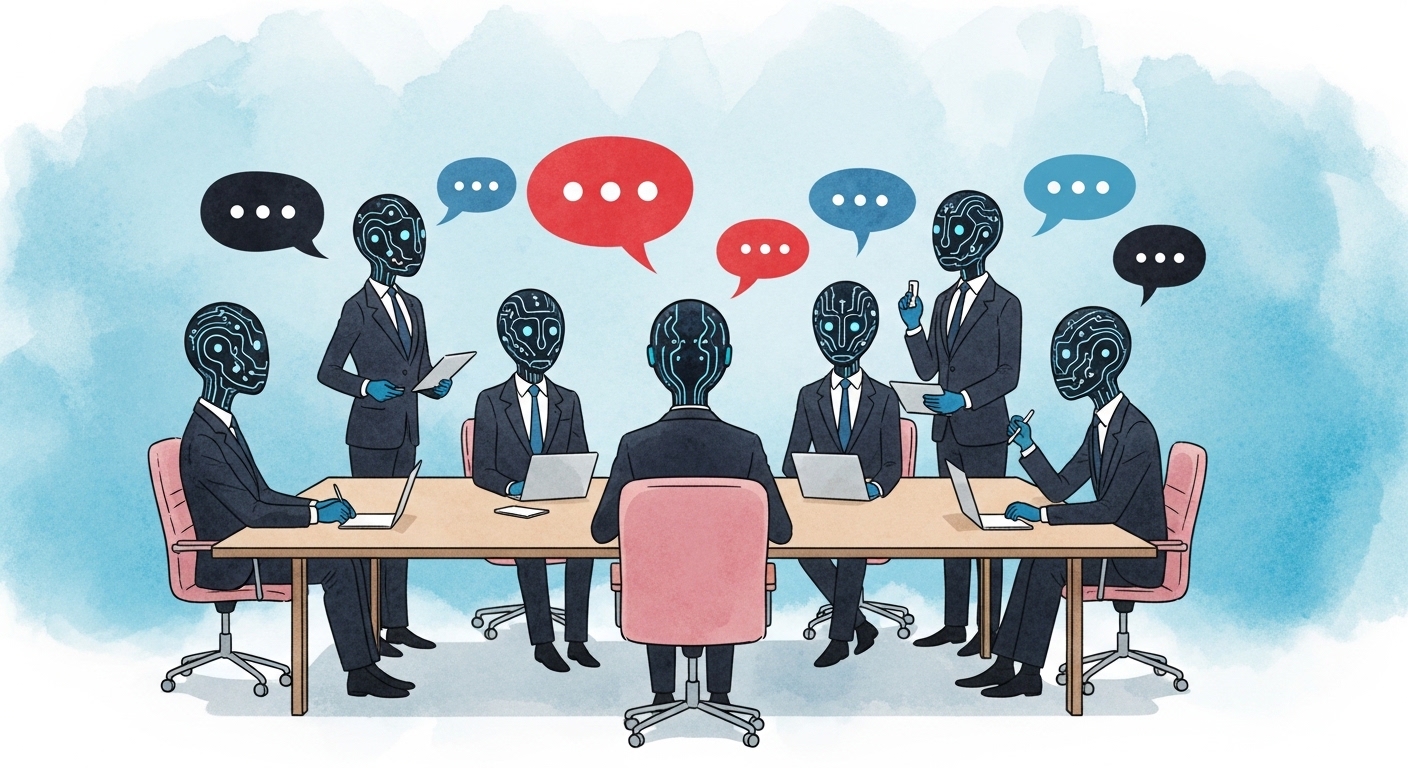

In a surprising twist for computer science, researchers have found that artificial intelligence agents become smarter and more effective when they stop waiting for their turn and start acting like messy, argumentative humans.
A new study from The University of Electro-Communications and the National Institute of Advanced Industrial Science and Technology (AIST) demonstrates that AI models perform better on complex tasks when they are given distinct personalities and the ability to interrupt one another.
While most multi-agent AI systems currently force bots into a rigid, round-robin structure where they speak in a fixed order, the Japanese research team proposes a framework that mimics the “chaotic” nature of human debate.
“Current multi-agent systems often feel artificial because they lack the messy, real-time dynamics of human conversation,” the researchers explain. “We wanted to see if giving agents the social cues we take for granted — like the ability to interrupt or the choice to stay quiet — would improve their collective intelligence.”
The urgency to speak
To test this, the team moved away from the standard model, where an AI generates a full paragraph before passing the baton. Instead, they utilised “sentence-by-sentence processing,” allowing agents to “hear” the conversation in real-time.
Each agent calculates an “urgency score” as the debate unfolds. If the score spikes — perhaps because the bot spots an error or has a critical insight — it can cut off the current speaker immediately. Conversely, if an agent has nothing valuable to add, it can choose silence, preventing the discussion from being cluttered with redundant information.
The researchers also integrated the “Big Five” personality traits (such as openness and agreeableness) into the agents.
The results, evaluated using the Massive Multitask Language Understanding (MMLU) benchmark, were clear: the dynamic, personality-driven agents outperformed standard models in task accuracy.
Interestingly, the inclusion of personalities made the debates more efficient. By allowing agents to act according to specific characters — with some being dominant and others reflective — the group experienced less unproductive silence and reached consensus faster than a group of generic bots.
“This study suggests that the future of AI collaboration lies not in stricter controls, but in mimicking human social dynamics,” the researchers conclude. “By allowing agents to navigate the friction of interruptions… developers can create systems that are not only more naturalistic but also more effective.”



