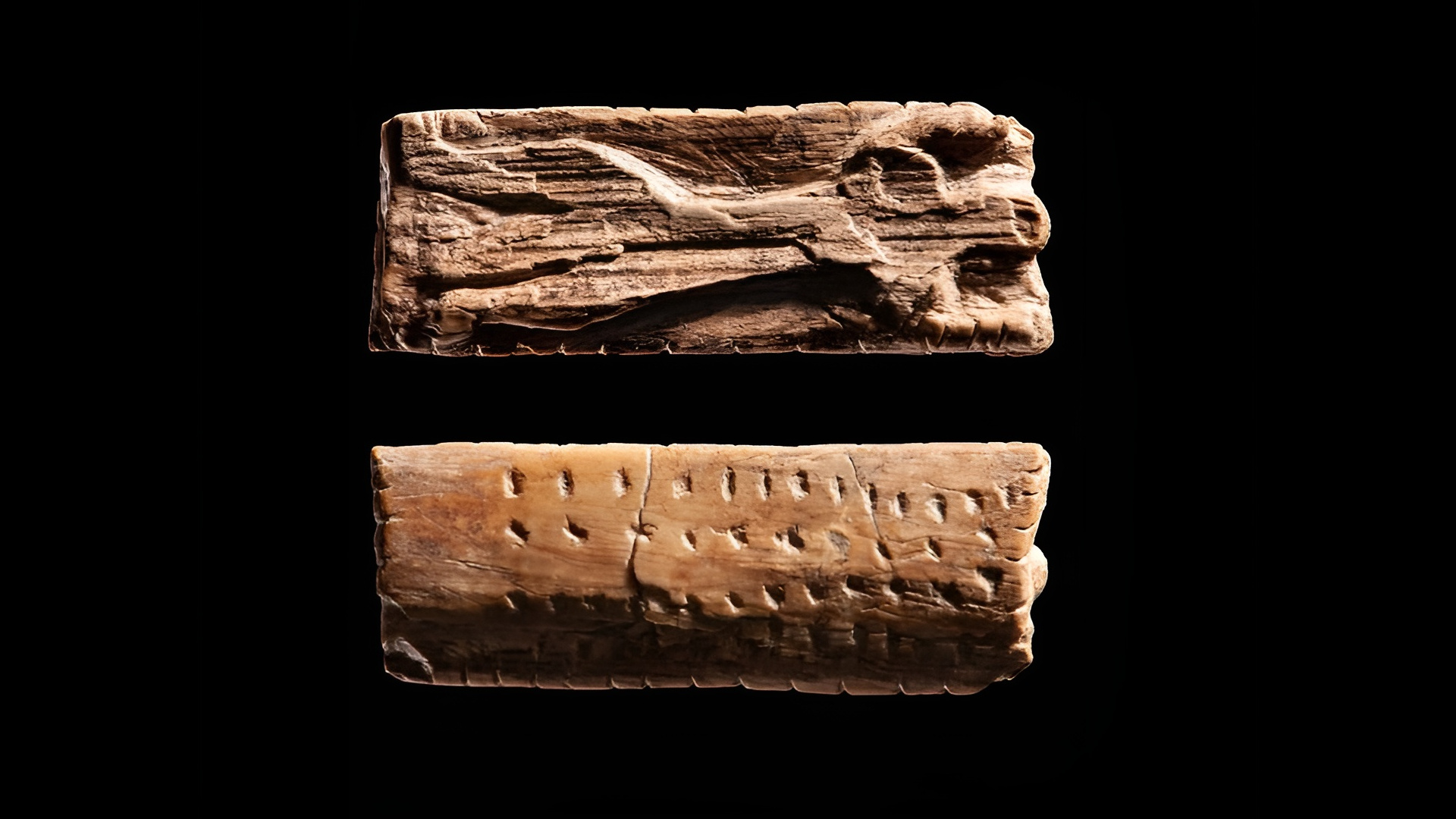

Long before the invention of the alphabet, our early ancestors were carefully carving sequences of dots, notches, and crosses into their tools and sculptures. For decades, the exact purpose of these Stone Age marks remained a mystery. Now, a new computational analysis reveals that these ancient symbols possess the same level of complexity and information density as the earliest known writing systems.
According to a study published this week in the journal PNAS, researchers analysed more than 3,000 geometric signs found on roughly 260 Palaeolithic objects dating back between 34,000 and 45,000 years.
Many of these artefacts were discovered in the caves of the Swabian Jura in south-western Germany. One such artefact is the ‘Adorant’ from the Geißenklösterle cave, a small ivory plate depicting a lion-human creature adorned with sequences of dots.
Similarly, a tiny mammoth carved from a tusk found in the Vogelherd Cave features deliberate rows of crosses and dots. Even the famous Lion Human from the Hohlenstein-Stadel Cave bears systematic notches placed at regular intervals along its arm.
Linguist Professor Christian Bentz of Saarland University and archaeologist Ewa Dutkiewicz of the Museum of Prehistory and Early History in Berlin led the project, using machine learning and statistical modelling to uncover the “statistical fingerprint” of these marks.
Matching ancient Mesopotamia
The researchers set out to measure the “entropy” — or information density — of the Palaeolithic sign sequences. When they compared this data to proto-cuneiform tablets from ancient Mesopotamia, created tens of thousands of years later, around 3,000 B.C.E., the researchers were stunned.
“We hypothesised that the early proto-cuneiform script would be more similar to the writing systems of today, especially due to their relative proximity in time,” the researchers noted. “Yet the more we studied them, the clearer it became that the early proto-cuneiform script is very similar to the much older Palaeolithic sign sequences.”
Professor Bentz explained that these ancient sequences — such as repeating a cross or a line multiple times — do not represent spoken language. However, the statistical predictability and the rate of sign repetition indicate that Palaeolithic hunter-gatherers had developed a sophisticated system of symbols for encoding information. Interestingly, the researchers found that carved figurines exhibited a higher information density than tools.
Decoding the past
While the study does not determine exactly what Stone Age humans were trying to record, it shows the marks were intentional and foundational to human communication.
Dutkiewicz noted that the ability to record and convey information was likely crucial for the survival and coordination of early Homo sapiens as they settled in Europe and encountered Neanderthals. The fact that many of these objects were small enough to fit in the palm of a hand suggests they were carried as portable records — much like the proto-cuneiform clay tablets that would follow millennia later.
“The human ability to encode information in signs and symbols was developed over many thousands of years,” said Professor Bentz. “Writing is only one specific form in a long series of sign systems.”