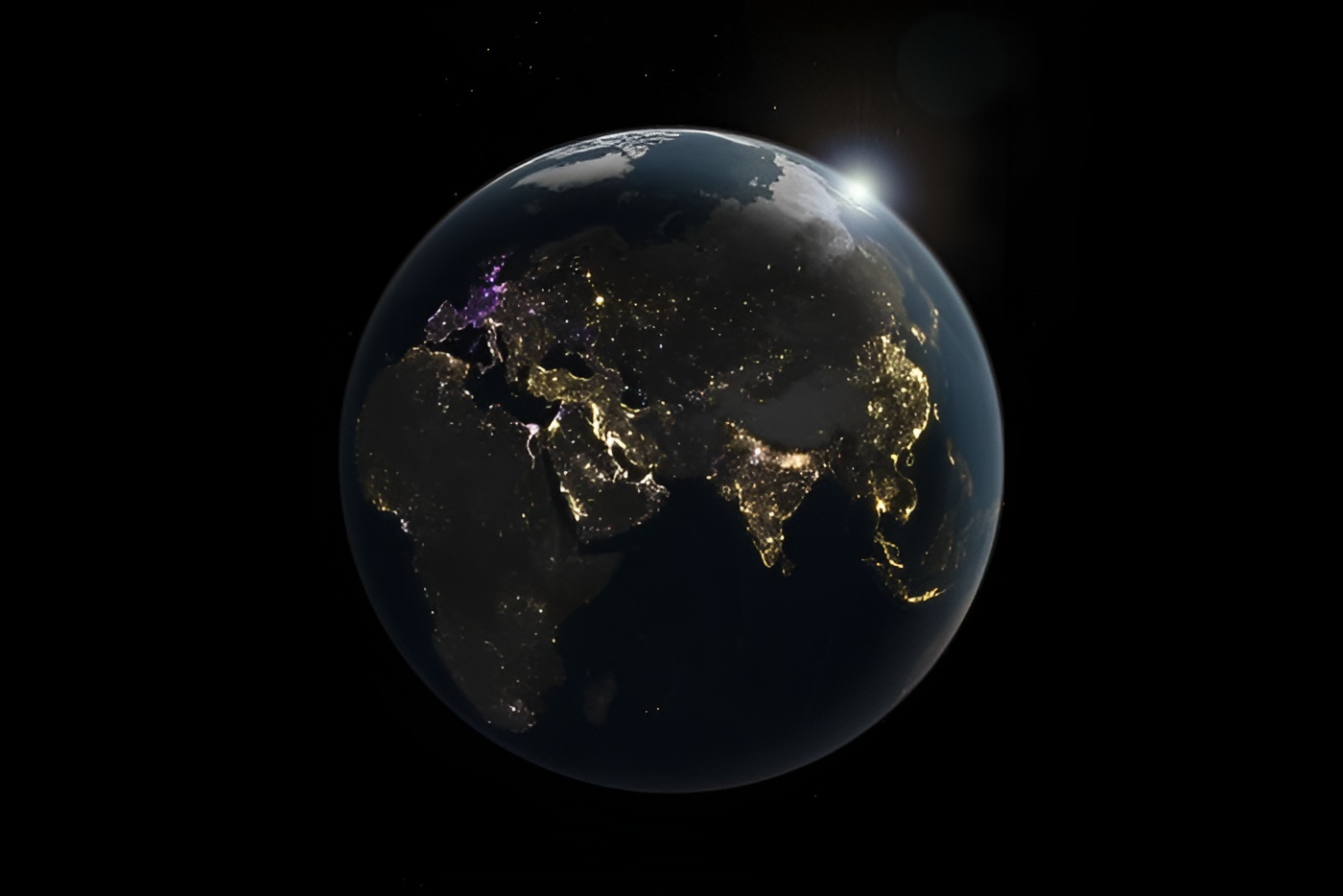

While human civilisation is glowing brighter than ever before, the lights across much of Europe are slowly fading to black.
According to a new analysis of high-resolution satellite data from Ruhr-University Bochum, nighttime lighting is increasing globally by about two per cent every year. However, the economic fallout of the Russian invasion of Ukraine and strict new energy-saving measures have caused a distinct dimming effect across the European continent.
By analysing data captured between 2014 and 2022 by the Visible Infrared Imaging Radiometer Suite (VIIRS), researchers discovered a dramatic shift in how humanity illuminates the night sky.
A continent in the dark
While rapid urbanisation made countries like China and India significantly brighter during the study period, Europe’s nighttime light emissions declined by four per cent overall.
The data revealed a dramatic plunge in illumination across Ukraine following the Russian invasion. Meanwhile, France dimmed by a staggering 33 per cent at night, largely because municipalities have begun turning off streetlights after midnight to save energy and curb light pollution.
Christopher Kyba, who led the research, noted that local changes in lighting are far more dynamic than previously assumed.
Kyba explained: “Although there has been a total increase of 16 per cent worldwide, that does not mean that lighting is increasing everywhere. In areas where lighting increased, we found global emissions rose by 34 per cent. This was offset by an 18 per cent decrease in emissions from other areas.”
In Germany, light emissions remained almost completely static, falling by 9.2 per cent in dimming areas but rising by 8.9 per cent in rapidly developing regions.
A new way to view the world
Previous astronomical observations relied on monthly or annual composites to track artificial light, but this study marks the very first time scientists have analysed the planet at full resolution using daily, night-by-night data.
The satellites — operated by the US agencies NOAA and NASA — image the entire planet between 1:00 am and 4:00 am local time, with a single pixel covering approximately 0.5 square kilometres. The research team also developed a new algorithm that accounts for the satellite’s viewing angle, correcting optical illusions that make residential areas look artificially brighter from certain perspectives.
Kyba warned that artificial light remains a massive consumer of electricity and a severe threat to nocturnal ecosystems. To better track these changes, his team is currently proposing a dedicated European Space Agency (ESA) mission, dubbed “Earth Explorer 13”.
Kyba said: “While the U.S. and China each have multiple satellites that observe nighttime light, there is currently no European satellite designed for this purpose.”



