
In a major leap forward for the future of hyper-efficient computing, physicists have successfully generated orbital angular momentum in electrons using a non-magnetic material. The breakthrough opens the door to practical devices in the emerging field of “orbitronics.”
As global data demands skyrocket, researchers are turning to the quantum realm to find faster, more efficient ways to process information. Orbitronics seeks to harness the path of an electron around its nucleus — its orbital angular momentum — to store and process data. However, until now, controlling this orbit required heavy, expensive, and critical magnetic transition metals, making practical applications difficult.
In a new study published in Nature Physics, researchers from North Carolina State University and the University of Utah have developed a streamlined alternative that doesn’t rely on traditional magnets. Instead, they used a phenomenon known as “chiral phonons.”
“We don’t need a magnet. We don’t need a battery. We don’t need to use voltage. We just need a material with chiral phonons,” said Valy Vardeny, distinguished professor of physics and astronomy at the University of Utah and co-author of the study. “Before, it was unimaginable. Now, we’ve invented a new field, so to speak.”
Harnessing chiral phonons
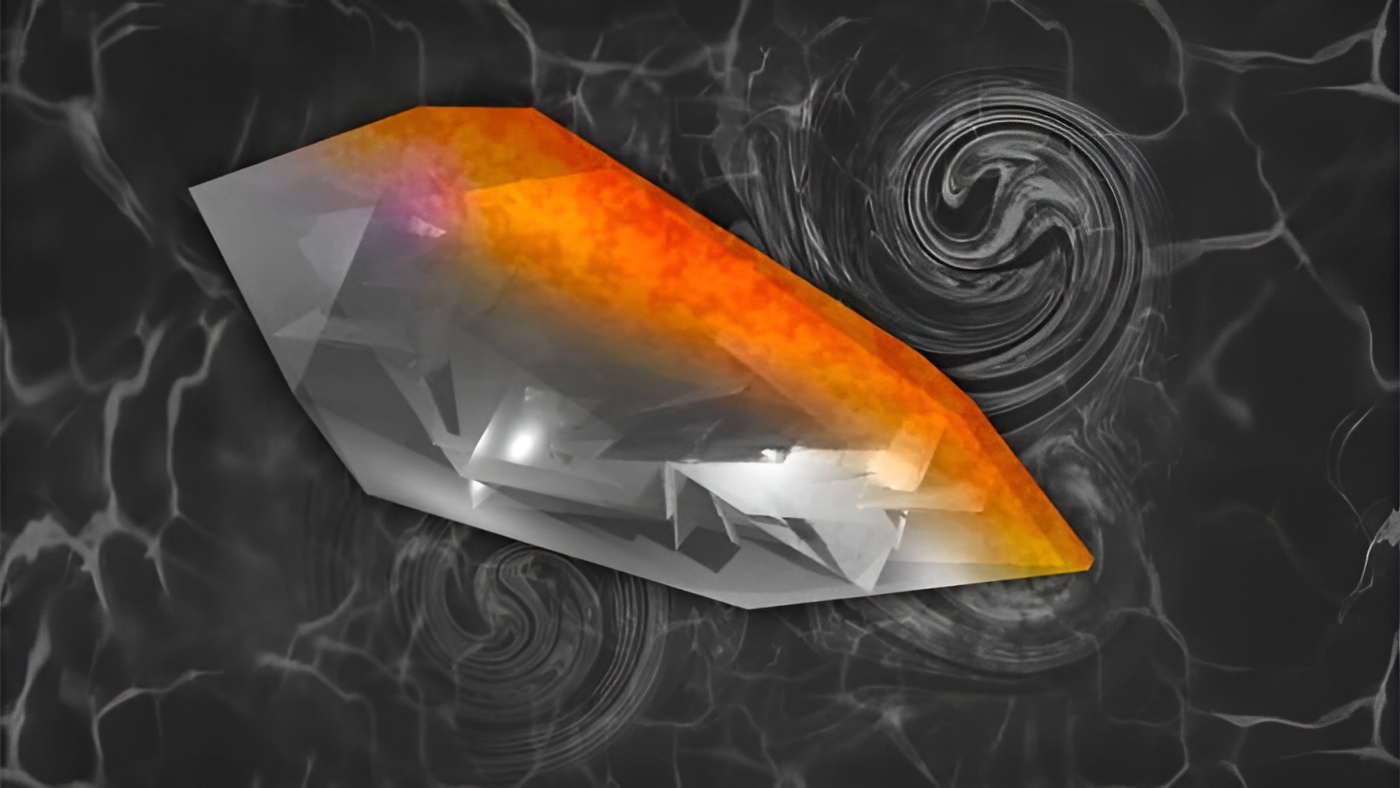
The key to the discovery lies in the natural symmetry and vibration of atoms. In standard metals, atoms are packed in symmetrical, cube-like patterns. But in chiral materials, such as quartz, atoms are arranged in a helical, screw-like pattern that has a distinct “left-handedness” or “right-handedness”, much like how human hands are mirror images but cannot perfectly superimpose on one another.
Because of this twisted structure, when atoms in a chiral material vibrate, they wobble in a circular pattern. These collective, rippling vibrations travelling through the solid are called chiral phonons.
Because the atoms vibrate in a circular path, they naturally possess their own angular momentum and carry a hidden internal magnetic field. Using lasers at the National High Magnetic Field Lab in Florida, the team directly measured this substantial magnetic field in quartz for the first time.
Crucially, the researchers proved that the angular momentum from these chiral phonons can be transferred directly to the orbital angular momentum of the surrounding electrons.
The ‘Orbital Seebeck Effect’
To prove the concept, the team used $\alpha$-quartz, applying a magnetic field to align the right- and left-handed phonons. Once a critical mass of these phonons aligned, they transferred their momentum to the electrons without needing an external magnet to maintain it.
The researchers coined this flow of electron momentum the “orbital Seebeck effect.” To measure it, they placed thin layers of tungsten and titanium on top of the quartz, which converted the hidden orbital flow into a readable electrical signal.
“The generation of orbital currents traditionally necessitates the injection of charge current into specific transition metals, and many of these elements are now classified as critical materials,” explained Dali Sun, a physicist at North Carolina State University and co-author. “There are other ways to generate orbital angular momentum, but this method allows for the use of cheaper, more abundant materials.”
Beyond quartz, the researchers note that this highly efficient method will work on other chiral materials, such as tellurium, selenium, and hybrid organic/inorganic perovskites, holding the angular momentum far longer than previously tested systems.
“Even though the material itself isn’t magnetic, the existence of chiral phonons gives us these magnetic levers to pull on,” said Rikard Bodin, a doctoral candidate at the University of Utah. “When we talk about discovering things, like the orbital Seebeck effect—I can’t tell you that your TV is going to run on it, but it’s creating more levers that we can pull on to do new things. Now that it’s here, someone else can push it forward and before you know it, it’s ubiquitous. That’s how technology is.”