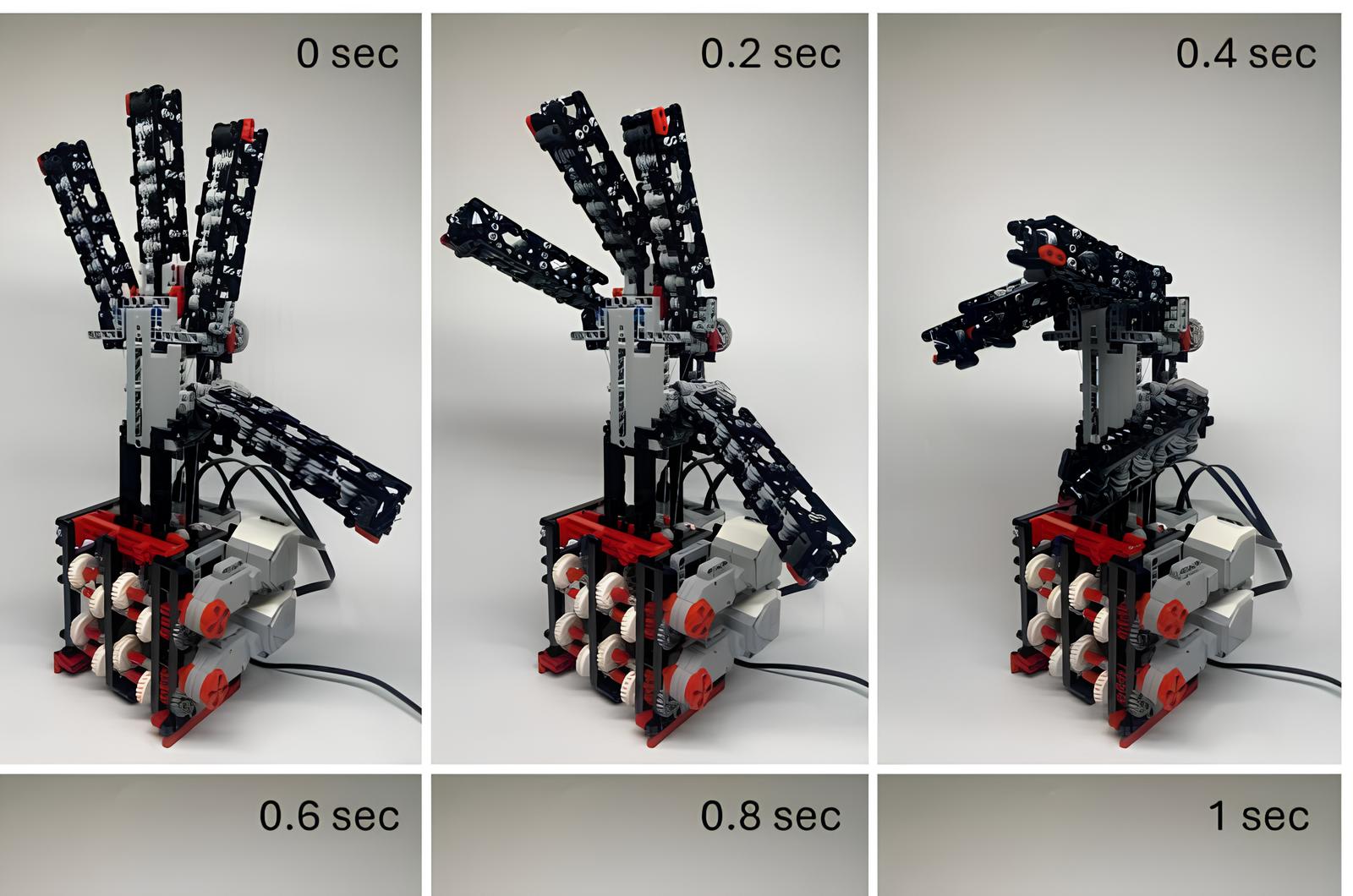

A 16-year-old student from the UK has designed and built a four-fingered robotic hand using standard LEGO parts that mimics the human-like adaptable grasp of advanced research models.
Jared Lepora, a student at Bristol Grammar School, developed the “Educational SoftHand-A”. The project is described in a paper published on the arXiv preprint server, reports Phys.org. The device is made entirely from LEGO MINDSTORMS components, with the only non-LEGO parts being the cords that act as tendons.
The anthropomorphic hand has four fingers — an index, middle, pinkie, and opposing thumb — and 12 joints. It is “highly underactuated,” meaning only two motors drive its 12 joints. One motor controls the “agonist” (closing) tendons and the other controls the “antagonist” (opening) tendons, mimicking the push-pull system of human muscles.
Human-like adaptivity
Its human-like adaptivity comes from a “soft synergy” mechanism implemented with a differential built from LEGO clutch gears. This system mechanically links the joints. If one finger hits an object, its clutch gear temporarily slips, allowing the motor’s force to redirect to the other fingers so they can continue closing and wrap around the object.
During testing, the hand successfully grasped and held nine different household items, including soft toys, plastic cups, and tape spools. The hand can fully open or close in approximately one second, and a single finger has a bearing capacity of 5 to 6 Newtons.
The paper states the project’s goal was not to outperform industrial robots but to create an educational tool to inspire children. “Constructing the Educational SoftHand-A has the potential to be an engaging and interesting project for children to learn about modern robotics,” the authors wrote.