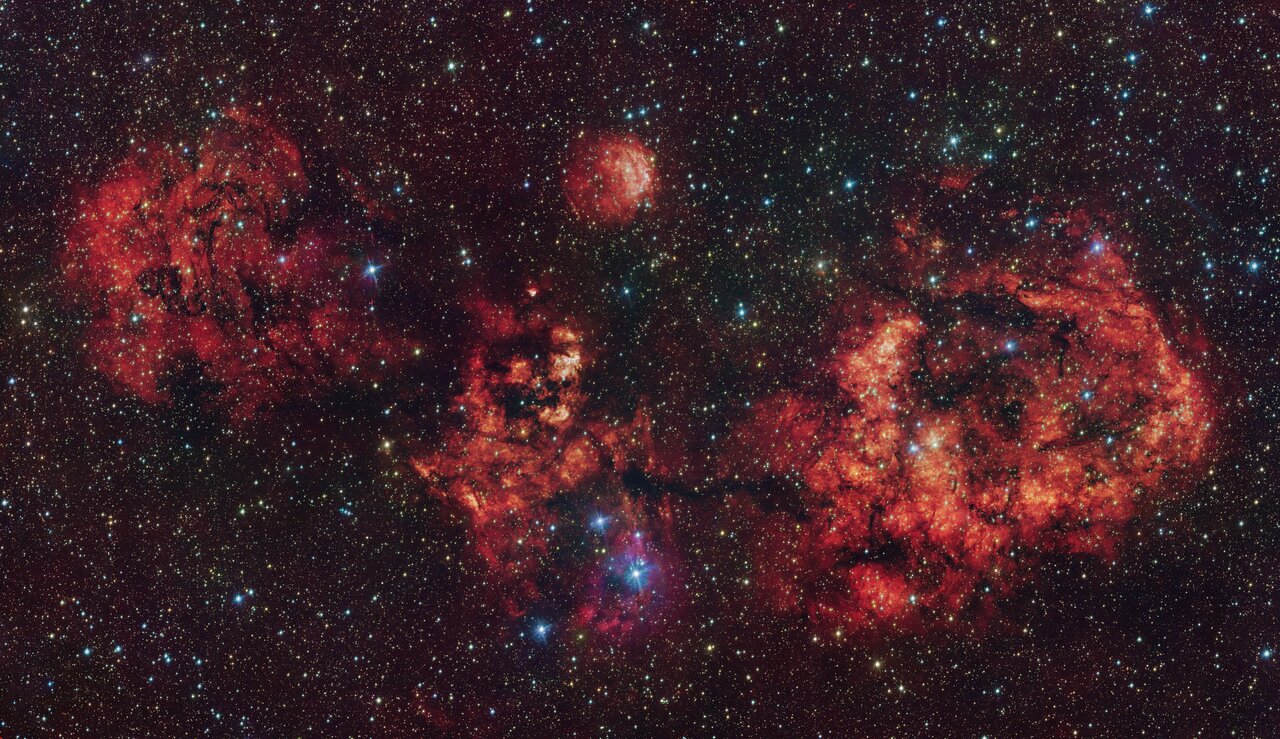
A ‘cosmic bat’ has been spotted flying over the European Southern Observatory’s (ESO) Paranal site in Chile in an image released just in time for Halloween.
The VLT Survey Telescope (VST) captured the large cloud of cosmic gas and dust, whose appearance resembles the silhouette of a bat.
The stellar nursery is located about 10,000 light-years away, spanning an area of the sky equivalent to four full Moons between the southern constellations of Circinus and Norma. The nebula’s appearance is created by infant stars releasing energy, which excites the surrounding hydrogen atoms and causes them to glow red.
The bat’s dark “skeleton” filaments are colder, denser accumulations of gas and dust that block the visible light from stars located behind them. The most prominent clouds forming the shape are identified as RCW 94 (the right wing) and RCW 95 (the body).
Vast areas of the sky
The image was captured using the VST, a telescope owned and operated by the Italian National Institute for Astrophysics (INAF) and hosted at ESO’s Paranal Observatory in the Atacama Desert. The telescope is equipped with OmegaCAM, a state-of-the-art 268-megapixel camera designed to image vast areas of the sky.
This final image was pieced together by combining observations through different filters. The bat’s shape and red glow were captured in visible light as part of the VST Photometric Hα Survey of the Southern Galactic Plane and Bulge (VPHAS+).
Additional infrared data, which adds colour to the densest parts of the nebula, was obtained by ESO’s Visible and Infrared Survey Telescope for Astronomy (VISTA) during the VISTA Variables in the Vía Láctea (VVV) survey.