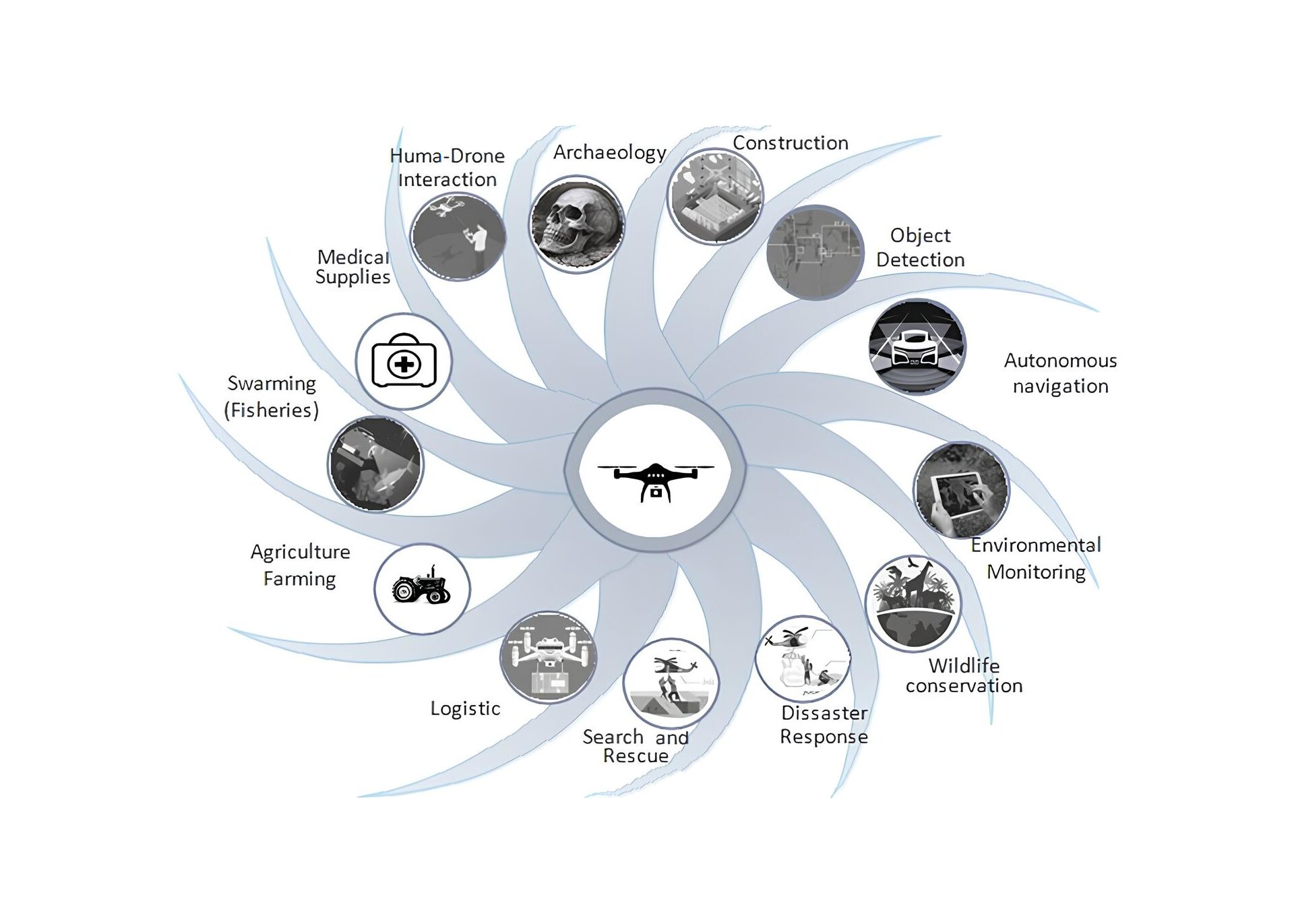

Intelligent drones are rapidly evolving from experimental prototypes into the backbone of modern society, set to reshape everything from disaster response to daily commuting, according to a major new study led by the University of Sharjah.
Published in the International Journal of Cognitive Computing in Engineering, the research asserts that the convergence of artificial intelligence, extended battery life, and advanced sensors is turning unmanned aerial systems (UAS) into “essential infrastructure” for human development.
The study, a collaboration among researchers in the UAE, Algeria, and Malaysia, predicts a future in which drones possess significantly greater endurance and resilience. This leap in capability will enable wide-area surveillance in dense urban areas, long-distance medical supply runs, and complex environmental monitoring missions that are currently impossible.
“Drone technology is poised for remarkable advancements across multiple domains,” the authors write, noting that these systems are set to improve quality of life worldwide.
The brain of the machine
The primary driver of this evolution is the integration of artificial intelligence. The researchers note that AI is enabling drones to move beyond simple remote-controlled flight to fully autonomous operation, capable of “perceiving their surroundings” with unprecedented clarity.
“Drones will become more adept at perceiving their surroundings as sensor technology advances, such as LiDAR, multispectral cameras, and sophisticated IMUs, making drones useful tools for mapping, surveying, and agriculture,” the researchers explain.
To support this autonomy, the study introduces new mathematical models for navigation. The team developed “optimisation-based path loss models” that account for terrain and environmental constraints, allowing drones to compute efficient flight routes and avoid obstacles without human intervention.
From 5G to passenger travel
The researchers envision drones becoming a key component of the global “Internet of Things” (IoT) ecosystem. By leveraging 5G and future 6G networks, these devices will be able to transfer data in real time, facilitating real-time decision-making in disaster zones or security operations.
The study also points to the rise of Urban Air Mobility (UAM) — the use of passenger drones for transportation — as a sector moving closer to reality.
“Drone flights will go up due to improvements in battery technology and energy efficiency, which reduce recharge frequency, making them more useful for long-duration missions,” the authors state.
Privacy and the environment
However, the report warns that this rapid technological expansion brings significant ethical and environmental challenges. The authors call for stronger regulatory frameworks to address privacy concerns, noting that advanced cameras could be used to collect confidential data without consent.
Furthermore, the physical presence of drones poses risks to the natural world.
“Drones’ flight may disturb wildlife, especially bird habitats, and they may change their migration and nesting behaviours,” the authors write, also highlighting the issue of electronic waste generated by lithium batteries. “Consequently, we suggest a balance of technological advancements and ecological maintenance.”