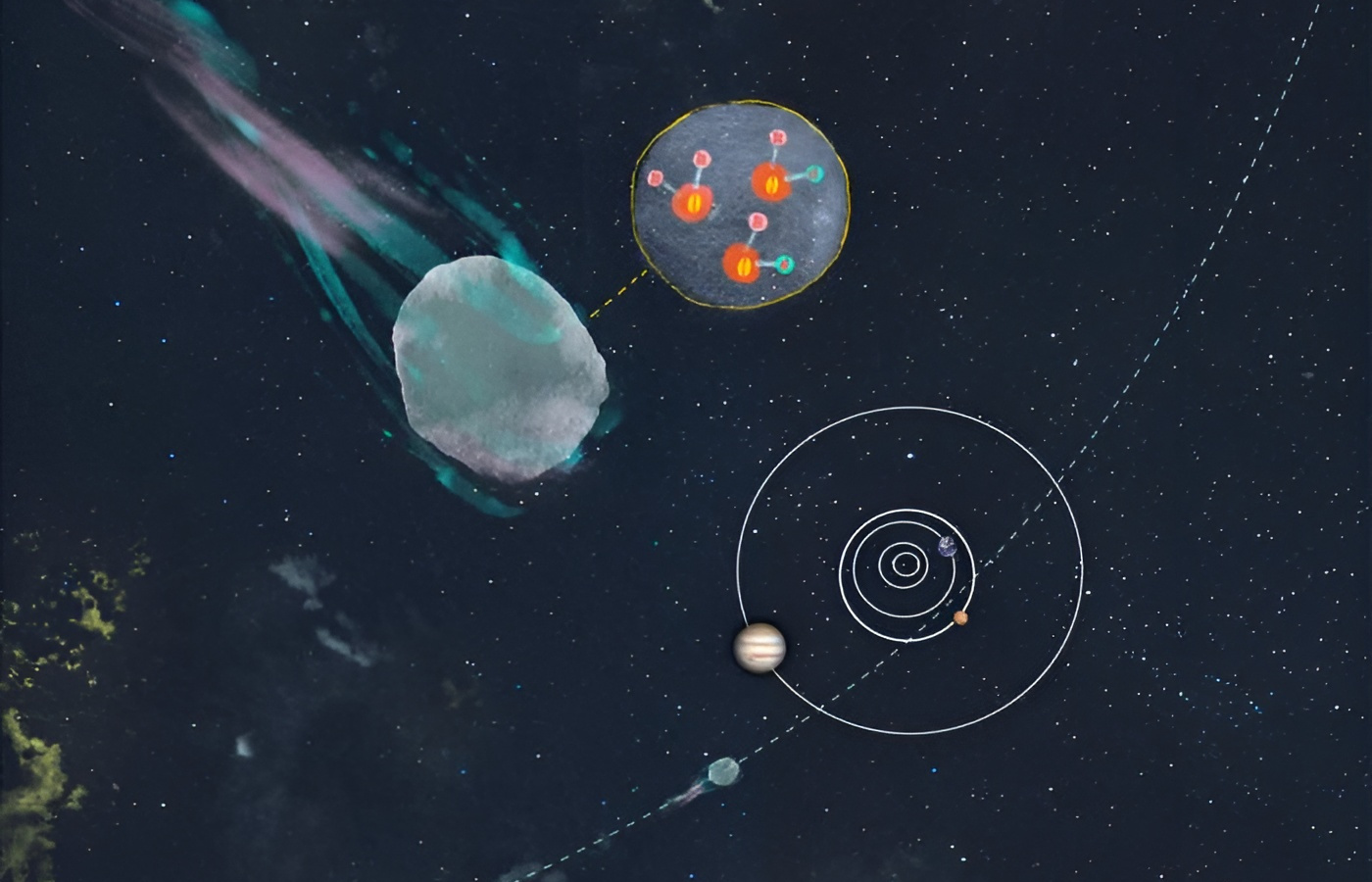

A recently discovered interstellar comet is carrying an unprecedented amount of “heavy water,” revealing that it was born in an alien environment drastically colder than our own solar system.
According to a new study published in the journal Nature Astronomy, the comet — known as 3I/ATLAS — contains a staggering concentration of deuterium, a heavier isotope of hydrogen.
Led by researchers at the University of Michigan, the findings provide the first chemical evidence that the conditions that forged our solar system are not ubiquitous throughout the galaxy.
The heavy water anomaly
Water is fundamentally made of two hydrogen atoms and one oxygen atom. In standard water molecules, the hydrogen atoms have just one proton at their core. However, in 3I/ATLAS, researchers detected an astonishingly high ratio of water molecules containing deuterium, a form of hydrogen that carries both a proton and a neutron.
While these heavier forms of water do naturally exist on Earth, they are found in vastly lower quantities.
“The amount of deuterium with respect to ordinary hydrogen in water is higher than anything we’ve seen before in other planetary systems and planetary comets,” explained Luis Salazar Manzano, lead author and a doctoral student in the University of Michigan Department of Astronomy.
Salazar Manzano noted that the heavy water ratio in 3I/ATLAS was 30 times higher than that of any known comet in our solar system, and 40 times higher than the baseline value found in Earth’s oceans.
A deep cosmic freeze
These specific chemical ratios act as a molecular time capsule, allowing researchers to accurately gauge the environmental conditions present when the celestial object first formed.
Because deuterium fractionation — the chemical process that incorporates heavy hydrogen into water ice — is highly sensitive to heat, the elevated levels found in 3I/ATLAS indicate the comet formed in an environment with incredibly low temperatures and minimal stellar radiation.
“This is proof that whatever the conditions were that led to the creation of our solar system are not ubiquitous throughout space,” said Teresa Paneque-Carreño, a co-leader of the study and a U-M assistant professor of astronomy. “That may sound obvious, but it’s one of those things that you need to prove.”
Reading the chemical signature
Because 3I/ATLAS is only the third interstellar object ever discovered by astronomers, studying it required a coordinated global effort.
After initial observations at the MDM Observatory in Arizona detected early gas emissions, the team utilised the Atacama Large Millimeter/submillimeter Array (ALMA) in Chile. ALMA’s extreme sensitivity allowed the researchers to detect the incredibly subtle frequency differences between standard and deuterated water, marking the first time scientists have successfully performed this type of chemical analysis on an interstellar object.
The team believes this technique will be vital for characterising future interstellar visitors, provided astronomers can maintain the clear, dark skies necessary to spot these faint objects as they pass through our system.



