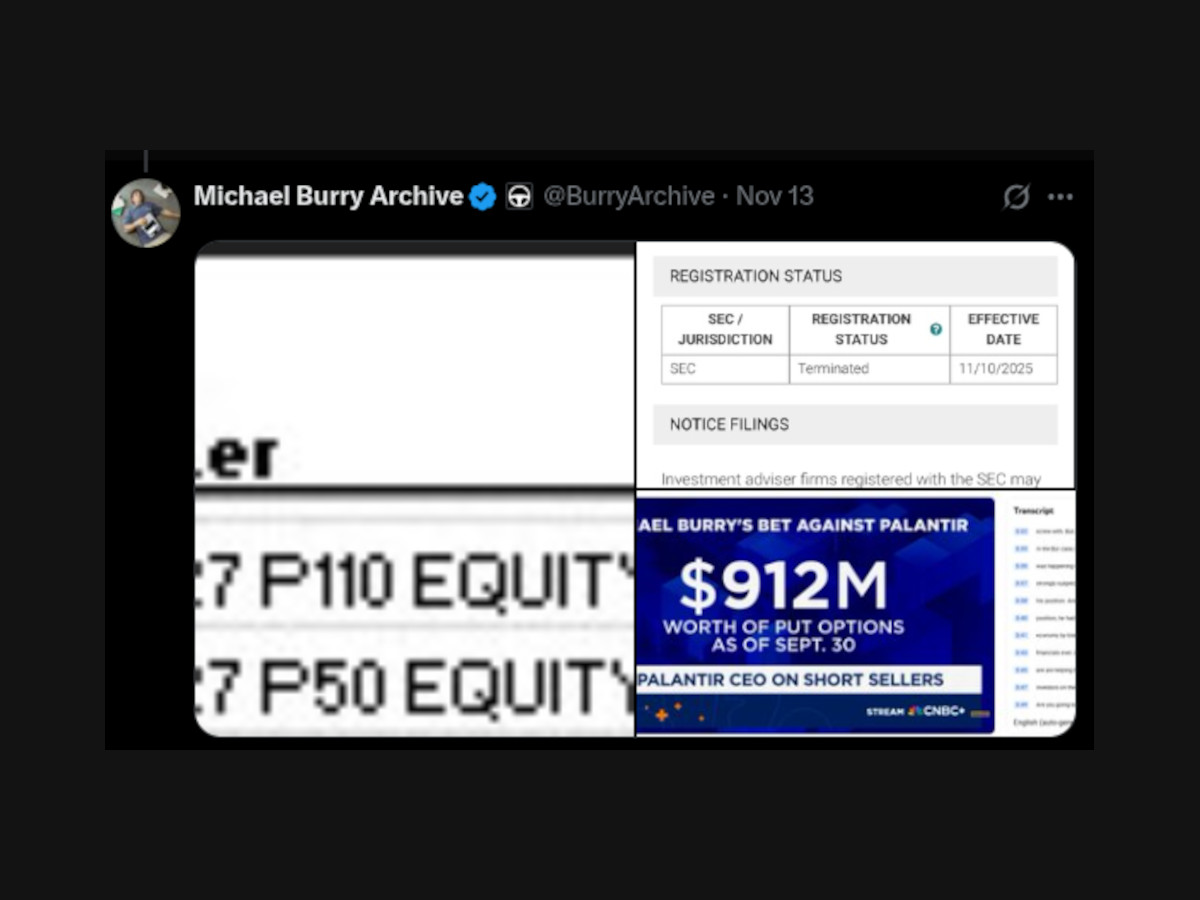

Michael Burry, the investor who predicted the 2008 financial crash, is closing his hedge fund after placing bearish bets against major technology companies and warning that the artificial intelligence infrastructure boom relies on “aggressive accounting”.
In a letter to investors dated 27 October, Burry announced plans to “liquidate the funds and return capital” by the end of the year, reports Reuters.
“My estimation of value in securities is not now, and has not been for some time, in sync with the markets,” Burry wrote in the letter.
Betting against the boom
The closure follows Burry’s intensified criticism of the technology sector. He recently disclosed spending about $9.2 million on put options against data analytics firm Palantir and revealed a position against chipmaker Nvidia.
Burry has argued that tech giants including Microsoft, Google, and Meta are artificially inflating profits by stretching out depreciation schedules on their massive hardware investments. He estimates this accounting practice could understate depreciation by about $176 billion between 2026 and 2028.
“Burry’s decision feels less like ‘calling it quits’ and more like stepping away from a game he believes is fundamentally rigged,” said Bruno Schneller, managing director at Erlen Capital Management.
Burry’s warnings regarding artificial profit inflation align with broader concerns about the sector’s fundamentals. As previously reported, the AI market is increasingly defined by “circular” speculative investments, such as chipmakers investing in startups that immediately use the funds to purchase hardware back from them.
This circularity persists despite a lack of tangible utility. Nearly eight in 10 businesses using generative AI report “no significant bottom-line impact” from the technology, fuelling fears that infrastructure spending is vastly outpacing actual economic returns.
The move comes as AI-related stocks have driven the majority of market gains, with the Financial Times noting that valuations have hit “lofty heights compared with their average in recent years”.
A basket of the 250 US stocks most popular with short sellers has surged more than 50 per cent this year, driven largely by investor enthusiasm for artificial intelligence.



