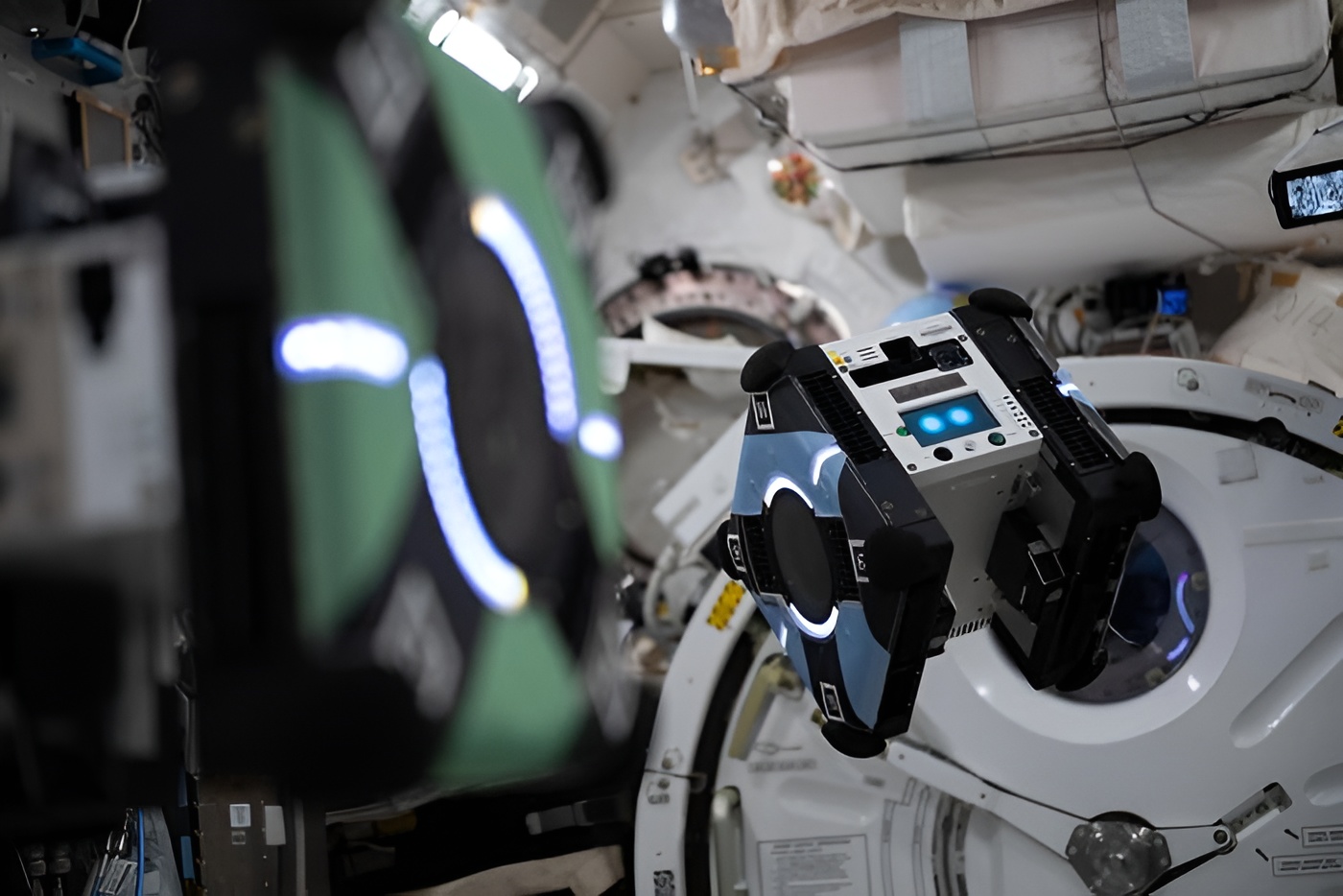
A cube-shaped robot has successfully navigated the cluttered corridors of the International Space Station using artificial intelligence, marking the first time machine learning has controlled hardware in orbit.
Stanford University researchers demonstrated that their “warm start” software enabled NASA’s Astrobee robot to plan autonomous movements 50 to 60 per cent faster than standard methods, reports Stanford University.
The breakthrough, presented at the 2025 International Conference on Space Robotics, proves that robots can operate safely in space without constant human supervision, a critical requirement for future missions to the Moon and Mars, where communication delays make real-time remote control impossible.
“This is the first time AI has been used to help control a robot on the ISS,” said Somrita Banerjee, lead researcher on the project. “It shows that robots can move faster and more efficiently without sacrificing safety, which is essential for future missions where humans won’t always be able to guide them.”
Maze of modules
Navigating the ISS is notoriously tricky for robots due to the maze of interlinked modules, stray cables and sensitive equipment. Traditional motion planning requires complex calculations that often overwhelm the limited processing power of space-rated computers.
To solve this, the team enhanced the robot’s navigation system with a machine learning model trained on thousands of past path solutions. This “warm start” gives the robot a foundational knowledge of the environment — such as where corridors exist and obstacles usually sit — before safety algorithms refine the path.
“Using a warm start is like planning a road trip by starting with a route that real people have driven before, rather than drawing a straight line across the map,” said Banerjee. “You start with something informed by experience and then optimise from there.”
During the experiment, astronauts set up the robot but then stepped aside, allowing the AI to take control. The team ran 18 different trajectories, testing the robot in tight corridors and cluttered areas. The AI-assisted method proved significantly faster, especially during complex manoeuvres requiring rotation.
For Banerjee, the technical success was matched by the sight of her childhood hero, astronaut Sunita Williams, observing the test in orbit.
“The coolest part was having astronauts float past during the experiment,” said Banerjee. “One of them was one of my childhood heroes, Sunita Williams. Seeing years of work actually perform in space and watching her there while the robot moved around was incredible.”