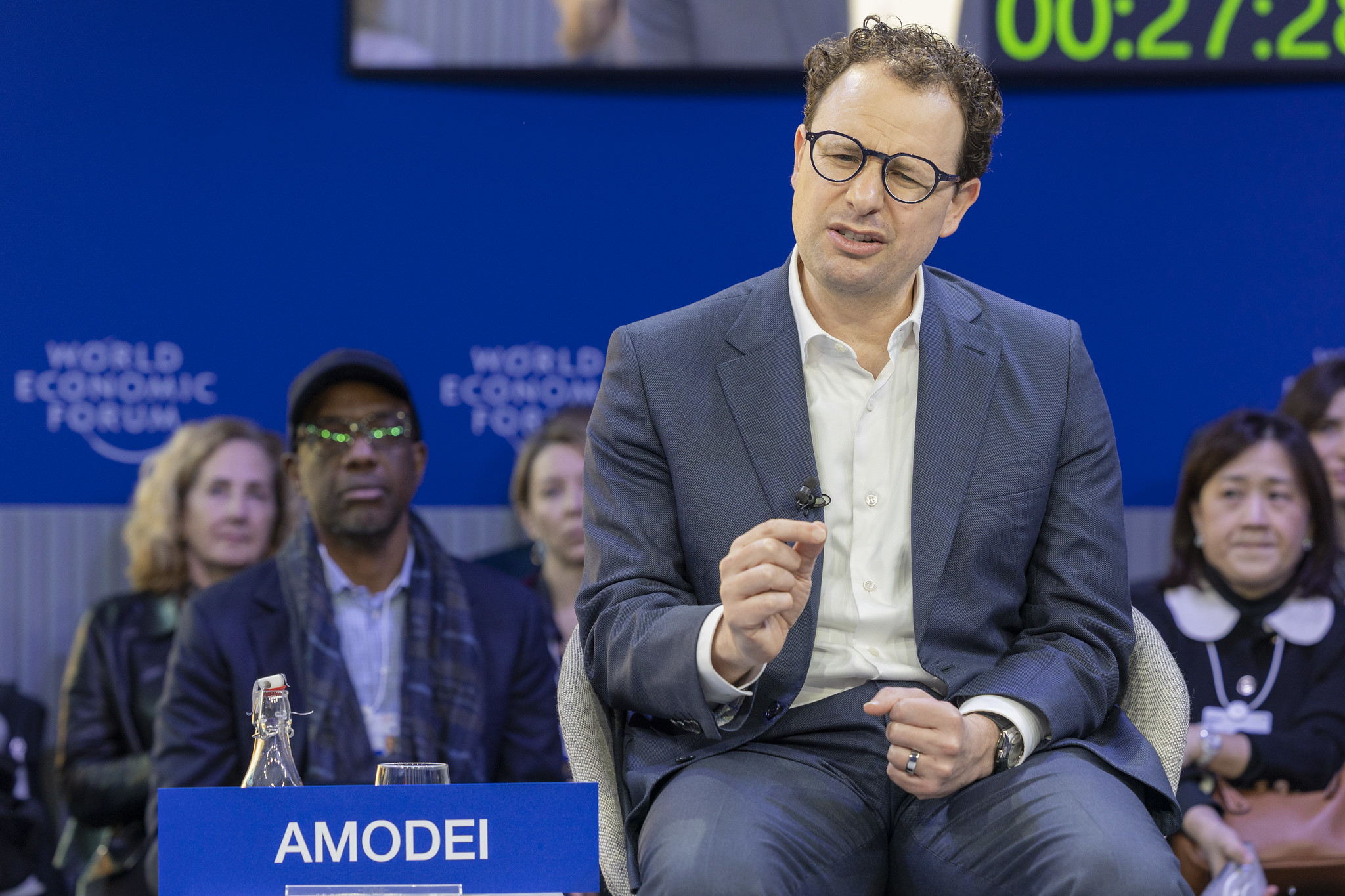

The leaders of two of the world’s most powerful AI companies offered diverging predictions on the arrival of human-level artificial intelligence at Davos today, though both warned of imminent disruptions to the workforce.
In a panel titled The Day After AGI, Dario Amodei, CEO of Anthropic, reaffirmed his prediction that AI models capable of performing at the level of a “Nobel laureate across many fields” could arrive as early as “2026 or 2027”.
When asked if he stood by the timeline he set last year, Amodei replied: “I don’t think that’s going to turn out to be that far off.”
He argued that the industry is rapidly approaching a feedback loop where AI models write their own code to create the next generation of systems.
“We might be six to 12 months away from when the model is doing most, maybe all, of what [software engineers] do end-to-end,” Amodei said. “It’s very hard for me to see how it could take longer than a few years.”
Demis Hassabis, CEO of Google DeepMind, took a more cautious stance, maintaining his prediction that artificial general intelligence (AGI) is likely to arrive towards the “end of the decade”.
Hassabis argued that while coding and mathematics are verifiable and easier to automate, the natural sciences require hypothesis generation and experimental testing, which remain significant hurdles.
“AI currently lacks the ability to ask questions or create new theories,” Hassabis said. “I think that’s the highest level of scientific creativity.”
Job market warnings
Despite the disagreement on timelines, both leaders agreed that the labour market faces significant upheaval.
When pressed on his previous comments that half of entry-level white-collar jobs could disappear within one to five years, Amodei confirmed he maintained that view.
“One to five years as of six months ago, I would stick with that,” Amodei said, warning that the exponential speed of development could “overwhelm our ability to adapt”.
Hassabis noted that he is already sensing a “slowdown in hiring” for entry-level roles and internships, suggesting that AI tools are allowing individuals to “leapfrog” traditional training periods.
Geopolitics and ‘nuclear’ risks
The discussion also turned to the geopolitical implications of AI development. Amodei criticised the current US approach of continuing to sell high-end chips to geopolitical adversaries to support American manufacturers.
He compared the strategy to “selling nuclear weapons to North Korea” because it “produces some profit for Boeing”.
“I just don’t think it makes sense,” Amodei said. “If we can just not sell the chips, then this isn’t a question of competition between the US and China. This is a question of competition between me and Demis, which I’m very confident that we can work out.”
Financial growth
Amodei also revealed striking revenue figures for Anthropic, claiming the company had grown from $100 million in 2023 to $1 billion in 2024, and reached $10 billion in 2025.
“Those numbers are starting to get not too far from the scale of the largest companies in the world,” he noted.
Both CEOs agreed that the critical metric to watch over the coming year is the effectiveness of “AI systems building AI systems”, a self-improvement loop that could decouple technological progress from human limitations.