

With AI skills commanding a 23% wage premium and offsetting age bias in recruitment, the labour market is shifting away from formal education towards verifiable capabilities, writes Fabian Stephany.
General-purpose technologies have a distinctive footprint in economic history. Electricity, the automobile and the internet did not merely improve existing processes, they reorganised societies. They reshaped firms, altered cities, transformed communication and redefined work. Each wave of technological change created new industries and occupations that were difficult to imagine beforehand.
Artificial intelligence (AI) now appears to be the next candidate in this lineage. Over the past decade, AI has moved from a specialised research field to become a widely deployed economic technology. It is increasingly embedded in everyday business functions – from logistics and marketing to finance, healthcare and software development.
History shows that the success of general-purpose technologies depends not only on invention, but on the diffusion of skills. Electricity transformed economies once engineers and technicians could deploy it at scale. The internet became economically transformative once digital skills spread beyond a small technical elite.
AI follows the same logic. Its economic impact hinges on whether workers and firms can acquire and apply the skills needed to make it productive.
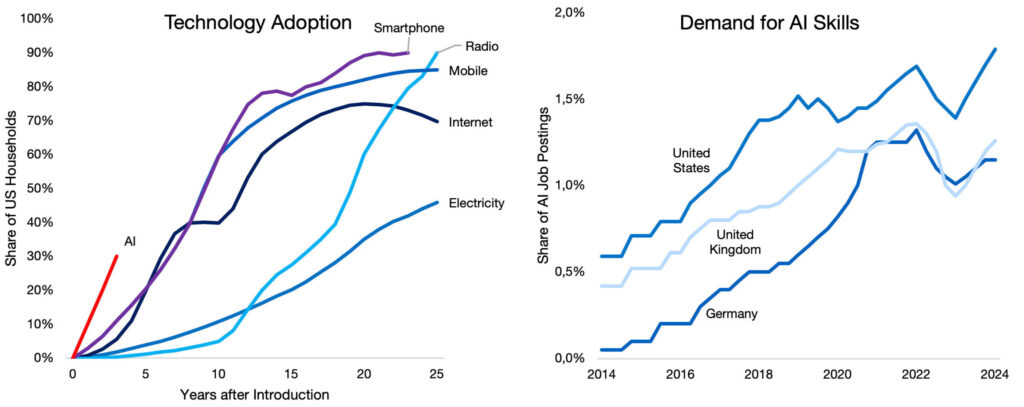
The charts above illustrate this dynamic. On the left-hand side, the chart compares the adoption trajectories of major technologies over the first 25 years – AI stands out for its sharp acceleration. The right-hand chart shows online job vacancies explicitly requesting AI-related skills in three countries. Again, it shows a steep rise.
Together, these panels tell a consistent story: that AI adoption is accelerating rapidly and labour markets are responding in kind. But demand has outpaced supply. As firms compete for a limited pool of AI-capable workers, the value of AI skills has risen sharply, reshaping wages, job quality and hiring decisions.
The growing value of AI skills
Across advanced economies, employers increasingly seek workers who can develop, deploy or work effectively alongside AI systems. This demand extends well beyond the technology sector into finance, manufacturing, healthcare, logistics and public services.
With my team at the SkillScale project at the University of Oxford, I have conducted research across major European economies that shows a consistent upward trajectory in AI skill demand throughout the 2010s and early 2020s, despite substantial differences in labour market institutions and education systems.
Crucially, this surge in demand has not been matched by a corresponding increase in supply. Training pipelines struggle to keep pace and firms report growing difficulty in recruiting qualified candidates.
The result is a global skills shortage that has elevated the economic value of AI capabilities. This value manifests in three ways:
1. Higher wages
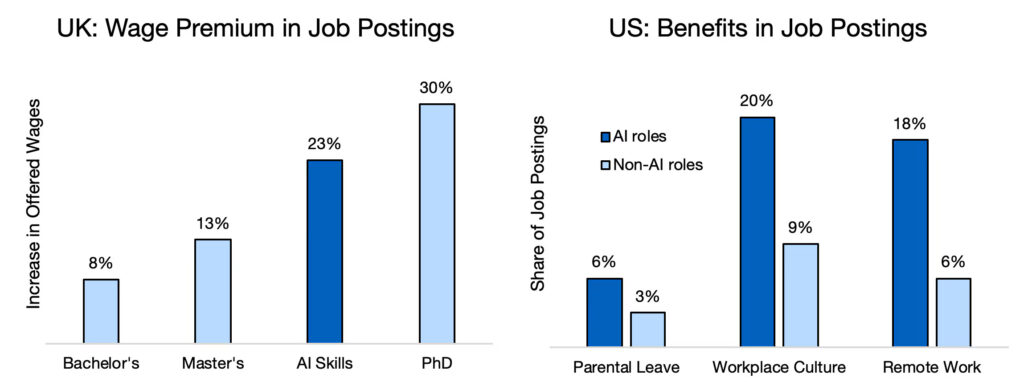
The most visible effect of this imbalance is a substantial wage premium. Our study of more than 10 million job postings in the UK shows that candidates with AI-related skills command, on average, an advertised salary 23% higher than otherwise comparable candidates without those skills.
The same data show that a Master’s degree is associated with approximately a 13% wage premium, and a Bachelor’s degree with approximately 8% (see the charts below). In other words, AI skills now outperform formal educational qualifications in immediate labour market returns as employers shift towards more skill-based hiring.
In fact, hiring practices are becoming increasingly skills-based, particularly in fast-moving technological domains where formal education currently struggles to keep pace with innovation. For workers, this means targeted skill acquisition – often through shorter, modular training – can boost wages, in some cases even more than a degree. For employers, it reflects intense competition for scarce expertise critical to AI adoption and productivity growth.
2. Improved job quality
Rising wages are only part of the story. Firms competing for AI talent are also offering richer non-monetary rewards that improve overall job quality. An analysis of US job postings from 2018 to 2024 shows that AI-related roles are significantly more likely to advertise benefits such as generous parental leave, flexible working arrangements, and remote or hybrid work options. AI jobs are roughly twice as likely to include parental leave benefits and around three times as likely to offer remote work (see the chart above).
Importantly, these differences have widened in recent years, suggesting that firms are increasingly relying on job quality, rather than just pay, to attract scarce AI talent. This indicates that competition for AI skills is influencing employment standards more generally, potentially raising working conditions in parts of the labour market. AI skills, in this sense, are not only raising wages but also reshaping expectations regarding flexibility, work-life balance, and support for workers’ family lives.
3. Stronger employability
AI skills also confer advantages before a job offer is even made. In an experimental study involving 1,700 hiring professionals in the US and the UK, my colleagues and I examined how AI skills on résumés affect interview decisions. Recruiters were presented with pairs of otherwise identical candidates, differing only in whether AI competencies were listed.
In the case of identical CVs, the probability of being invited is 50%, as highlighted by the dotted line in the charts below. But, on average, candidates with AI skills were 8–15% more likely to be invited for an interview, depending on the role. This effect held across diverse occupations, including graphic design, office administration and software development.
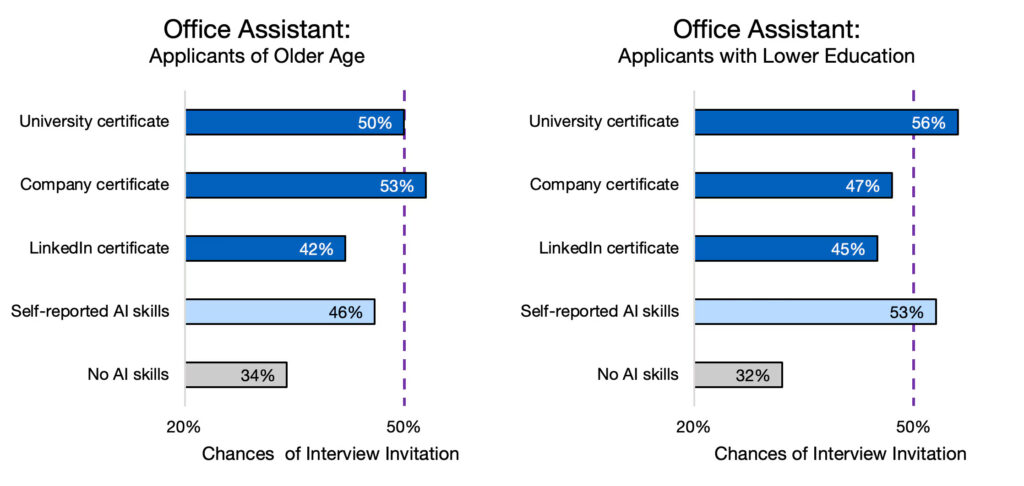
Most notably, AI skills helped offset conventional disadvantages in hiring. Older applicants and candidates without advanced degrees – groups that often face lower call-back rates – saw their prospects improve substantially when AI skills were present on their résumés. When those skills were supported by a recognised certificate, such as a university or company training programme, the effect was even stronger (see the above chart).
The results suggest that AI skills can act as a partial equalizer in hiring, shifting attention away from static characteristics toward demonstrable, current capabilities.
How to boost AI skills
Rather than eroding employment, AI is restructuring the value of skills. And so the key economic challenge of AI is not job loss, but skill diffusion.
For businesses, access to AI-capable talent is rapidly becoming a source of competitive advantage. Firms that invest in training, certification and internal upskilling are better positioned to adopt AI effectively and sustainably. Competing solely on wages is unlikely to be sufficient – job quality, learning opportunities and credible skill recognition all increasingly matter.
For policy-makers, the priority should be scale and inclusion. The returns from encouraging AI skills are large and broadly distributed, but only for those who can acquire them. Expanding access to modular training, supporting credible certification pathways and enabling firms – particularly small and medium-sized enterprises – to invest in continuous learning will be critical.
More broadly, the AI transition reinforces a recurring lesson from economic history: general-purpose technologies deliver shared prosperity only when skills diffuse as rapidly as the technologies themselves. The race is not between humans and machines, but between economies that succeed in building AI capabilities at scale and those that do not.
- Fabian Stephany is an Assistant Professor in AI & Work at the Oxford Internet Institute (OII), University of Oxford and a Senior Research Fellow with the Institute for New Economic Thinking at the Oxford Martin School. This article was originally published by the World Economic Forum.