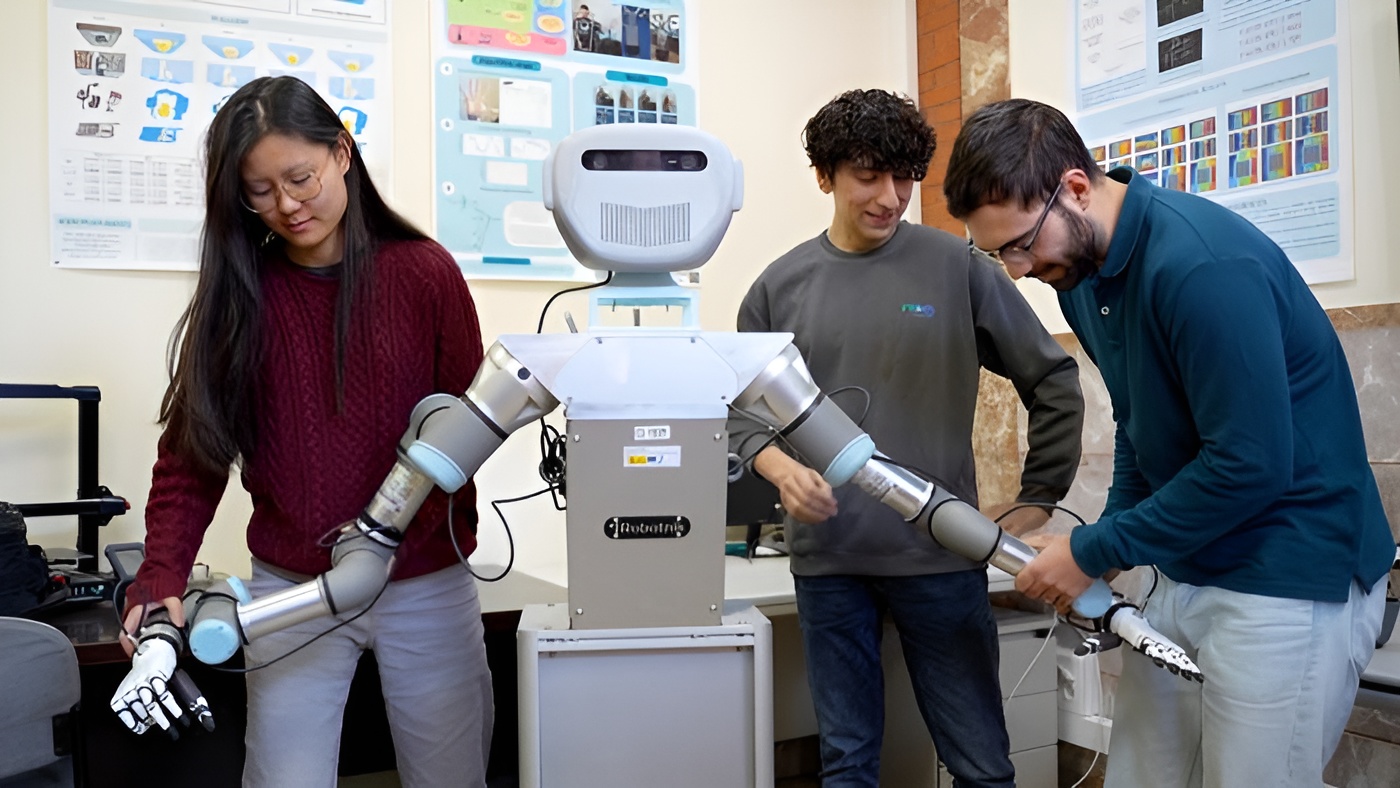

A team at the Universidad Carlos III de Madrid (UC3M) has unveiled a new methodology that enables service robots to perform complex domestic chores — such as setting the table, ironing, or serving water — without requiring thousands of lines of code.
The system uses the ADAM robot (Autonomous Domestic Ambidextrous Manipulator), which is designed specifically to assist elderly people and those with reduced mobility in their homes.
“We all know people for whom simple gestures, such as someone bringing them a glass of water with a pill or setting the table for them, represent a very significant help,” says Ramón Barber, director of the Mobile Robots Group at UC3M. “That is the main objective of our robot.”
The rubber band effect
Coordinating two robotic arms to work together without colliding is one of the most difficult challenges in robotics.
To solve this, the researchers combined “imitation learning” — where the robot learns by watching a human demonstrate a task — with a mathematical system called Gaussian Belief Propagation. This creates an invisible, constant dialogue between the robot’s limbs, allowing them to adjust in real-time to avoid collisions.
Crucially, the system allows the robot to adapt rather than just repeat. The researchers describe the movement as behaving like a “rubber band”: if a target object, such as a bottle, is moved slightly, the robot’s trajectory deforms smoothly to reach it while maintaining essential properties, such as keeping the bottle upright to prevent spills.
“The ultimate goal is for robots to stop being simple movement recorders and become authentic coworkers,” says researcher Adrián Prados.
Currently, ADAM is an experimental platform costing between €80,000 and €100,000. However, the team believes the technology is mature enough that similar robots could be living in our homes at a much more affordable price within 10 to 15 years.
With a growing elderly population and fewer caregivers available, the team argues that such “assistive robots” will become essential tools for maintaining quality of life and autonomy.



