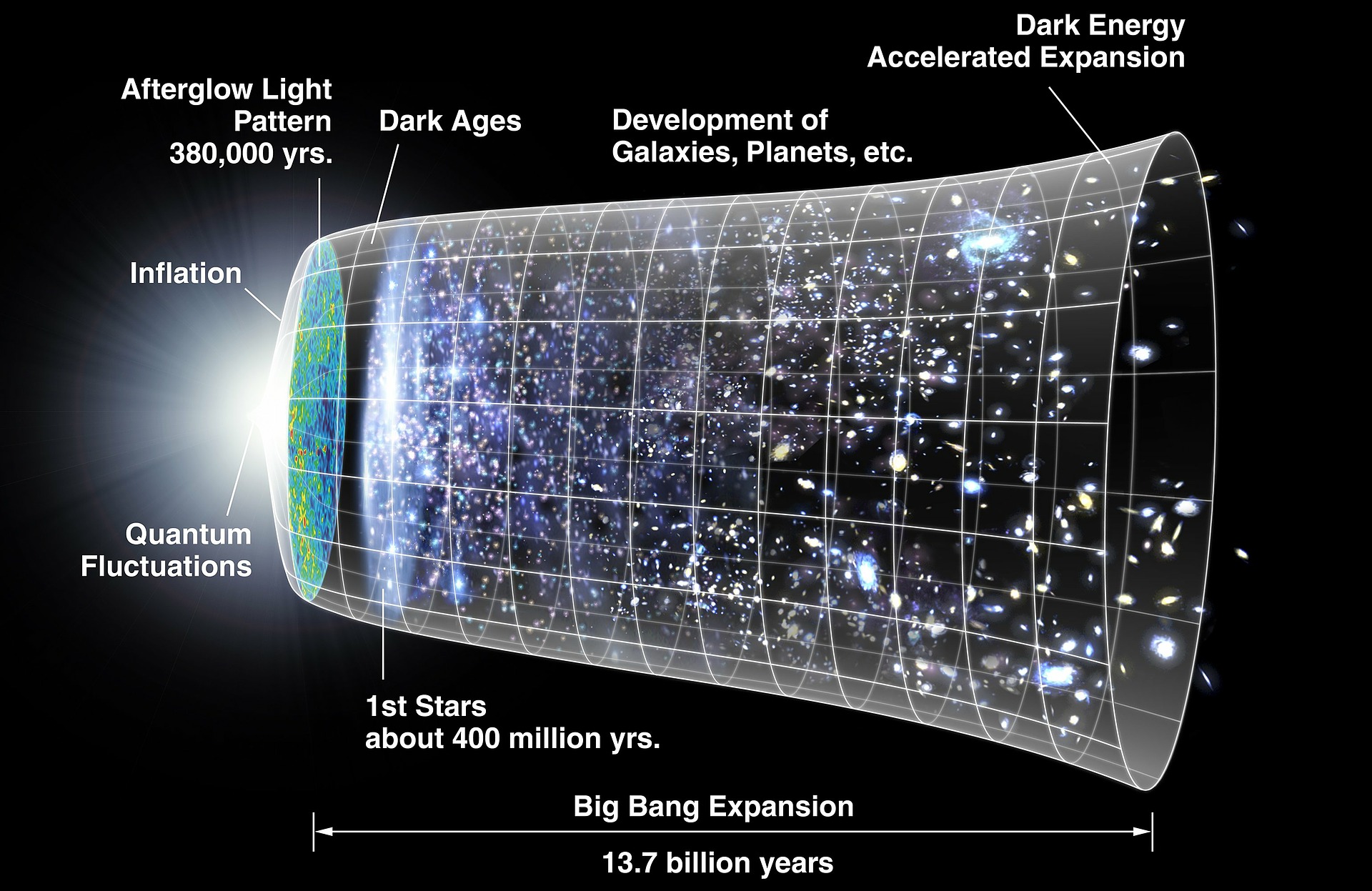

It appears the universe’s three-decade-long acceleration party might be over. A new study suggests that, contrary to a Nobel Prize-winning theory, the universe’s expansion has already started to slow down.
The “remarkable” findings, published yesterday in Monthly Notices of the Royal Astronomical Society, question the entire concept of ‘dark energy’ constantly pushing galaxies apart faster and faster.
Lead researcher Professor Young-Wook Lee, of Yonsei University in South Korea, said: “Our study shows that the universe has already entered a phase of decelerated expansion at the present epoch and that dark energy evolves with time much more rapidly than previously thought. If these results are confirmed, it would mark a major paradigm shift in cosmology since the discovery of dark energy 27 years ago.”
Supernovae as “standard candles”
For the past 30 years, the entire field has largely agreed that the universe is expanding at an accelerating rate. This conclusion, which bagged the 2011 Nobel Prize in Physics, was based on using type Ia supernovae as “standard candles” to measure cosmic distances.
However, the Yonsei University team has now pointed out a rather significant flaw in those candles. Their new evidence, based on a much larger sample of 300 host galaxies, shows these supernovae are strongly affected by the age of their progenitor stars. This was confirmed with 99.999% confidence.
In simple terms, supernovae from younger stars appear systematically fainter, while those from older stars seem brighter. The researchers argue this dimming arises from stellar astrophysics effects, not just the universe expanding.
When this systematic bias was corrected, the supernova data suddenly stopped matching the standard ΛCDM cosmological model (which assumes accelerating expansion), researchers said.
Instead, the corrected data aligned far better with a different model, one favoured by the Dark Energy Spectroscopic Instrument (DESI) project, derived from baryonic acoustic oscillations (BAO) and cosmic microwave background (CMB) data.
The researchers said that when their corrected supernova data were combined with BAO and CMB results, the standard ΛCDM model was ruled out with overwhelming significance. Most surprisingly, this combined analysis indicates the universe is not accelerating today as previously thought, but has already transitioned into a state of decelerated expansion.
The Yonsei team is now carrying out an “evolution-free test”, which uses only supernovae from young host galaxies, to further confirm their results. They will be aided by the Vera C. Rubin Observatory, which began scientific operations this year.
“Within the next five years, with the Vera C. Rubin Observatory discovering more than 20,000 new supernova host galaxies, precise age measurements will allow for a far more robust and definitive test of supernova cosmology,” said research professor Chul Chung, a co-lead on the study.



