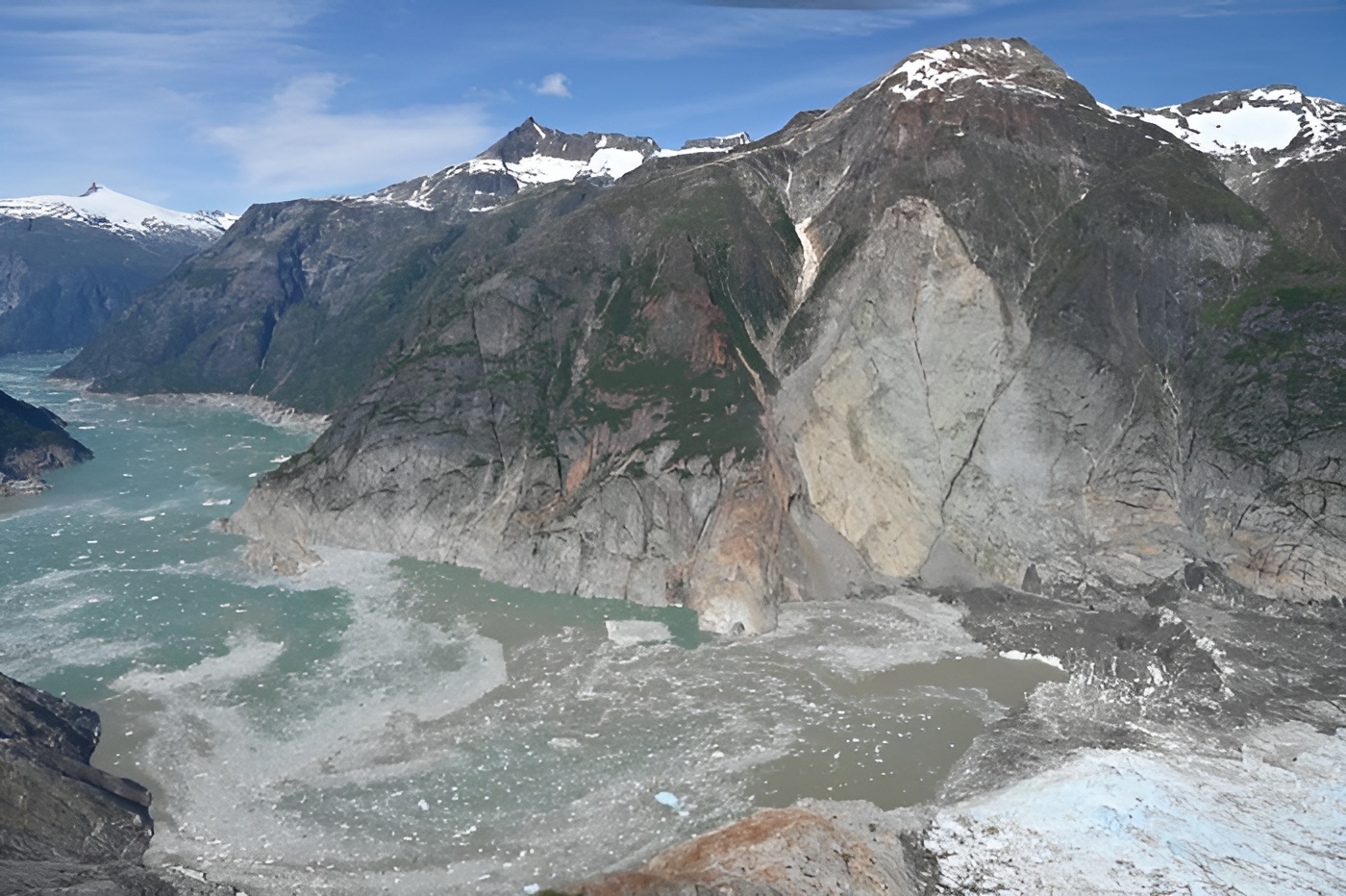

Scientists have identified a distinctive geological “ringing” that could provide an early warning system for massive landslide-generated tsunamis in the Arctic.
A multi-institutional study led by researchers at the University of Calgary has analysed the August 2025 megatsunami in Alaska’s Tracy Arm Fjord. The investigation discovered that the event — triggered by a 64 million cubic metre rock collapse — produced a unique resonant oscillation known as a seiche that “rang” the fjord for 36 hours. detectable on seismic sensors worldwide, this sustained signal and a buildup of micro-earthquakes prior to the collapse offer a new framework for detecting lethal waves in remote, heavily trafficked regions.
As climate change thaws permafrost and thins glaciers, removing the structural “buttressing” of steep fjord walls, the risk of these extreme, localised floods is rising. The researchers argue that identifying these seismic precursors is critical for protecting the 1.6 million cruise ship passengers who now visit Alaska annually.
The 481-metre ‘near miss’
The disaster unfolded at 5:26 AM on 10 August 2025, when a massive wedge of rock high above the South Sawyer Glacier failed. The resulting landslide struck the glacier terminus at speeds exceeding 70 metres per second, displacing an enormous volume of ice and water.
The impact generated an initial 100-metre breaking wave that surged across the fjord. Maximum runup — the height water reached on the opposite slope — hit 481 metres above sea level. For perspective, this wall of water reached nearly the height of the Empire State Building, making it one of the largest tsunamis recorded in the last century.
While the early-morning timing meant no tour boats were in the immediate vicinity, Tracy Arm is a summer hotspot, frequented by more than 20 vessels per day. Some large cruise ships carry as many as 6,000 passengers and crew, highlighting the potential for a mass-casualty event.
The study, published in Science, utilised global seismic data to pinpoint two critical detection windows:
- The Precursor: Seismometers recorded an increase in microseismicity 24 hours before the primary failure. In the six hours leading up to the landslide, these tremors increased exponentially, occurring every 30 to 60 seconds.
- The ‘Calling Card’: The tsunami triggered a long-period (66-second) global seismic signal produced by the water sloshing back and forth within the fjord’s geometry. This was only the second time a days-long seiche has been observed globally.
“A promising area of further investigation,” the researchers wrote, “could be improved understanding of precursory warning signals either from direct measurement or remote sensing”.
The climate link
The authors state that the warming trend driving regional glacier retreat is “entirely anthropogenic,” equating to an increase in summertime temperatures of 1.1 °C since the start of the industrial era.
South Sawyer Glacier thinned by approximately 100 to 130 metres between 2013 and 2022. This thinning removed the rock wedge’s mechanical support, leaving it prone to collapse as the ice face retreated. Base exposure of the failed slope occurred just weeks before the 10 August disaster.
The team suggests that narrowband seismic monitoring could now be used to detect these fjord-specific harmonic responses. This would allow for near-real-time identification of hazardous processes even in areas with sparse traditional tide-gauge data or satellite coverage.