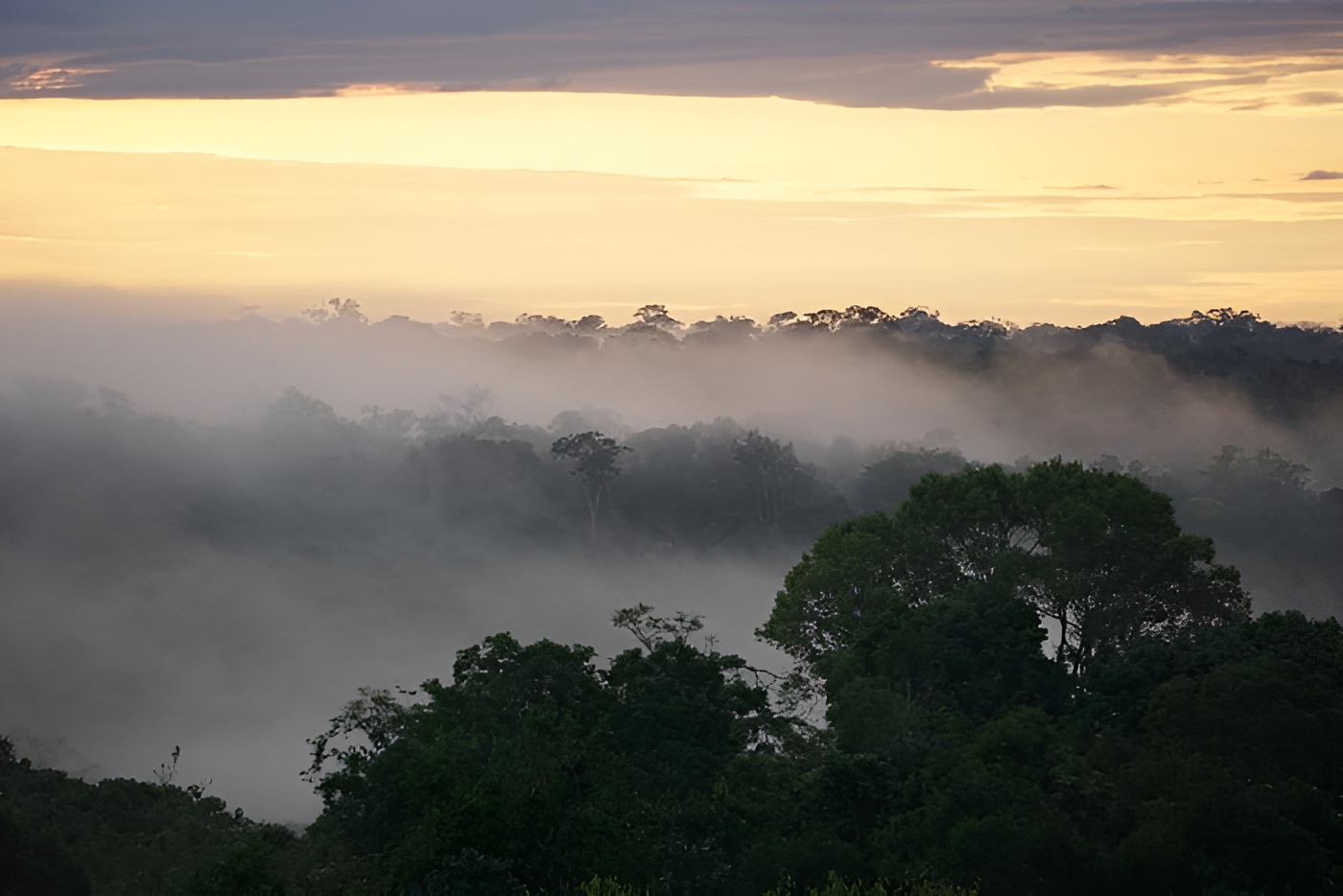

The Amazon rainforest is transitioning into a new, hostile climate state characterised by “hot droughts” that have not been seen on Earth for tens of millions of years, according to a landmark study.
Researchers from the University of California, Berkeley, warn that a new “hypertropical” regime is emerging due to global warming, exposing trees to unprecedented stress that causes them to suffer fatal embolisms akin to human strokes.
The study, published in the journal Nature, predicts that if greenhouse gas emissions remain high, these deadly conditions could become prevalent across the Amazon by 2100, potentially occurring for up to 150 days a year, even during the wet season.
“When these hot droughts occur, that’s the climate that we associate with a hypertropical forest, because it’s beyond the boundary of what we consider to be tropical forest now,” said study leader Jeff Chambers, a UC Berkeley professor of geography.
The scientists define this new biome as the “hypertropics” — regions warmer than the 99th percentile of historical tropical climates. This shift is driven by global warming extending the typical July-to-September dry season while simultaneously driving temperatures higher than normal.
Devastating impact
The team found that these conditions increase the normal tree mortality rate by 55 per cent. While an annual mortality increase of 0.55 per cent may seem small, Chambers warns it has a cumulative, devastating impact on the forest’s ability to function as a carbon sink.
Using data spanning 30 years from study sites north of Manaus, Brazil, the researchers identified the precise mechanism killing the trees. They discovered a critical “tipping point” for soil moisture: when water content drops below roughly one-third (a value of 0.32), the trees enter a danger zone.
“The really remarkable thing is that the threshold soil moisture content in a different plot with different trees for droughts in different years — 2015 and 2023 — were essentially the same: 0.32 and 0.33,” said Chambers. “That was really surprising to everyone.”
Once this threshold is crossed, trees face a lethal dilemma. They either shut down carbon capture and starve to death, or they continue trying to draw water from the dry soil, developing air bubbles in their sap. These bubbles act like embolisms in human blood vessels, blocking the flow of vital fluids and causing hydraulic collapse.
“Normally, plants are pretty good at trying to compartmentalise and just say, OK, I’m willing to sacrifice that branch to keep this core piece alive,” Chambers said. “But if there are enough embolisms, the tree just dies.”
Drought-induced mortality
The study found that fast-growing, low wood-density trees are the most vulnerable to these conditions. This implies that secondary forests — those regrowing after logging or fire — are particularly at risk of drought-induced mortality.
If the number of high heat-stress days increases as predicted, the makeup of the Amazon could shift entirely, favouring only those species capable of withstanding the new climate, provided the change doesn’t happen too fast for them to adapt.
The researchers emphasise that the “hypertropical” future is not yet guaranteed to be permanent. The most extreme predictions — where hot drought conditions occur year-round — depend on society’s failure to curb emissions.
“It all depends on what we do,” said Chambers. “It’s up to us to what extent we’re actually going to create this hypertropical climate. If we’re just going to emit greenhouse gasses as much as we want, without any control, then we’re going to create this hypertropical climate sooner.”