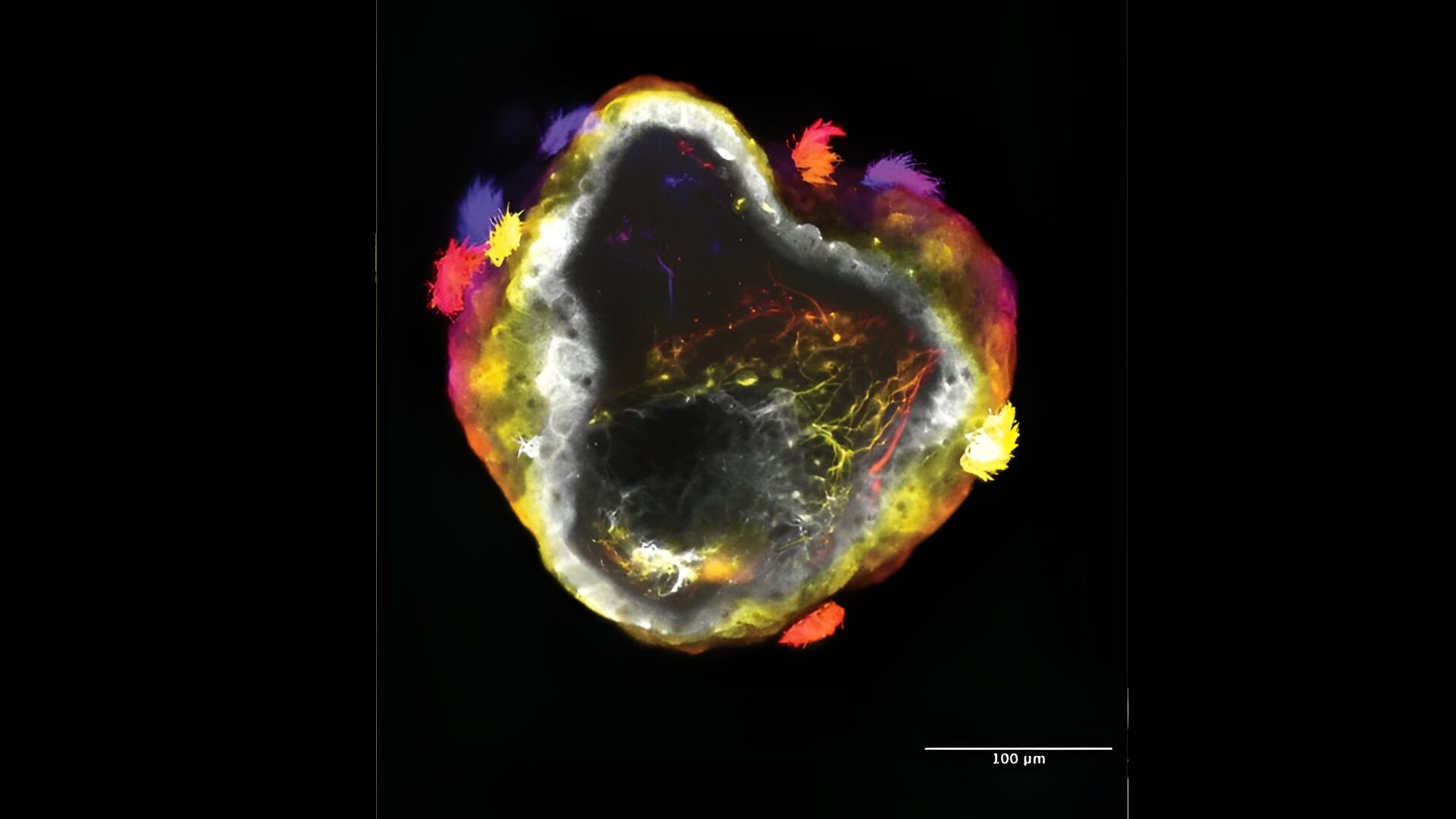

Researchers have successfully grown a functional nervous system inside tiny, self-organising biological robots, marking a major leap toward creating autonomous living machines.
In a first-of-its-kind study published in the journal Advanced Science, a team from the Wyss Institute for Biologically Inspired Engineering at Harvard and Tufts University created “neurobots” — living, self-powered cellular robots capable of complex movement.
The neurobots are an evolution of “biobots” (such as Xenobots and Anthrobots), which were originally built using frog embryonic cells and human cells. While these earlier biobots could move autonomously and even heal neural wounds in a lab setting, they lacked a nervous system.
To bridge this gap, the research team, led by Wyss Institute Senior Scientist Dr Haleh Fotowat and Tufts University Professor Michael Levin, implanted neuronal precursor cells into the biobots during their initial formation.
Dr Fotowat explained: “The implanted neuronal precursor cells differentiated into mature neurons with defined cell bodies and axonal and dendritic projections. They connected to one another and extended processes to cells at the surface of the neurobot. This all happened spontaneously in a completely novel biological context that we created, one that was different from the way the nervous system normally develop in frogs.”
A new kind of motility
The integration of a nervous system fundamentally changed the robots’ shape and function. Compared to standard biobots, the neurobots developed a more elongated shape, exhibited increased activity, and displayed highly complex, repeating movement patterns.
The nervous system successfully reached out to various surface cells, including multiciliated cells (MCCs) that enable motility, mucus-secreting goblet cells, and ionocytes that regulate ion balance.
When the researchers tested the neurobots with pentylenetetrazole (PTZ)—a drug that inhibits a specific receptor and normally triggers seizures in animals by shifting neurons into overdrive—the bots exhibited complex changes in their movement, either increasing or decreasing their activity complexity.
Hinting at a visual system
Perhaps most surprisingly, a genetic analysis revealed that the neurobots had upregulated a large group of genes associated with the development of the visual system in the eyes of Xenopus frogs.
Professor Levin noted: “Although we have to validate these observations on the level of proteins and map them across individual cells, they could mean that some kind of visual system may be developing in neurobots. If so, they could display visually-evoked behaviours such as light-controlled motility, which could be a powerful way to guide their behaviour for useful applications, and learn about the evolutionary origin of behavioural competencies.”
Ultimately, the researchers hope these living robots could one day be constructed from a patient’s own cells and deployed inside the human body to repair spinal cord damage, clear arterial plaques, or deliver targeted regenerative drugs.
Wyss Founding Director Donald Ingber concluded: “Biobots, and now neurobots, are the kind of advances that defy scientific thinking and all previously existing paradigms. They present a new frontier in biomedical research with potential for gaining insights into fundamental biology and developing solutions to problems in medicine that can’t even be fathomed yet.”