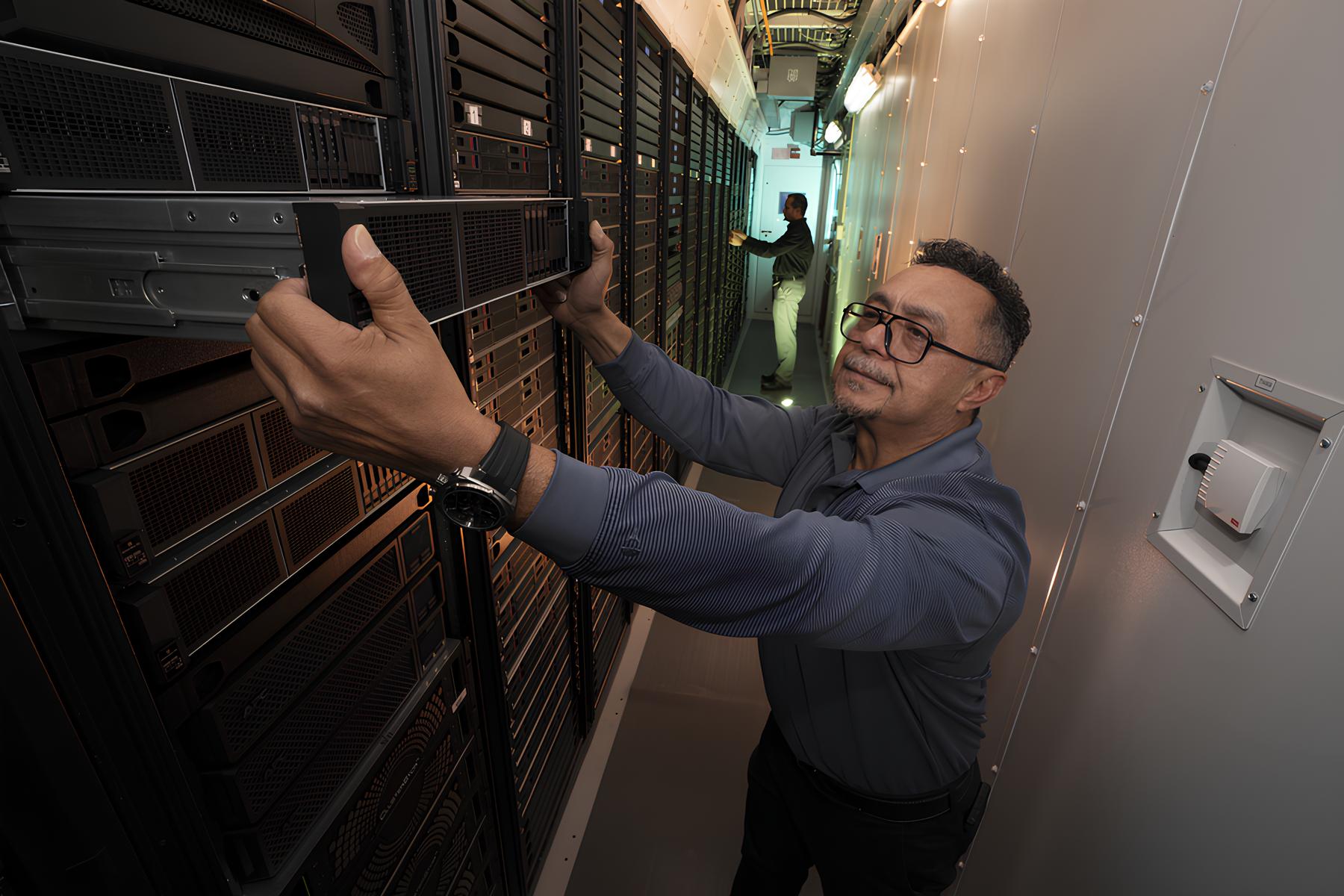

MIT Lincoln Laboratory has launched TX-Generative AI Next, the most powerful artificial intelligence supercomputer at any US university, delivering peak performance of two AI exaflops and ranking among TOP500’s leading global systems for generative AI research across biodefense, materials discovery and cybersecurity applications.
The system, powered by more than 600 NVIDIA graphics processing unit accelerators explicitly designed for AI operations, came online this summer at the Lincoln Laboratory Supercomputing Center in Holyoke, Massachusetts. TX-GAIN joins existing supercomputers supporting thousands of researchers across federally funded projects at Lincoln Laboratory and MIT campus.
“TX-GAIN will enable our researchers to achieve scientific and engineering breakthroughs. The system will play a large role in supporting generative AI, physical simulation, and data analysis across all research areas,” says Lincoln Laboratory Fellow Jeremy Kepner, who heads the LLSC.
The supercomputer focuses on generative AI applications that produce entirely new outputs rather than traditional categorisation tasks. Research teams are applying the technology to evaluate radar signatures, supplement weather data coverage gaps, identify network traffic anomalies and explore chemical interactions for medicine and materials design.
Biological defence applications demonstrate the system’s research impact. “TX-GAIN is allowing us to model not only significantly more protein interactions than ever before, but also much larger proteins with more atoms. This new computational capability is a game-changer for protein characterisation efforts in biological defence,” says Rafael Jaimes, a researcher in Lincoln Laboratory’s Counter–Weapons of Mass Destruction Systems Group.
The facility supports research collaborations with MIT’s Haystack Observatory, Center for Quantum Engineering, Beaver Works and Department of Air Force–MIT AI Accelerator, which prototypes AI technologies for US Air Force and Space Force operations including global flight scheduling optimisation.
Energy efficiency remains a priority, with LLSC research staff developing software tools that can reduce AI model training energy consumption by as much as 80 per cent. The system continues the laboratory’s TX nomenclature tradition honouring the 1956 Transistorized Experimental Computer Zero, one of the world’s first transistor-based machines.
The supercomputing centre’s interactive approach allows researchers to access powerful systems without parallel processing expertise, making advanced computational capabilities accessible across diverse research domains.



