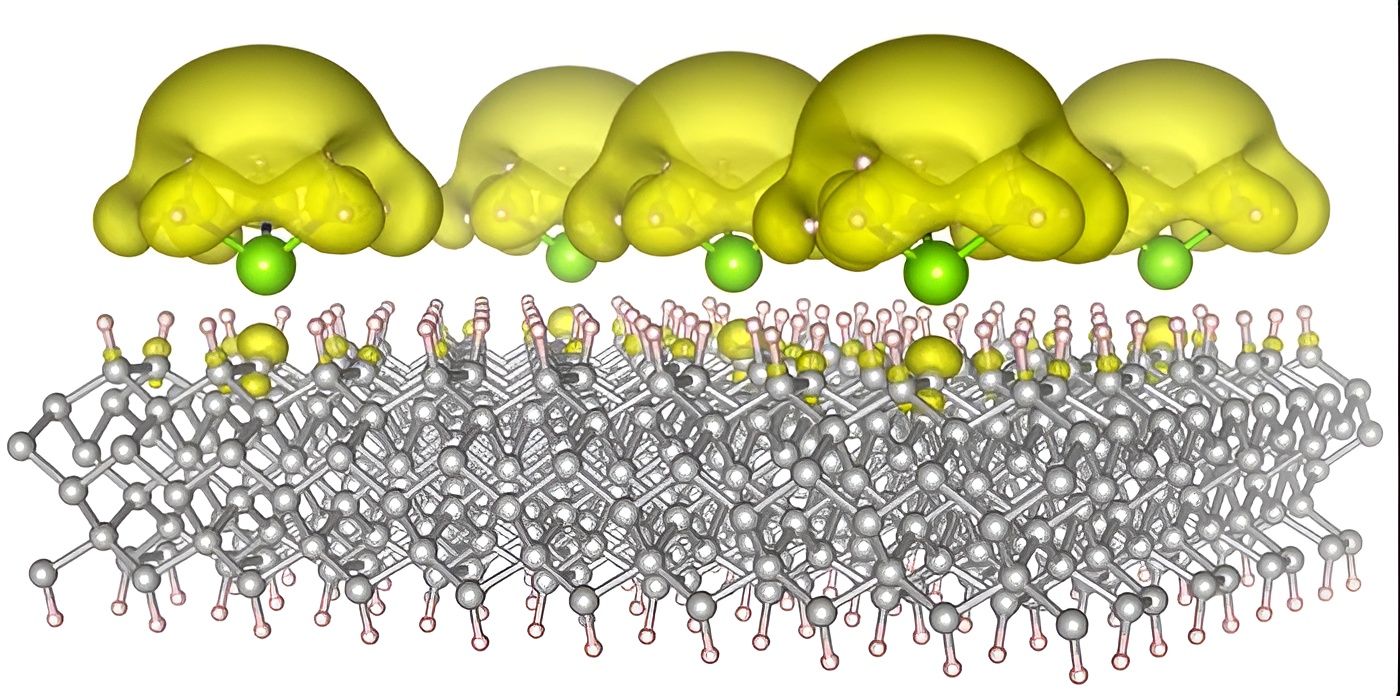

Auburn University scientists have created a new class of materials that gives unprecedented control over free-floating electrons, offering potential applications in quantum computing and advanced chemical catalysis.
The team designed Surface Immobilised Electrides by anchoring special molecules, known as solvated electron precursors, onto stable surfaces such as diamond and silicon carbide. The study, published in ACS Materials Letters, demonstrates how electrons can be arranged in different patterns within these materials, either forming isolated “islands” that act like quantum bits for advanced computing or extended metallic “seas” that drive complex chemical reactions.
Dr Evangelos Miliordos, Associate Professor of Chemistry at Auburn and senior author of the study, says: “By learning how to control these free electrons, we can design materials that do things nature never intended.”
Unlike traditional materials, where electrons are bound tightly to atoms, electrides allow electrons to roam freely in open spaces. This flexibility enables the materials to be tuned for different applications. One configuration could help build quantum computers capable of solving problems impossible for today’s supercomputers, whilst another could serve as the foundation for next-generation catalysts that speed up chemical reactions.
Dr Konstantin Klyukin, Assistant Professor of Materials Engineering at Auburn, says: “This is fundamental science, but it has very real implications. We’re talking about technologies that could change the way we compute and the way we manufacture.”
Earlier versions of electrides were unstable and difficult to scale. By depositing them directly on solid surfaces, the Auburn team has overcome these barriers, proposing a family of materials structures that could move from theoretical models to real-world devices.
Dr Marcelo Kuroda, Associate Professor of Physics at Auburn, notes: “As our society pushes the limits of current technology, the demand for new kinds of materials is exploding. Our work shows a new path to materials that offer both opportunities for fundamental investigations on interactions in matter as well as practical applications.”
The theoretical study was led by faculty across chemistry, physics and materials engineering at Auburn University and was coauthored by graduate students Andrei Evdokimov and Valentina Nesterova. It was supported by the US National Science Foundation.



