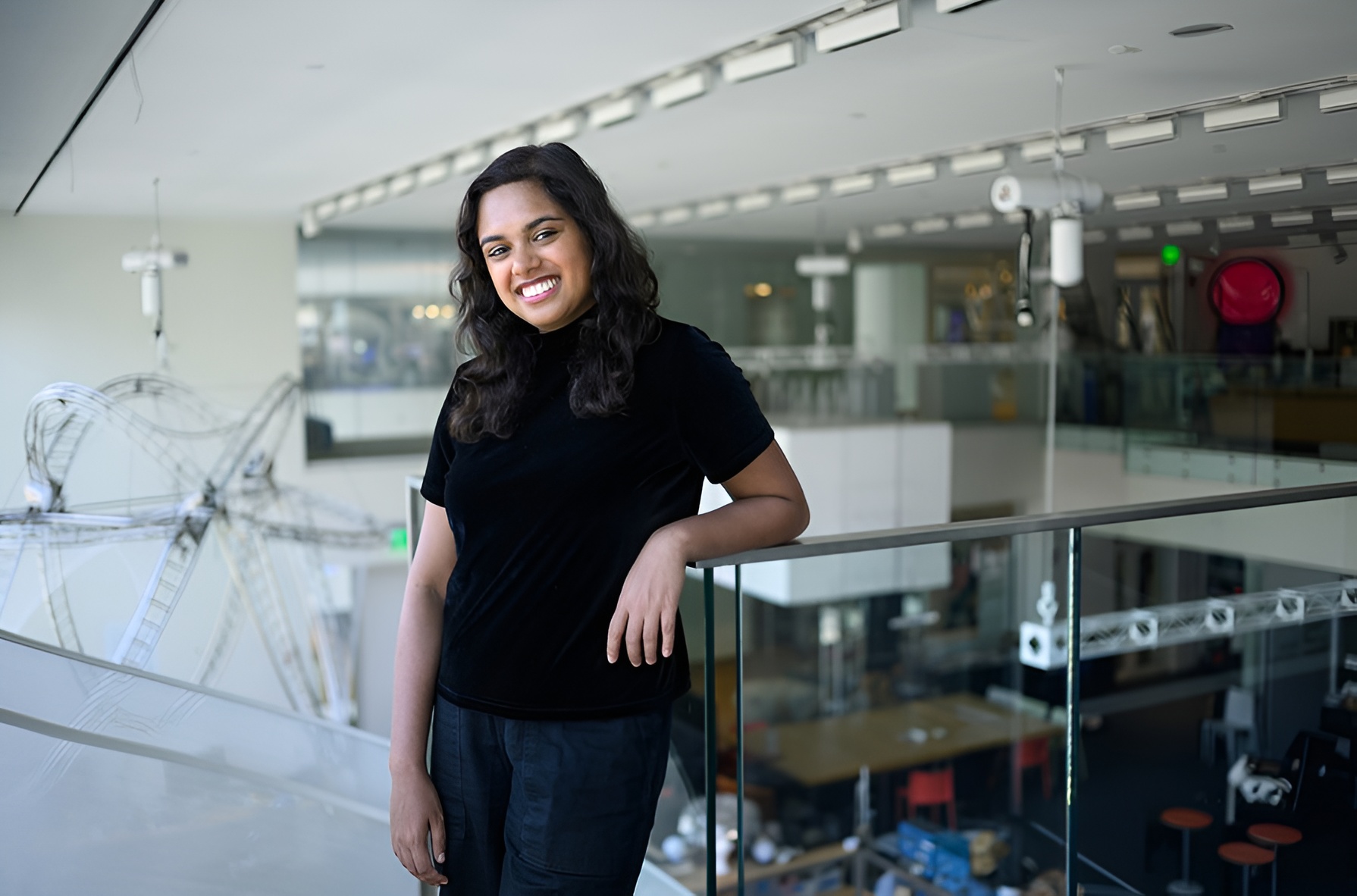

MIT Media Lab PhD student Kimaya Lecamwasam is clinically validating music listening, composition and performance as health interventions to combine with psychotherapy and pharmaceutical treatments for anxiety and mental health conditions.
Lecamwasam, a computational neuroscientist and musician in the Opera of the Future group, is investigating how large-scale live music and concert experiences impact the mental health and well-being of both audience members and performers. Her research focuses on harnessing the emotional potency of music into scalable, non-pharmacological mental health tools.
“For most of my life, writing and playing music was the clearest way I had to express myself,” Lecamwasam said. “I was a really shy and anxious kid, and I struggled with speaking up for myself. Over time, composing and performing music became central to both how I communicated and to how I managed my own mental health.”
Her master’s thesis focused on pharmamusicology, examining how music might positively affect the physiology and psychology of those with anxiety. She is now in the third year of her doctoral programme exploring the physical, mental and emotional impacts of music and affective computing.
Emotional resonance of AI music
Lecamwasam’s recent work, in collaboration with Professor Anna Huang’s Human-AI Resonance Lab, assesses the emotional resonance of AI-generated music compared to human-composed music. The research aims to identify more ethical applications of emotion-sensitive music generation and recommendation that preserve human creativity and agency whilst serving as health interventions.
She has collaborated with Carnegie Hall’s Weill Music Institute on its Well-Being Concerts and is partnering on a study assessing the impact of lullaby writing on perinatal health with the North Shore Lullaby Project in Massachusetts. Her main international collaboration is with Myndstream, comparing the emotional resonance of AI-generated music to human-composed music and exploring clinical and real-world applications.
Lecamwasam is also working with MIT Media Lab spinoff Empatica and PixMob on assessing the impact of interactive lighting and large-scale live music experiences on emotional resonance in stadium and arena settings.
Professor Tod Machover, Lecamwasam’s research adviser and Media Lab faculty director, said she “combines a deep love for — and sophisticated knowledge of — music with scientific curiosity and rigour in ways that represent the Media Lab/MAS spirit at its best”.
Lecamwasam earned a bachelor’s degree in 2021 from Wellesley College, where she studied neuroscience and music. During her studies, she participated in the MIT Undergraduate Research Opportunities Program for three years, working in the Department of Brain and Cognitive Sciences lab, focusing on classifying consciousness in anaesthetised patients and training brain-computer interface-enabled prosthetics using reinforcement learning.



