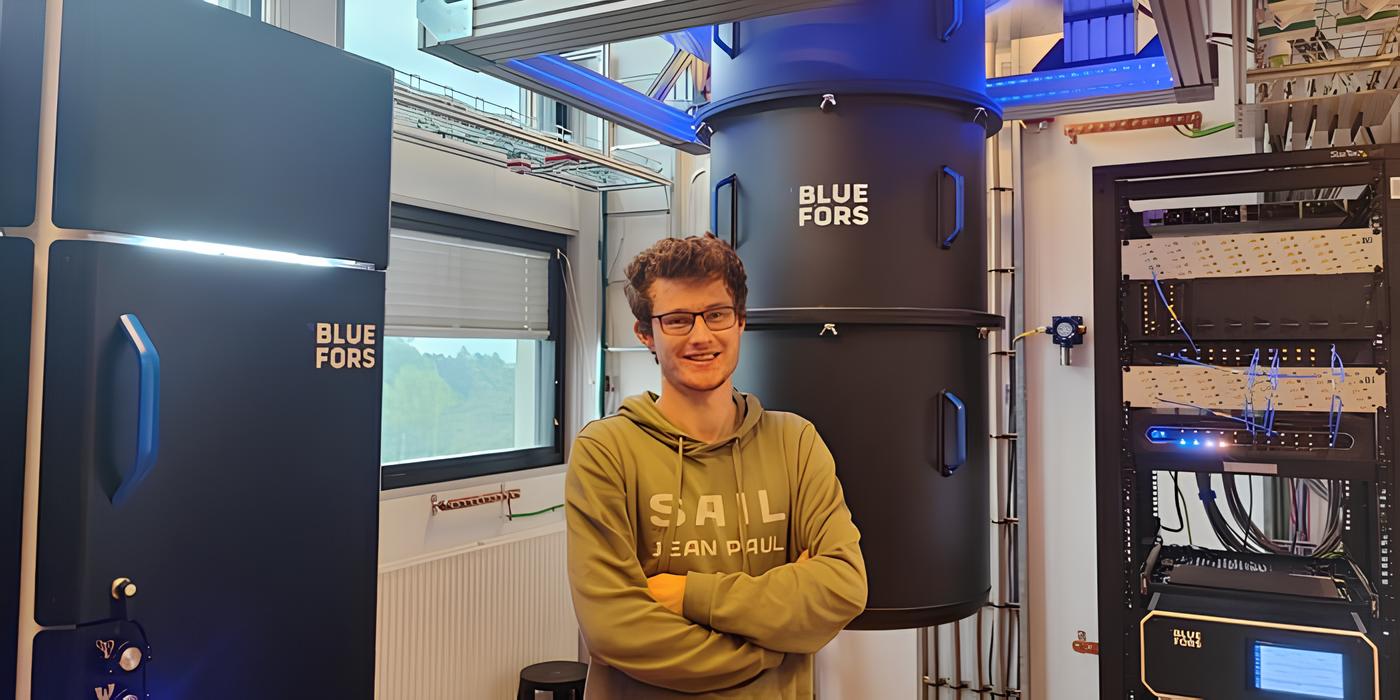

Researchers develop a method that continuously adjusts quantum bits like tuning a guitar string while playing, extending the lifetime of notoriously fragile quantum computing components.
Scientists from the Norwegian University of Science and Technology have created a system that monitors and corrects quantum bits in real time, addressing one of quantum computing’s most persistent challenges – the extreme instability of qubits that prevents these machines from reaching their full potential.
The research team, including collaborators from Leiden University, the University of Copenhagen’s Niels Bohr Institute, and the Massachusetts Institute of Technology, developed an FPGA controller that detects when a qubit begins to destabilise and immediately corrects its frequency.
“Quantum computers are completely dependent on qubits remaining stable in order to perform the special calculations they are designed for,” said Jacob Benestad, who recently earned his doctorate on qubit physics at NTNU’s Department of Physics.
Enormous posibilities with one answer
Unlike traditional computer bits that exist as either 0 or 1, quantum bits can exist in intermediate states and each qubit can know the state of all other qubits simultaneously. This enables quantum computers to excel at specific types of calculations, particularly those requiring checking enormous numbers of possibilities to find one correct answer.
However, qubits are extremely sensitive to environmental disturbances. Small disruptions cause them to lose their unique properties, limiting the size and usefulness of current quantum processors.
The new method works like continuously tuning a guitar string while it’s being played. The FPGA controller monitors the qubit and adjusts its frequency to compensate for environmental disturbances, keeping it stable for longer periods.
“This provides a longer lifetime, better precision and more robust quantum operations. It is an important step towards reliable quantum computers,” said Jeroen Danon, professor at NTNU’s Department of Physics and Benestad’s supervisor.
The breakthrough is significant because practical quantum computers will require many stable qubits working together. While quantum computers won’t replace traditional computers for most tasks, they promise dramatic speed improvements for optimisation problems, simulations, and calculations where vast possibilities must be checked.
The research, published in PRX Quantum, demonstrates that real-time calibration can extend qubit stability, bringing functional quantum computers closer to reality.