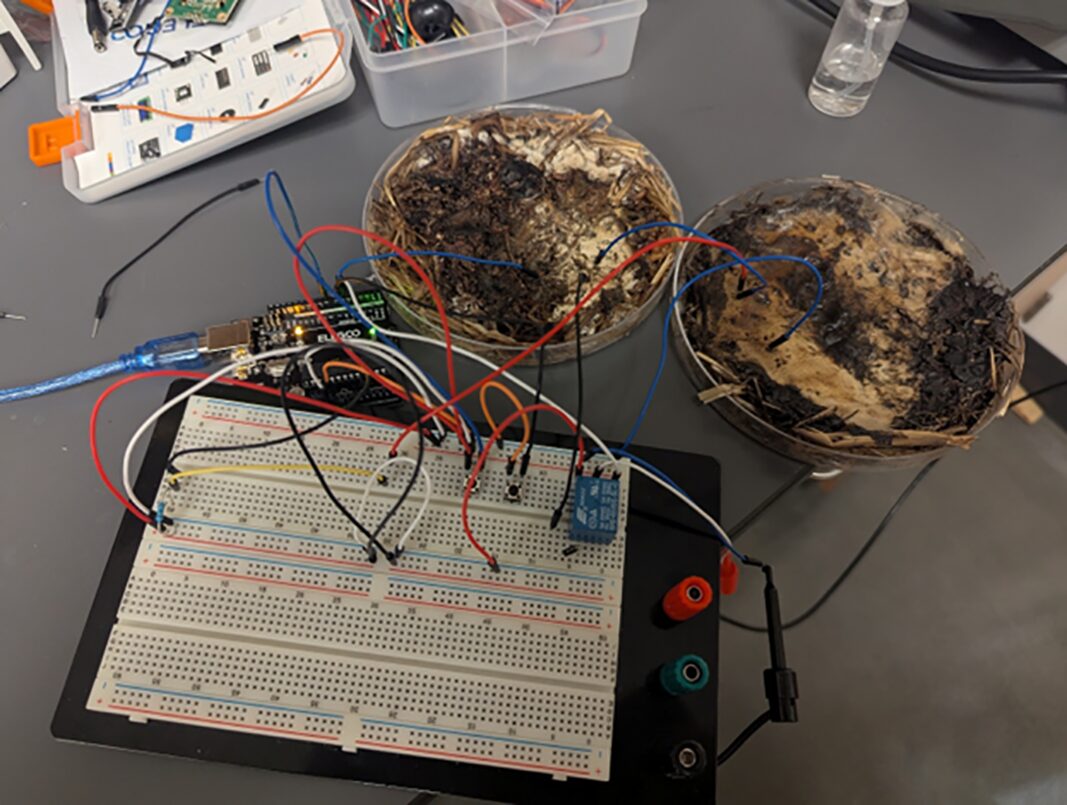

Researchers at The Ohio State University have successfully grown and trained common edible fungi to act as organic memristors, a form of biological data processor that can remember past electrical states.
The study found shiitake-based devices are a low-cost, biodegradable alternative to traditional semiconductor chips, which rely on rare-earth minerals and high-energy data centres. The findings were recently published in the journal PLOS ONE.
The breakthrough could lead to brain-inspired computing components that use significantly less energy.
“Being able to develop microchips that mimic actual neural activity means you don’t need a lot of power for standby or when the machine isn’t being used,” said John LaRocco, lead author of the study and a research scientist in psychiatry at Ohio State’s College of Medicine. “That’s something that can be a huge potential computational and economic advantage.”
To test the concept, the team cultured shiitake and button mushrooms, dehydrated them for long-term viability, and then connected them to electronic circuits, applying various voltages and frequencies.
More mushrooms for memristors
The team discovered that when used as RAM, the mushroom memristor was able to switch between electrical states at up to 5,850 signals per second with about 90 per cent accuracy. While performance dropped at higher frequencies, researchers found this could be fixed by connecting more mushrooms to the circuit, much like a biological brain.
“Mycelium as a computing substrate has been explored before in less intuitive setups, but our work tries to push one of these memristive systems to its limits,” said LaRocco.
Qudsia Tahmina, co-author of the study and an associate professor in electrical and computer engineering at Ohio State, said the research is an example of technology advancing by relying on the natural world, driven by a need to protect the environment.
The researchers suggest larger fungal systems could be useful in edge computing and aerospace, while smaller ones could enhance autonomous systems or wearable devices. They note that organic memristors are still in early development and will require significant miniaturisation to be viable.