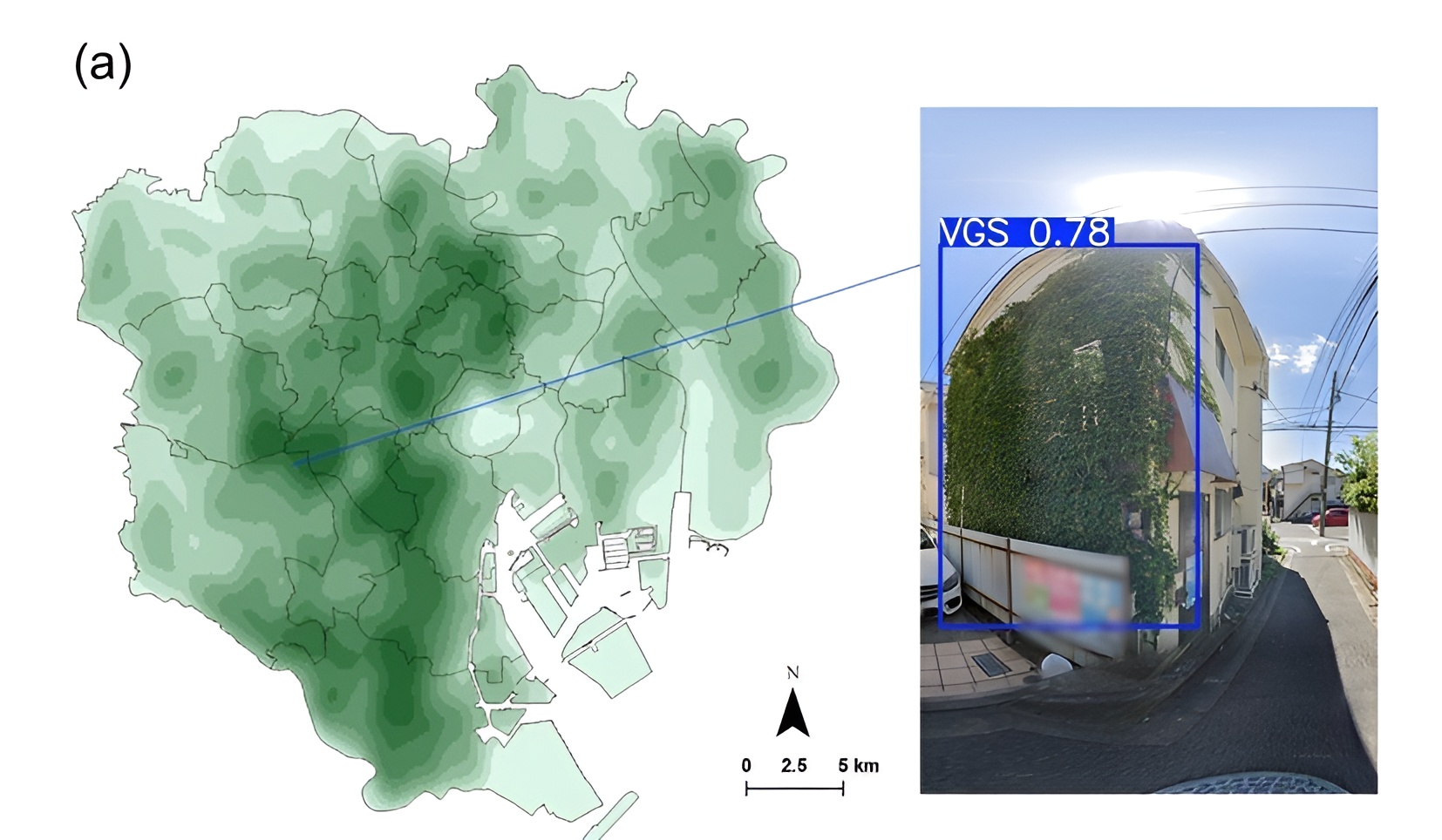

Researchers at Chiba University in Japan have developed a data-driven spatial framework using artificial intelligence to identify the best locations for vertical greening across Tokyo’s 23 wards.
The study, published in the journal Sustainable Cities and Society, provides the first citywide map of vertical greenery in one of the world’s most densely populated metropolitan areas. Vertical greening, the placement of vegetation on building façades, is seen as a key solution to reintroduce nature into crowded urban settings with limited space for parks.
The research team, led by Professor Katsunori Furuya, used a deep-learning model to analyse more than 80,000 Google Street View images. This created a detailed spatial inventory of Tokyo’s vertical greening systems by detecting façades featuring vegetation.
“With this study, we aimed to provide a clearer picture of how vertical greenery is distributed in dense urban areas like Tokyo and how it aligns — or fails to align — with environmental needs,” explains Prof. Furuya. “By combining AI-based image analysis with spatial data, we can now pinpoint where greening efforts could make the greatest difference.”
Vertical greening demand index
The researchers also introduced a new metric, the vertical greening demand index (VGDI), which assesses where additional greening could most effectively reduce urban heat and improve environmental quality.
Their findings revealed an uneven distribution of greenery. Several heat-prone and lower-income neighbourhoods had far less vegetation, highlighting the need for a more equitable distribution. The team identified “priority greening zones” where adding vegetation could reduce surface temperatures and improve thermal comfort.
“Our analysis shows that vertical greening is not just an architectural feature — it’s an environmental necessity,” says Prof. Furuya. “With data-driven planning, city authorities can target specific areas to enhance cooling, biodiversity, and overall urban resilience.”
The framework’s implications extend beyond Tokyo, offering a tool for other compact cities to guide building regulations, urban renewal projects, and greening incentive programs.



