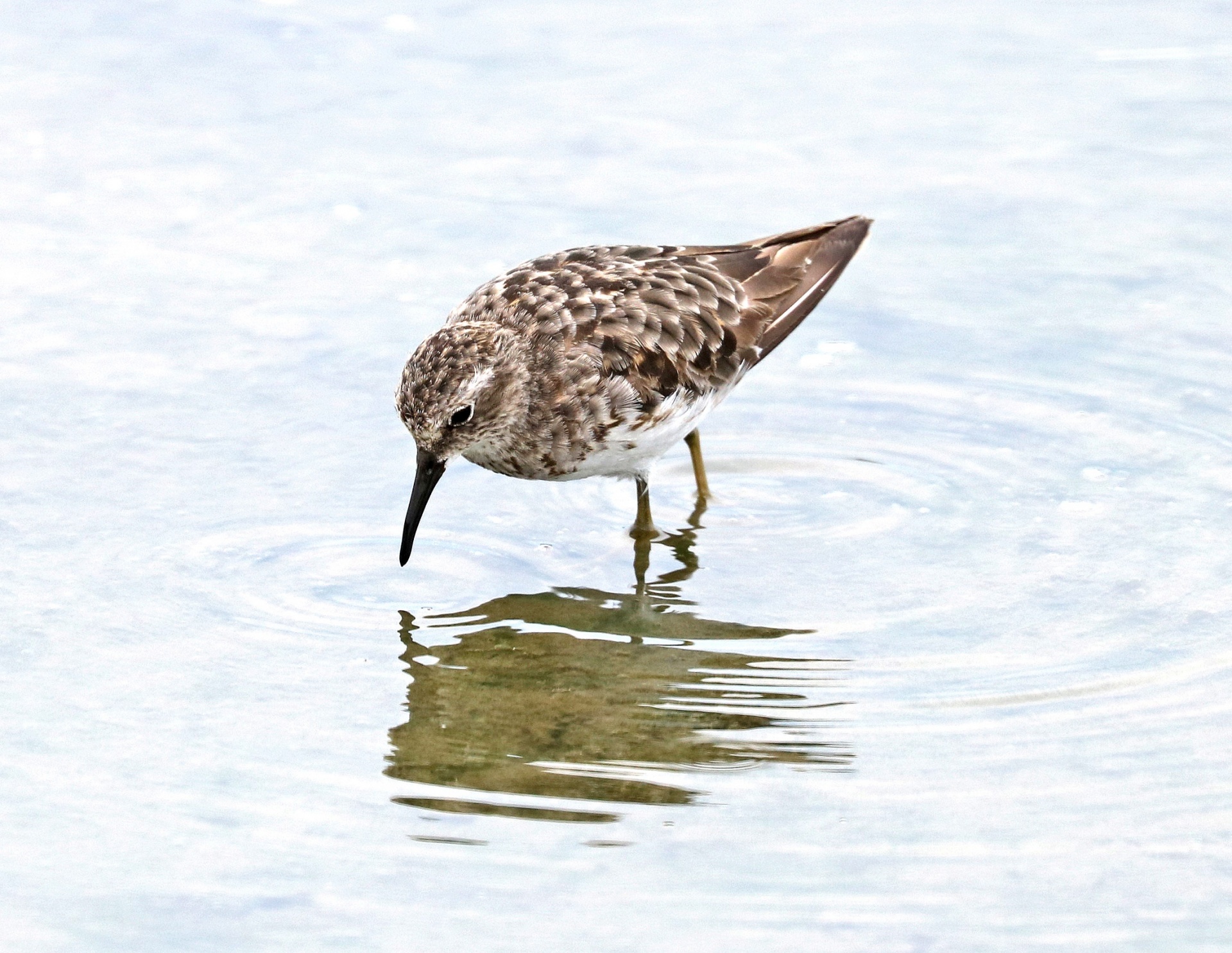
Research has revealed that humans possess a form of remote touch, or the ability to sense objects without direct contact, a capability previously documented only in certain animals, such as shorebirds, according to findings that are changing our understanding of the human perceptual world.
Researchers at Queen Mary University of London and University College London investigated whether humans share a similar capability to sandpipers and plovers, which use remote touch to detect prey hidden beneath sand. The findings were published in the IEEE International Conference on Development and Learning.
Participants gently moved their fingers through the sand to locate a hidden cube before physically touching it. Remarkably, the results revealed a comparable ability to that seen in shorebirds, despite humans lacking the specialised beak structures that enable this sense in birds.
“It’s the first time that remote touch has been studied in humans and it changes our conception of the perceptual world (what is called the ‘receptive field’) in living beings, including humans,” said Elisabetta Versace, Senior Lecturer in Psychology and lead of the Prepared Minds Lab at Queen Mary University of London who conceived the human experiments.
Theoretical physical threshold
By modelling the physical aspects of the phenomenon, the study found that human hands are remarkably sensitive, detecting the presence of buried objects by perceiving minute displacements in the sand surrounding them. This sensitivity approaches the theoretical physical threshold of what can be detected from mechanical “reflections” in granular material, when there is a sand movement that is “reflected” on a stable surface.
When comparing a human’s performance with a robotic tactile sensor trained using a Long Short-Term Memory algorithm, humans achieved an impressive 70.7 per cent precision within the expected detectable range. The robot could sense objects from slightly farther distances on average but often produced false positives, yielding only 40 per cent overall precision. Both humans and robots performed very close to the maximum sensitivity predicted with physical models and displacement.
“The discovery opens possibilities for designing tools and assistive technologies that extend human tactile perception. These insights could inform the development of advanced robots capable of delicate operations, for example locating archaeological artifacts without damage, or exploring sandy or granular terrains such as Martian soil or ocean floors,” said Zhengqi Chen, PhD student of Advanced Robotics Lab at Queen Mary University of London.
Remote touch allows the detection of objects buried under granular materials through subtle mechanical cues transmitted through the medium, when a moving pressure is applied nearby. Human touch is typically understood as a proximal sense, limited to what we physically touch, but the findings reveal humans can genuinely sense an object before physical contact.
The research could have applications in robotics and assistive technology, as well as helping with exploration, search and rescue and archaeology.



