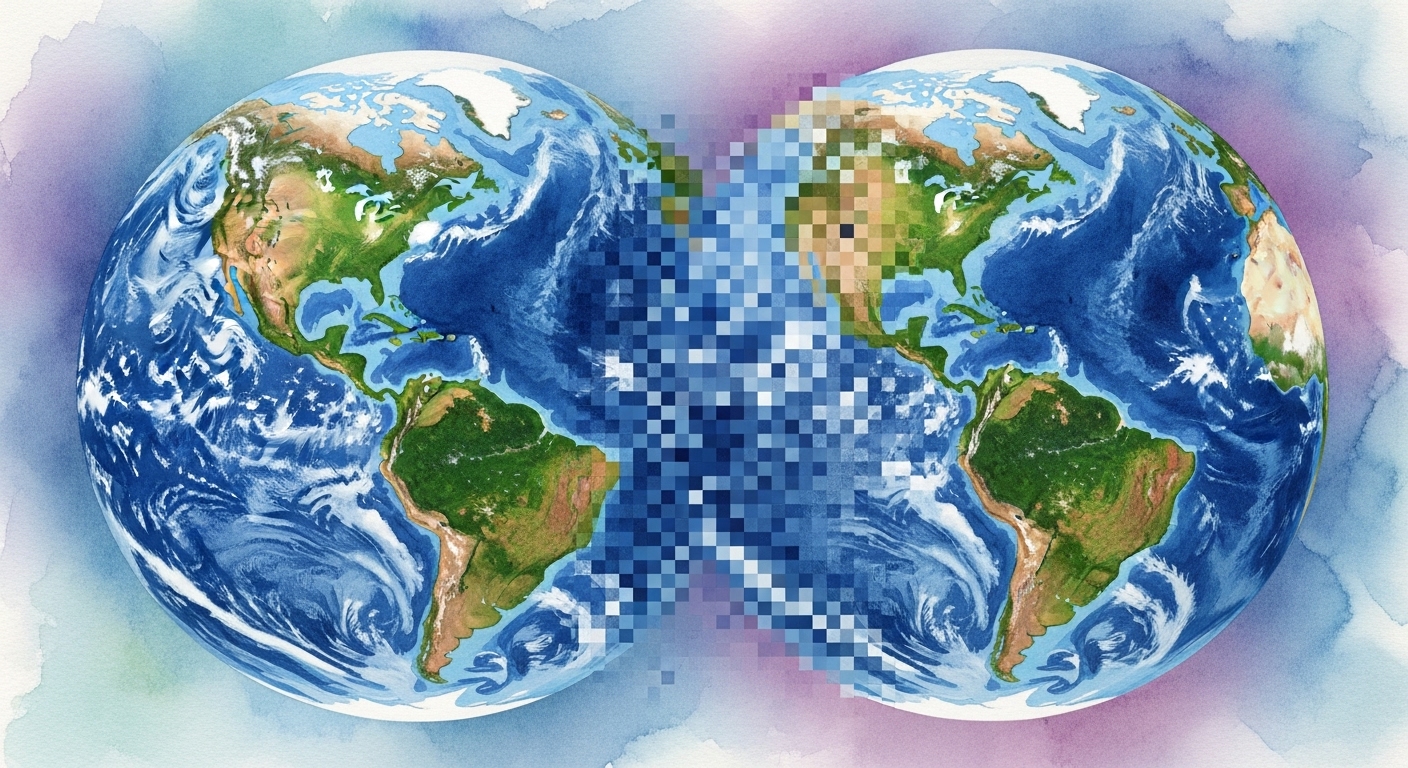

Researchers are building an artificial intelligence “world model” capable of simulating the Earth’s entire climate system to predict impacts ranging from extreme weather to the total collapse of ecosystems.
The “WOW” project, coordinated by the Karlsruhe Institute of Technology (KIT), aims to take climate modelling to a new level by linking various AI sub-models through their “latent spaces”. This approach allows for the coupling of data across vast spatial and temporal scales, creating a consistent end-to-end process chain from global changes down to highly local events like wildfires or flooding.
“AI has the potential to be a game-changing technology in modelling complex systems such as the Earth system,” said Professor Peer Nowack from KIT’s Institute of Theoretical Informatics. “AI can emulate, i.e. mimic, the behaviour of computationally expensive physics-based models. But the truly transformative step is that it can be trained or fine-tuned directly on observational data.”
Hidden connections
The team hopes to reveal hidden connections within the climate system, particularly nonlinear interactions between the atmosphere, water cycle, and land surface.
“We want to know how variations in one part of the Earth system affect others – for example, how droughts or changed cloud formation might feedback onto climate and vice versa,” said Professor Almut Arneth from the Institute of Meteorology and Climate Research. “This could help us to reveal so far hidden connections in the climate system.”
The five-year project is funded by the Carl Zeiss Foundation.