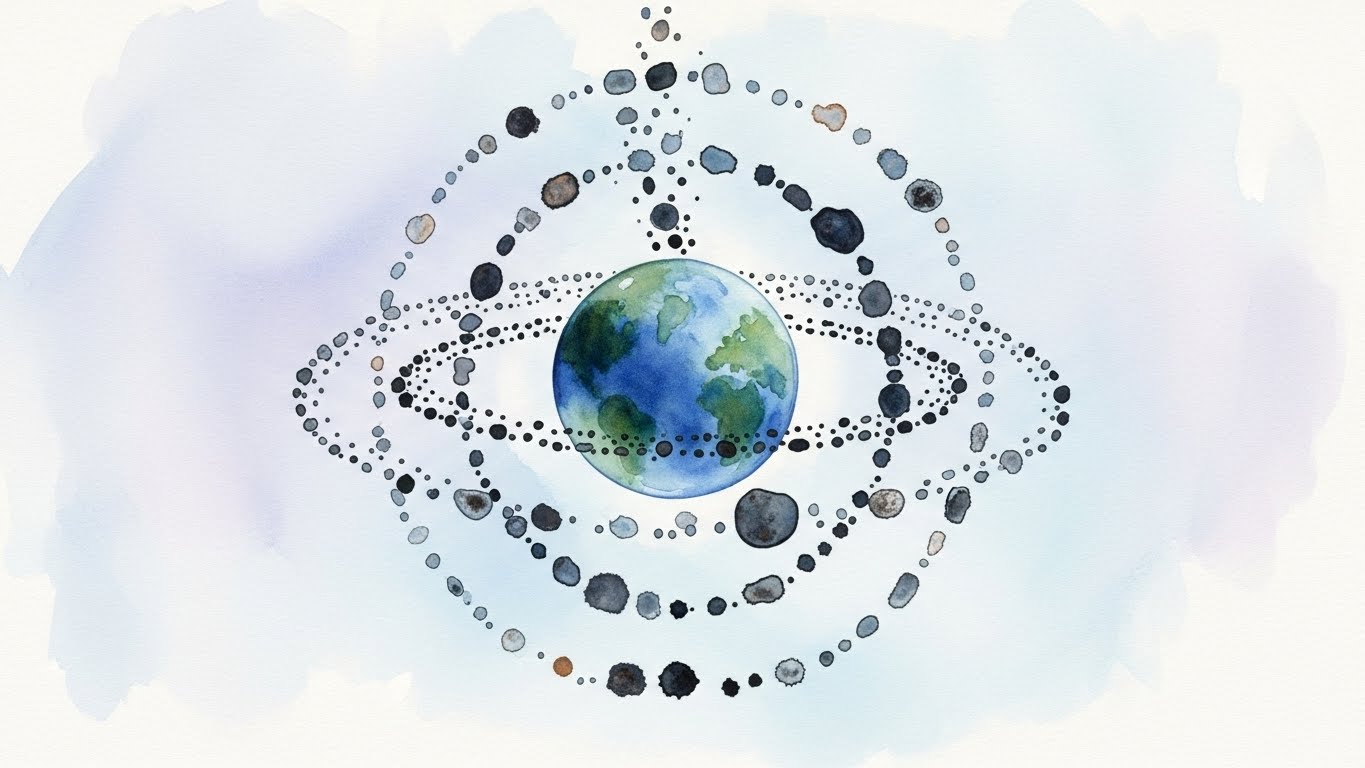

The “cosmic free-for-all” threatening Earth’s orbit with millions of high-speed projectiles requires a radical economic shift where satellite operators subsidise clean-up missions to prevent catastrophic collisions, according to new modelling.
Researchers from Stevens Institute of Technology have applied Nobel Prize-winning mathematics to the space junk crisis, determining that the only viable commercial path forward is a binding financial structure where those who benefit from clear orbits pay those who clean them.
“Even if a tiny, five-millimetre object hits a solar panel or a solar array of a satellite, it could break it,” says Hao Chen, assistant professor at Stevens Institute of Technology. “And we have over 100 million objects smaller than one centimetre in orbit.”
The cost of a clean orbit
The study, published in the Journal of Spacecraft and Rockets, analysed three technical methods for debris removal to determine commercial viability:
- Uncontrolled reentry: A service vehicle drags debris to an orbit 350 kilometres from Earth, allowing it to burn up or land randomly. This is identified as the cheapest method due to shorter travel distances.
- Controlled reentry: Debris is brought down to 50 kilometres, requiring significantly more fuel and energy to execute precise disposal.
- In-space recycling: Debris is transported to a processing centre in orbit. While transport requires fuel, reusing aluminium offers substantial savings, given the approximate $ 1,500-per-kilogram cost of launching materials from Earth.
The core challenge remains economic rather than technical. Currently, debris remediators bear all mission costs while satellite operators passively benefit from a safer environment without paying for it.
“The debris remediators pay for the missions, the technology, and the actual work. Without some kind of financial incentive, they don’t really gain anything from it — they bear all the costs while others reap the benefits,” says Chen.
Using Nash Bargaining Theory, the researchers propose a fee structure where space operators pay remediators, funded by the savings operators make by avoiding costly collision-avoidance manoeuvres.
“We will need some agency to create an incentive for the debris remediators,” says Chen. “The money should come from the people who enjoy all those benefits. Our analysis shows that there is a surplus to be generated from the remediation of orbital debris, and that surplus can be optimally shared by space operators and debris remediators.”