
Two significant breakthroughs in exoplanet research were announced this week, offering unprecedented views of a massive planet orbiting twin suns and a molten rocky world that has managed to cling to its atmosphere against the odds.
In the first discovery, astronomers at Northwestern University have directly imaged a “Tatooine-like” exoplanet orbiting a binary star system, a find described as “fit for a movie”. Meanwhile, a separate team using the James Webb Space Telescope (JWST) has detected the strongest evidence yet of a thick, volatile-rich atmosphere surrounding a “super-Earth” covered in a global magma ocean.
The newly imaged giant planet is an anomaly in the study of binary systems. It orbits its twin stars six times closer than any other previously imaged planet in a similar arrangement, providing astrophysicists with a rare test bed for theories of planet formation in complex systems.
“Of the 6,000 exoplanets that we know of, only a very small fraction of them orbit binaries,” said Jason Wang, a senior author of the study and professor at Northwestern. “Imaging both the planet and the binary is interesting because it’s the only type of planetary system where we can trace both the orbit of the binary star and the planet in the sky at the same time.”
“Photobombing” star
The discovery was made by re-analysing archival data from the Gemini Planet Imager (GPI) collected between 2016 and 2019. Lead author Nathalie Jones noticed a faint object moving in tandem with the star — rather than being a background “photobombing” star — and later confirmed it was a planet six times the size of Jupiter.
Located 446 light-years away, the planet formed approximately 13 million years ago — roughly 50 million years after the dinosaurs went extinct on Earth.
“That’s relatively young in universe speak, so it still retains some of the heat from when it formed,” said Wang.
The celestial mechanics of the system are extreme: the central binary stars complete a revolution around each other every 18 days, whilst the massive planet takes 300 years to orbit the pair.
Melting rocks
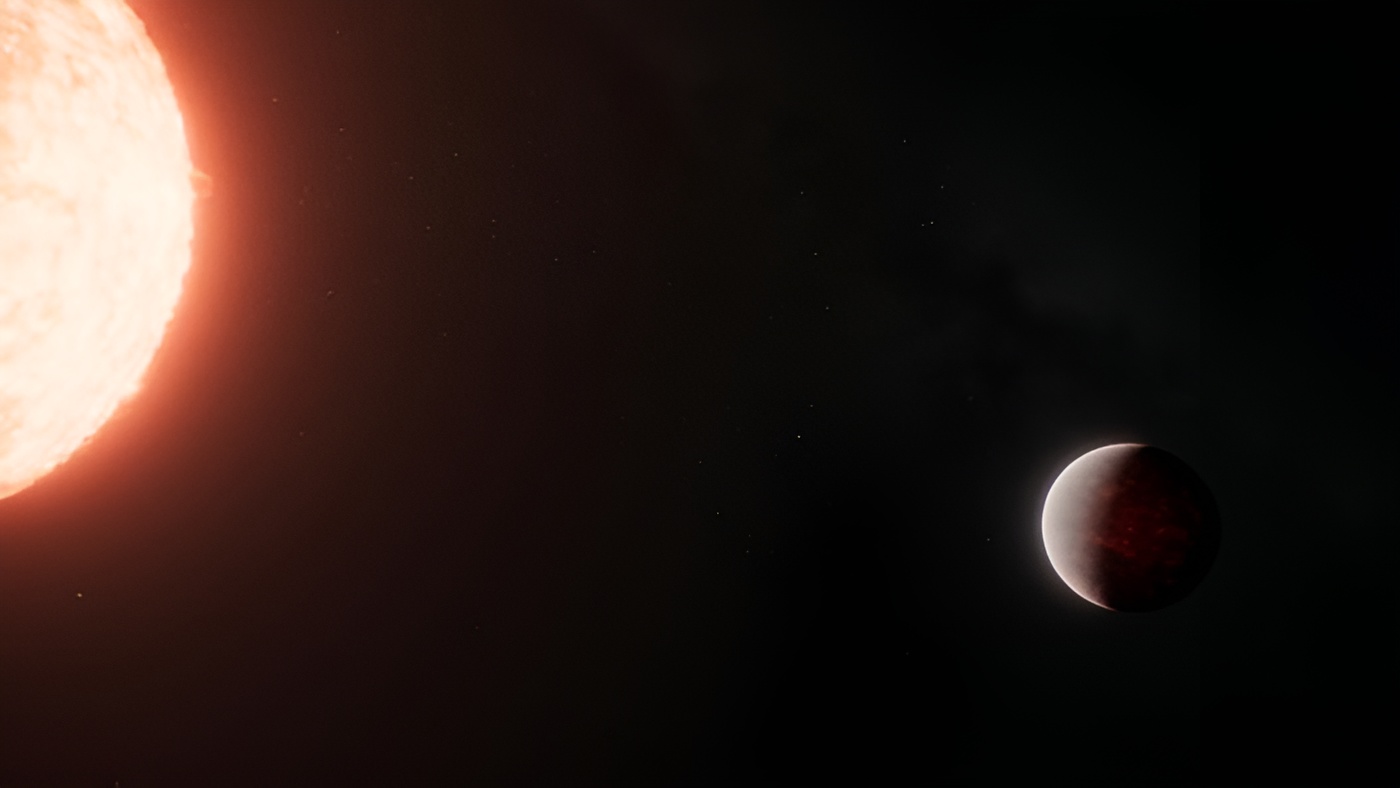
In a separate study published in The Astrophysical Journal Letters, researchers confirmed the existence of an atmosphere on TOI-561 b, an ultra-hot rocky planet orbiting an old, iron-poor star.
With a radius 1.4 times that of Earth and an orbital period of less than 11 hours, TOI-561 b falls into the rare class of “ultra-short period” exoplanets. It orbits less than one million miles from its star — one-fortieth the distance between Mercury and the Sun — resulting in surface temperatures that far exceed the melting point of rock.
Conventional wisdom suggests that such a small planet exposed to intense radiation should be a bare rock, stripped of any atmosphere. However, observations from the James Webb Space Telescope’s Near-Infrared Spectrograph (NIRSpec) showed the planet’s dayside temperature was roughly 1,800 degrees Celsius (3,200 degrees Fahrenheit) — drastically cooler than the expected 2,700 degrees Celsius (4,900 degrees Fahrenheit) for a world without an atmosphere.
“We really need a thick volatile-rich atmosphere to explain all the observations,” said co-author Dr Anjali Piette from the University of Birmingham. “Strong winds would cool the dayside by transporting heat over to the nightside.”
The researchers describe the planet as maintaining a precarious equilibrium, where gases escaping the interior feed an atmosphere that is simultaneously being sucked back into the magma ocean.
“This planet must be much, much more volatile-rich than Earth to explain the observations,” said co-author Tim Lichtenberg from the University of Groningen. “It’s really like a wet lava ball.”