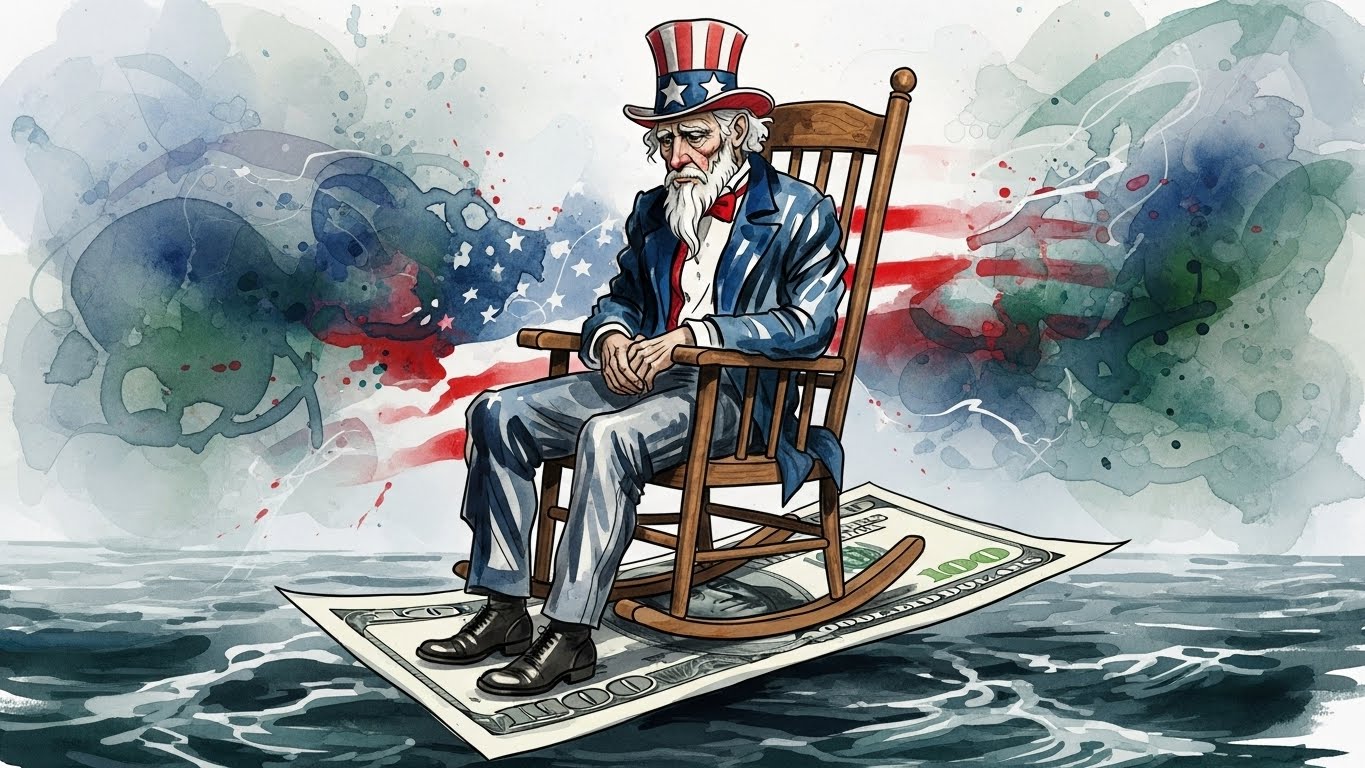

The United States has been living beyond its means for decades, but a new study from the University of Texas at Austin warns that the country’s ability to run up massive debts hangs on a single, fragile thread: the global dominance of the dollar.
According to the Congressional Budget Office, US national debt has nearly tripled over the past 25 years to reach 98 per cent of gross domestic product (GDP). By 2054, that figure is projected to hit 166 per cent.
Until now, the government has funded this spree because global investors are still willing to buy its IOUs — the US Treasury auctioned off $28 trillion in securities last year alone.
However, Mindy Xiaolan, an associate professor of finance at Texas McCombs, argues that this “exorbitant privilege” is not guaranteed to last, and the fallout could be severe if the dollar ever loses its crown.
The ‘Trillion-Dollar Question’
Xiaolan’s research, conducted with colleagues from Peking, Northwestern, Stanford, and Columbia universities, treats the federal balance sheet as a private corporation to assess whether it can pay its bills.
The results are stark: since World War II, the US government’s cash flows have only been sufficient to cover 32 per cent of its outstanding national debt. The gap is currently filled by the premium that investors pay for the dollar’s safety.
“When a country’s fiscal fundamentals deteriorate, and their currency loses its privileged status, its government’s borrowing capacity may become limited,” Xiaolan said. “The market value of its debt will be lower, and the bondholders will suffer losses”.
Whether this will happen to the US is what Xiaolan calls “a trillion-dollar question”.
Lessons from history
To predict the future, the researchers looked to the past, analysing two other superpowers that once boasted the world’s No. 1 currency: the Dutch Republic (17th–18th century) and the United Kingdom (19th century–WWII).
“The key common feature of those nations is that they were all the leading economy during their specific time frames,” Xiaolan explained.
As in the US today, both nations borrowed heavily to finance their global ambitions. Investors viewed their bonds as the world’s safest assets, paying a premium of one per cent to 1.5 per cent over other countries. This allowed debt to skyrocket — exceeding 200 per cent of GDP for the Dutch during the age of Napoleon, and topping 130 per cent for the British at the end of WWII.
When their currencies finally fell from dominance, the reckoning was severe:
- Dutch bondholders lost 70 per cent of their value as bonds traded far below face value.
- UK bondholders saw a 61 per cent drop in value.
- Both nations were forced to stop borrowing and run budget surpluses to survive, with Holland averaging surpluses of 3.3 per cent of GDP and the UK averaging 1.8 per cent.
While the US dollar currently faces no strong competition – with rivals such as the euro and the yuan experiencing their own economic woes — Xiaolan sees warning signs that investors might be losing patience.
The market value of US government debt, which reflects what investors are willing to pay for it, has already dropped more than 15 per cent since its high in 2020.
If the dollar falters, the US could be forced to impose severe austerity measures to run a surplus, something it hasn’t done since 2000.
“It may become more difficult to expand the balance sheet if we lose the privilege to borrow at a relatively low cost,” Xiaolan said.
She noted that while this might reduce reliance on deficit financing, it would come at the heavy price of losing the ability to stimulate the economy with short-term deficits.
“I think our message is that maybe we should be a little bit cautious as a country,” Xiaolan concluded. “We may not permanently enjoy this privileged status”.