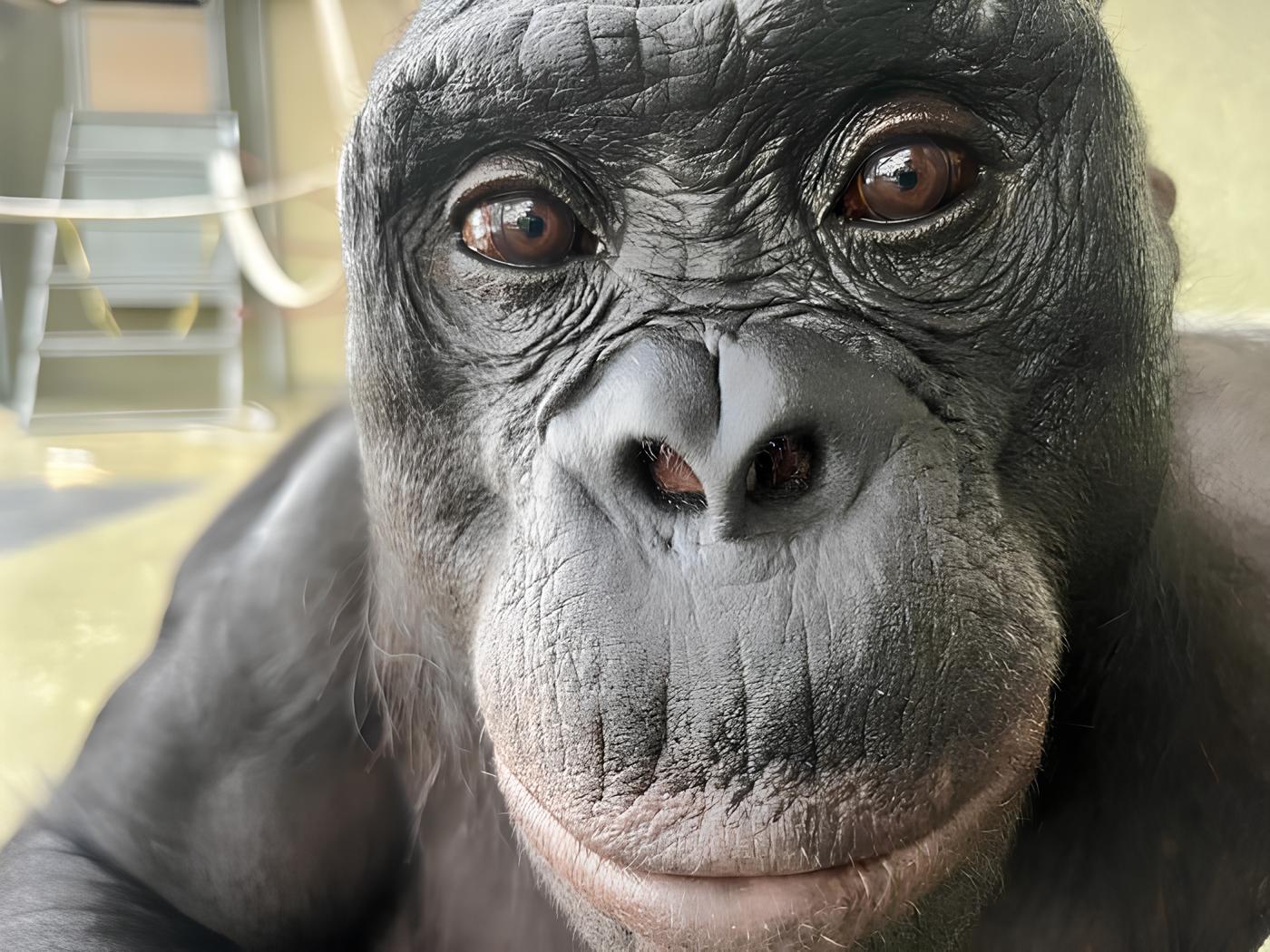

A 43-year-old great ape named Kanzi has shattered the long-held belief that humans are the only creatures capable of playing pretend, engaging in “tea party” games that suggest imagination is millions of years older than previously thought.
In a landmark set of experiments published in the journal Science, researchers from Johns Hopkins University demonstrated that apes can mentally simulate invisible objects and scenarios.
“It really is game-changing that their mental lives go beyond the here and now,” says Christopher Krupenye, a co-author and assistant professor at Johns Hopkins. “Imagination has long been seen as a critical element of what it is to be human but the idea that it may not be exclusive to our species is really transformative.”
Invisible juice and phantom grapes
To test the theory, the research team set up a controlled environment similar to a child’s tea party for Kanzi, an “enculturated” bonobo who understands verbal prompts.
In one test, an experimenter stood before two empty transparent cups. They tipped an empty pitcher to “pour” imaginary juice into one cup, then acted out “dumping” the juice from the other cup. When asked, “Where’s the juice?” Kanzi consistently pointed to the cup that was theoretically full.
“Kanzi is able to generate an idea of this pretend object and at the same time know it’s not real,” explains co-author Amalia Bastos, now a lecturer at the University of St Andrews.
In a conceptual replication, Kanzi also successfully tracked the location of “pretend grapes” placed into jars, identifying the correct location in nearly 69 per cent of unreinforced trials.
Not just confusion
Sceptics have long argued that anecdotal reports of animals pretending — such as chimpanzees cuddling sticks like babies — might simply be confusion or learned motor patterns.
The researchers ruled this out with a specific control test. When presented with a cup of pretend juice alongside a cup of real juice, Kanzi overwhelmingly chose the real liquid. This confirmed he was not deluded; he understood the game but preferred the actual reward when available.
The findings imply that the cognitive machinery required for imagination — known as “secondary representation” — likely evolved in the common ancestor of humans and apes some six to nine million years ago.
“If some roots of imagination are shared with apes, that should make people question their assumption that other animals are just living robotic lifestyles constrained to the present,” says Krupenye.



