
Researchers have developed a modular origami robot that reduces the probability of failure by sharing power and sensing resources among its individual units, reversing the traditional trend in robotics, where increasing complexity leads to higher failure rates.
Led by Jamie Paik, head of the Reconfigurable Robotics Laboratory (RRL) in EPFL’s School of Engineering, the team introduced local resource sharing as a new paradigm in robotics.
The methodology, published in Science Robotics, allows modular systems to maintain functionality even when individual components suffer catastrophic breakdowns.
Biological inspiration
The RRL team drew inspiration from collective survival strategies in nature, such as birds sharing sensing data through flocking or trees communicating threats via airborne signals. While traditional modular robots are often vulnerable to single-point failures, this new framework uses “hyper-redundancy” to distribute critical resources across all modules without changing the robot’s physical structure.
“For the first time, we have found a way to reverse the trend of increasing odds of failure with increasing function,” Paik explains. The researchers discovered that sharing only one or two resources was insufficient; however, when all critical power, communication, and sensing resources were shared, reliability improved as the number of modules increased.
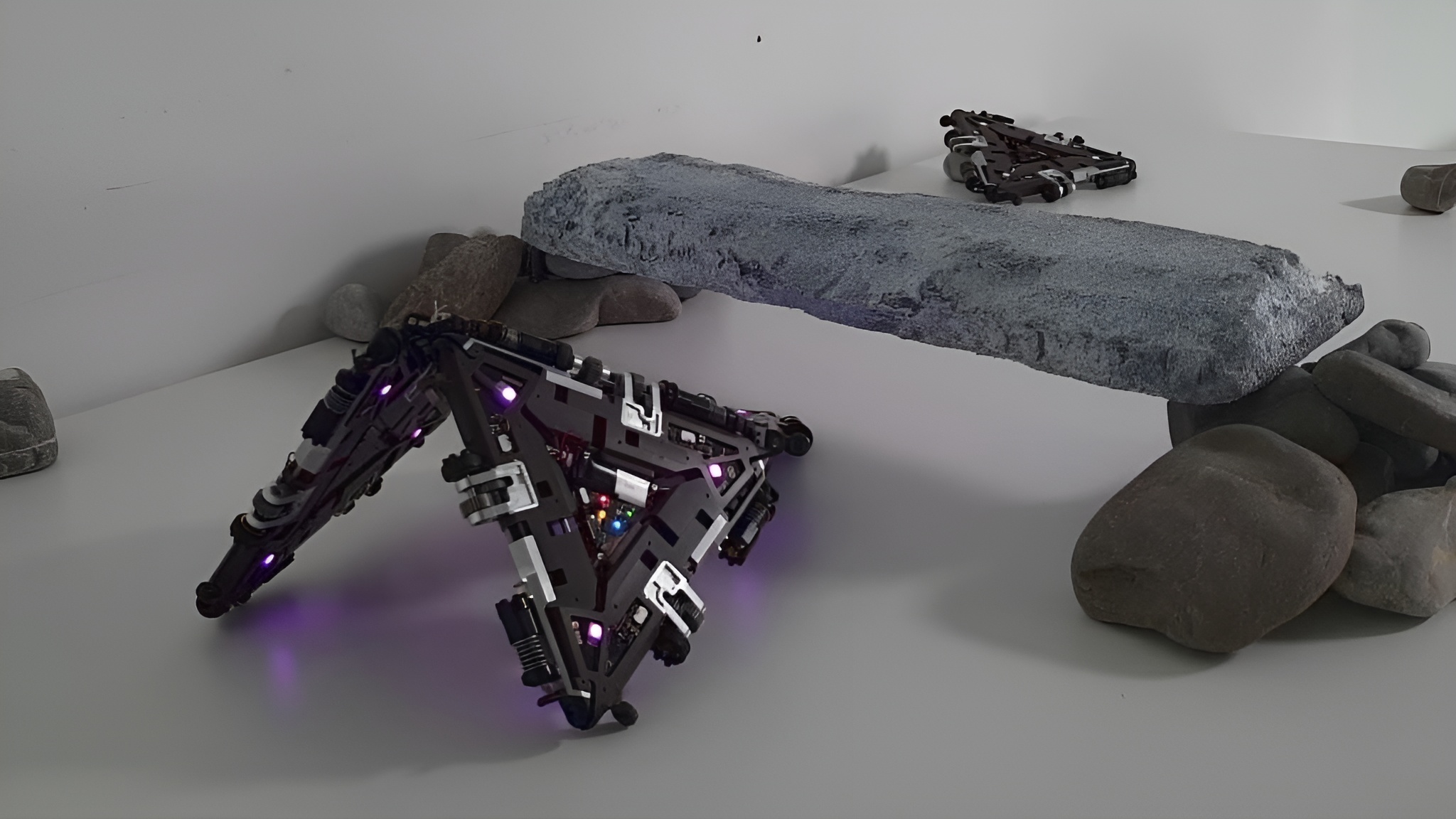
The team tested their methodology using the Mori3 robot, a system composed of four triangular modules. During locomotion experiments, the researchers cut the battery power, wireless communication, and sensing of the central module. Despite being effectively “dead,” the module was supported by its neighbours, allowing the collective robot to successfully navigate complex terrain and pass under a barrier.
“Essentially, our methodology allowed us to ‘revive’ a dead module in a collective and bring it back to full functionality,” says RRL researcher and first author Kevin Holdcroft. The framework aims to resolve the long-standing conflict between reliability and adaptability in autonomous systems.
Future applications of the research may include robotic swarms in which members dock with one another to transfer energy and information. The researchers suggest that the framework could support highly adaptive robots that operate with unprecedented reliability in unpredictable environments.