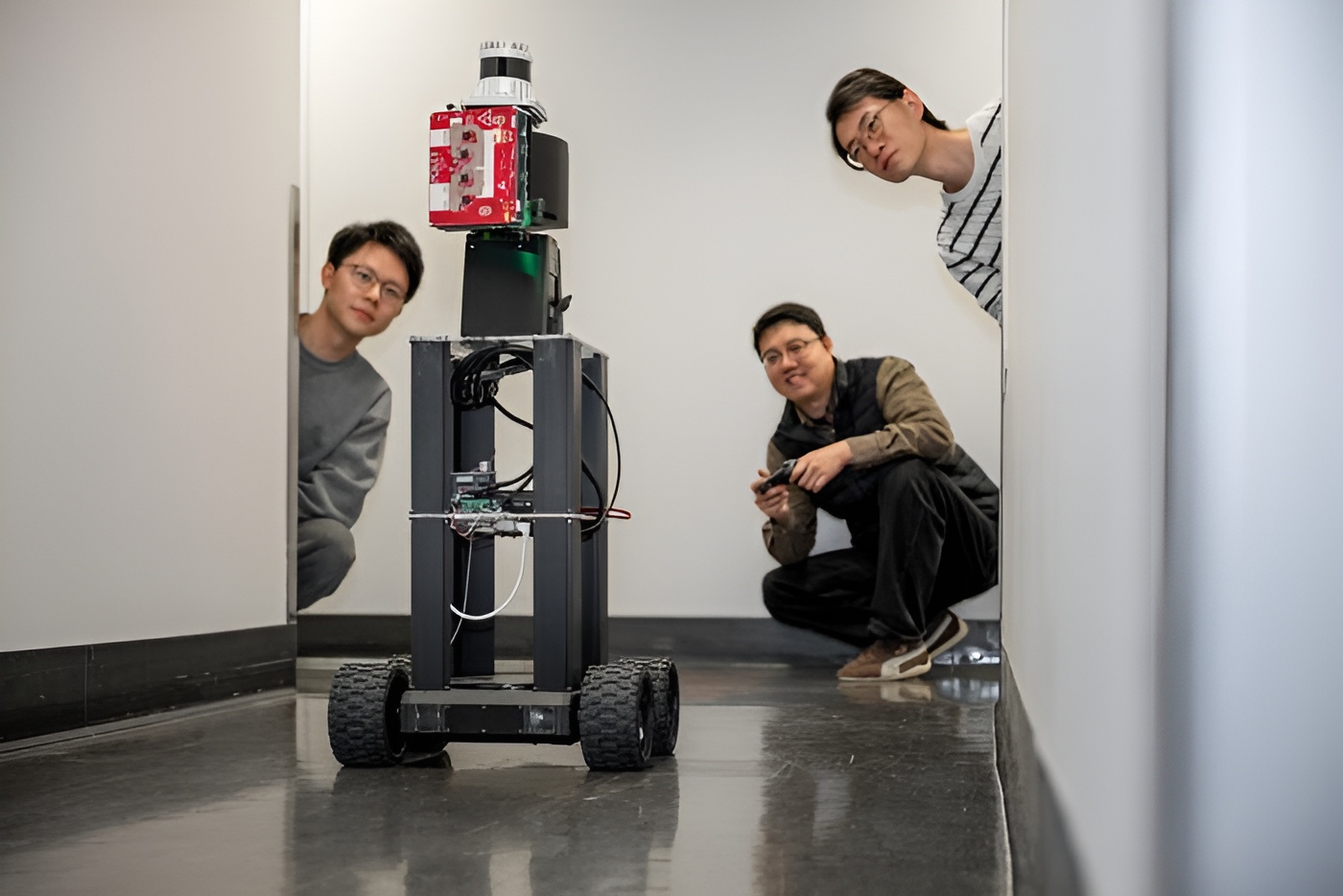
Robots could soon possess a form of “superhuman” vision that allows them to see around corners, thanks to a new system that uses artificial intelligence to interpret radio waves.
Developed by researchers at the University of Pennsylvania, the “HoloRadar” system can reconstruct three-dimensional scenes that are completely blocked from a robot’s direct line of sight.
This capability could drastically improve safety for self-driving cars approaching blind intersections or robots navigating cluttered warehouses, allowing them to detect pedestrians or obstacles before they become visible.
“Robots and autonomous vehicles need to see beyond what’s directly in front of them,” says Mingmin Zhao, an Assistant Professor in Computer and Information Science and senior author of the study. “This capability is essential to help robots and autonomous vehicles make safer decisions in real time.”
Turning walls into mirrors
The system works on a counterintuitive principle: while radio signals have long wavelengths that usually limit resolution, this trait makes them perfect for peering around corners.
Because radio waves are much larger than the tiny imperfections on a typical wall, they treat flat surfaces like floors and ceilings as smooth mirrors. HoloRadar bounces signals off these surfaces to carry information about hidden spaces back to the robot’s sensors.
“It’s similar to how human drivers sometimes rely on mirrors stationed at blind intersections,” explains Haowen Lai, a doctoral student and co-author of the paper. “Because HoloRadar uses radio waves, the environment itself becomes full of mirrors, without actually having to change the environment.”
Untangling the signal
While the concept is simple, the physics are messy. A single radio pulse can bounce multiple times, creating a tangled web of reflections that would confuse traditional sensors — much like trying to navigate a hall of mirrors.
To solve this, the team developed a custom AI that combines machine learning with physics-based modelling. The AI traces the reflections backwards to undo the “mirror” effects and reconstruct the actual position of hidden objects, such as a person walking down an adjacent hallway.
Unlike previous attempts to see around corners using visible light or shadows, HoloRadar works reliably in total darkness and does not require bulky, slow-scanning equipment, making it practical for real-world mobile robots.



