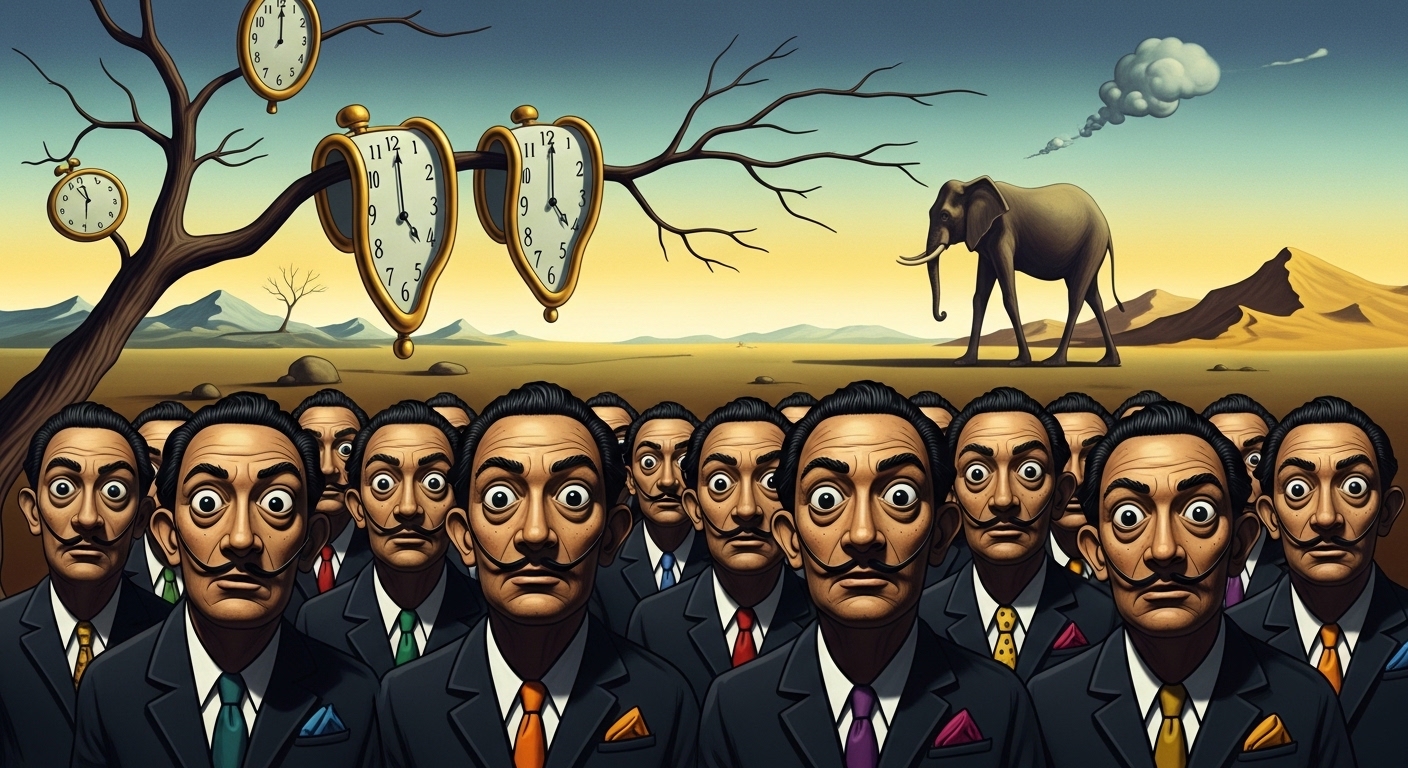

If you think asking a chatbot to brainstorm your next big project guarantees a unique, out-of-the-box idea, prepare for a rude awakening. While millions of us treat artificial intelligence as the ultimate digital muse, new research reveals these algorithms are actually trapping human imagination inside a highly predictable, homogenised box.
According to a major new study from Duke University, the creative outputs of commercial large language models (LLMs) are shockingly unoriginal, producing results that are significantly more identical to one another than human ideas.
Published in the journal PNAS Nexus, the research shatters the widely held illusion that bouncing ideas off different AI chatbots will yield unique, diverse perspectives.
The illusion of original thought
To test the true limits of machine imagination, researchers challenged 22 different commercial LLMs and over 100 human participants with three standard psychological tests designed to assess divergent thinking.
The assessments included the Alternative Uses Test (inventing new uses for everyday objects), the Divergent Association Task (generating 10 entirely unrelated words), and the Forward Flow test (a continuous word association chain).
Emily Wenger, an assistant professor of electrical and computer engineering at Duke who led the study alongside cognitive neuroscientist Yoed Kenett, explained that while an individual AI might outperform a single person, the AI population as a whole lacks true diversity.
“People might wonder if different LLMs will take them in different directions with the same prompts for creative projects,” Wenger said. “This paper basically says no. LLMs are less creative as a population than humans.”
Because commercial LLMs are ultimately all trained on the same dataset — the entirety of the internet — their responses are inherently limited. Even when the researchers actively tweaked the AI prompts to encourage maximum creativity, the algorithms’ answers remained strikingly similar to one another. Meanwhile, the human responses remained vastly diverse and highly original.
A threat to human variability
Professor Kenett, an associate professor at the Technion – Israel Institute of Technology, warned that true human creativity depends heavily on variability, a trait that modern AI fundamentally lacks.
Kenett said: “The problem, as we and others are increasingly showing, is that while LLMs appear to generate extremely original outputs, they are overly homogenised and not variable in their responses. This could have detrimental long-term impact on human creative thinking and thus must be addressed.”
With more than half of all Americans already reporting the use of AI to brainstorm, write, or code, the researchers warn that this overreliance will eventually smooth the world’s work into a single, predictable set of concepts and grammar.
Wenger concluded: “If you’re trying to come up with an original concept or product to stand out from the crowd, this work highly suggests you should bring together a diverse group of people to brainstorm rather than relying on AI.”