
A high-stakes medical video game could replace costly recertification courses after a study proved it fundamentally improved how emergency physicians treat severely injured patients.
According to the study published in JAMA, doctors who played a specially designed triage video game significantly outperformed their peers who only received standard continuing medical education.
The game, developed by a team of surgeon-scientists at the University of Pittsburgh and UPMC, was specifically built to tackle a major, deadly flaw in emergency rooms: the chronic under-triaging of older adults.
Hidden danger of “mental shortcuts”
When a trauma patient arrives at an emergency department, doctors must make split-second decisions regarding the right level of care. They must immediately determine whether to discharge the patient or transfer them by medical helicopter to a specialised trauma centre.
Because these decisions are made under extreme pressure, doctors rely heavily on ingrained decision-making behaviours known as “heuristics,” or mental shortcuts. Unfortunately, these shortcuts are notoriously hard to change and often lead to older patients being critically misdiagnosed.
Lead author Deepika Mohan, an associate professor of surgery and critical care medicine at Pitt’s School of Medicine, explained that older adults are under-triaged as much as 70 per cent of the time.
“An increasing proportion of seriously injured patients are older than 65 and, unfortunately, when they come into the emergency department, they are under-triaged because their injuries are more insidious,” Dr Mohan said. “People may not think a rib fracture is a big deal. But if an older person falls and suffers four rib fractures, their risk of dying is the same as a young person shot in the liver.”
Training the subconscious
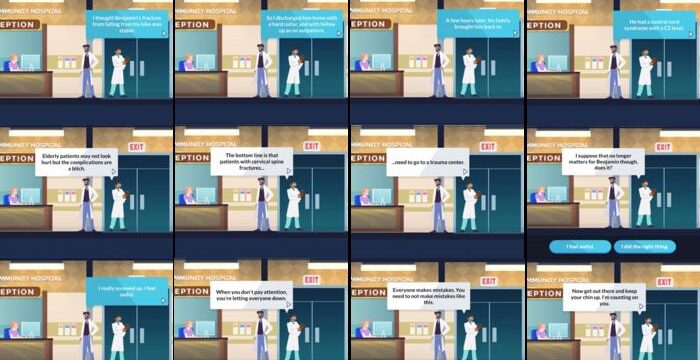
To combat these fatal mental shortcuts, Dr Mohan partnered with Carnegie Mellon University decision scientist Baruch Fischhoff and Pittsburgh-based developer Schell Games to create Night Shift in 2016.
The game places the player in the shoes of a young emergency physician who must triage trauma patients in a high-stakes, highly emotional setting. Players are required to solve medical puzzles in under 90 seconds using only limited clinical information, and their decisions garner immediate, reinforcing praise or harsh admonishment.
The game is specifically designed to let physicians subconsciously learn from their rapid-fire decisions without putting real patients at risk.
To test the game’s efficacy, researchers tracked 800 emergency department physicians at non-trauma centres across the US over a one-year period starting in 2024. Half the doctors were told to play the game for two hours, followed by 20-minute quarterly sessions, while the other half only attended standard continuing education courses.
The results were stark. The physicians who played the video game had a significantly lower rate of under-triaging severely injured older patients (49 per cent) than those who did not (57 per cent).
Crucially, playing the game did not simply make doctors more likely to transfer everyone; both groups over-triaged patients at the exact same rate. This proves the game actively improved the doctors’ diagnostic abilities, successfully rewiring their flawed mental heuristics.
Determining the right “dose”
While the game proved highly effective, researchers noted that the doctors’ adherence to trauma triage guidelines peaked within 30 days of playing, with the positive effects fading until their next scheduled gaming session.
Dr Mohan believes the key to permanent behavioural change will be determining the correct gaming schedule.
“Quarterly exposure for 20 minutes may not be the best ‘dose’,” she said. “Perhaps playing the game more frequently and for less time would be better – maybe even a ‘microdose’ of 90 seconds each week.”
The team is currently preparing to test this new hypothesis, with the ultimate goal of rolling out a multi-component behavioural intervention across the entire spectrum of trauma care.



