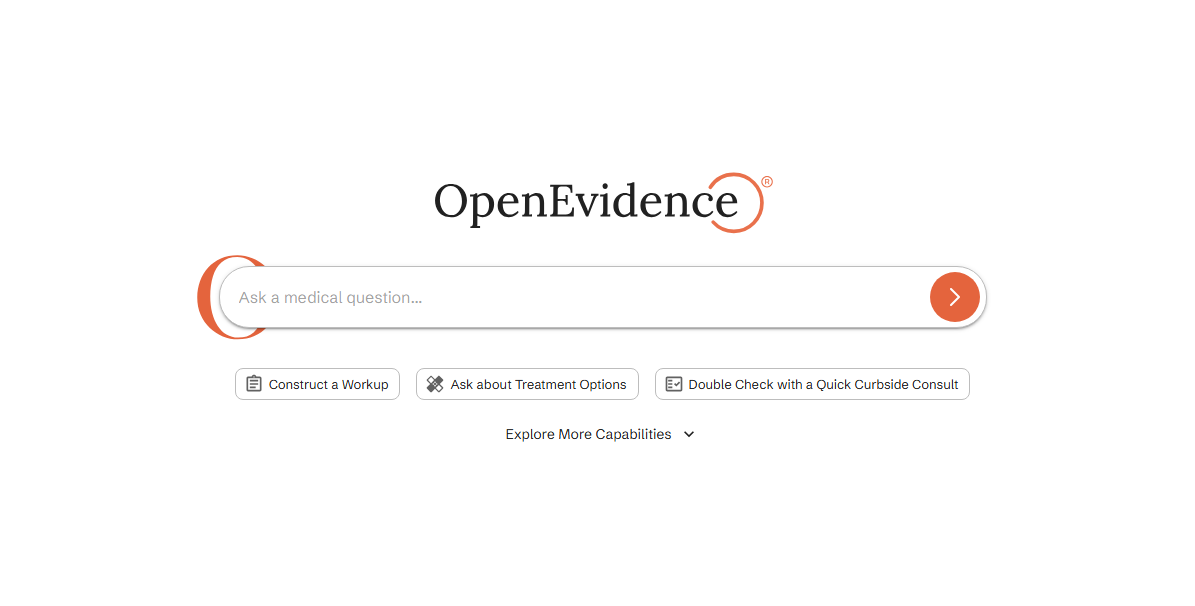

OpenEvidence, a medical AI chatbot serving more than 40 per cent of US physicians, has raised $200 million at a $6 billion valuation as the three-year-old startup’s user base continues to expand rapidly.
The Miami-based company now supports approximately 15 million clinical consultations per month, up from 8.5 million monthly consultations in July, reports the New York Times. The platform has become the most widely used medical search engine among US clinicians, operating across more than 10,000 hospitals and medical centres.
Google Ventures led the funding round, with participation from Sequoia Capital, Kleiner Perkins, Blackstone, Thrive Capital, Coatue Management, BOND and Craft. The investment follows a $210 million round in July at a $3.5 billion valuation, bringing total funding to approximately half a billion dollars.
Daniel Nadler, CEO and co-founder of OpenEvidence, said the platform has become essential infrastructure for medical knowledge dissemination. “OpenEvidence has become an accelerator for the dissemination of medical knowledge, with more than 40% of U.S. physicians actively using its point-of-care clinical decision support AI,” he said. “By bridging the gap between peer-reviewed evidence and on-the-ground medical practice, OpenEvidence is streamlining and quickening the translation of medical research from bench to bedside.”
The company was founded in 2022 by Nadler, who previously sold an AI startup to S&P Global for $550 million, and Zachary Ziegler. The chatbot is trained on medical journals including JAMA and the New England Journal of Medicine to help medical professionals quickly draw on existing medical knowledge to treat patients.
Sangeen Zeb, partner at Google Ventures, said the funding round came together rapidly after a presentation with Google drew attention from advertising buyers. “It’s reaching verb-like status,” he said. The firm raised the idea of a new funding round with Nadler on a Thursday, ironed out details by Sunday and signed documents days later.
Rapid expansion of free-to-use model
OpenEvidence operates on a free-to-use model for verified medical professionals, supported by advertising revenue. Nadler said this setup, rather than charging individual health systems, has enabled rapid expansion. The company is halfway to hitting $100 million in advertising revenue expected next year, having started commercialising its application approximately 90 days ago.
The platform is adding between 60,000 and 70,000 users monthly and has collected more than 100 million clinical consultations, providing valuable training data for its models. “No one else in the world has that data,” Nadler said.
On 16 October, the company announced a long-term partnership with Veeva Systems to create Open Vista, which will use AI to increase patient access to clinical trials, accelerate drug discovery by better understanding unmet needs, and improve the understanding and adoption of existing approved medicines. First Open Vista product offerings are expected in 2026.
Peter Gassner, CEO of Veeva, said the partnership enables new capabilities for life sciences. “We are very excited about our long-term partnership with OpenEvidence as we enter the AI chapter in life sciences,” he said. “Combining the strengths of Veeva and OpenEvidence, we can use AI to bridge life sciences companies, making life-saving medicines, patients, and the physicians who treat them.”
OpenEvidence launched from the Mayo Clinic Platform Accelerate programme and was cited by Jensen Huang, chief executive of Nvidia, as an AI startup worth watching. The company aims to address information overload in medicine, where the amount of medical research published annually doubles every five years.