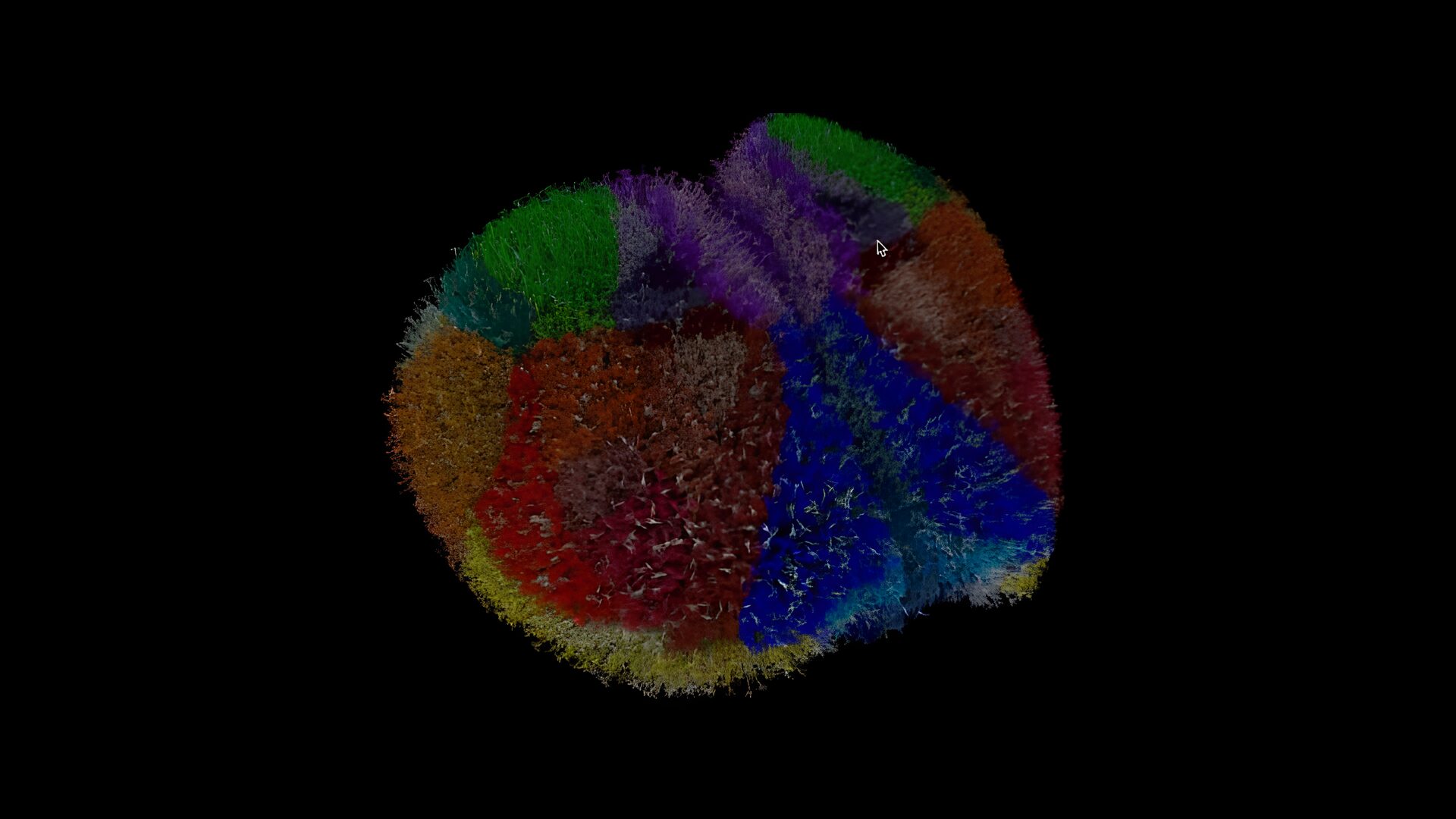
Japanese researchers have created one of the most extensive and most detailed brain simulations ever made: a virtual mouse cortex with nearly 10 million neurons and 26 billion synapses, running on one of the world’s fastest supercomputers.
The achievement enables scientists to conduct “virtual experiments” on diseases such as Alzheimer’s or epilepsy, observing in detail how damage spreads through neural networks in a digital environment.
The simulation, which models 86 interconnected brain regions, is a collaboration between scientists at the Allen Institute and researchers in Japan, including Dr Tadashi Yamazaki from the University of Electro-Communications. The project was run on Japan’s Supercomputer Fugaku, a machine capable of processing quadrillions of calculations per second.
This virtual model allows scientists to test hypotheses about brain disorders, cognition, or how seizures spread, in ways previously only possible using real brain tissue, one experiment at a time.
“This shows the door is open. We can run these kinds of brain simulations effectively with enough computing power,” said Dr Anton Arkhipov, an investigator at the Allen Institute who worked on the project. “It’s a technical milestone giving us confidence that much larger models are not only possible, but achievable with precision and scale.”
Bringing data to life
The Allen Institute provided the blueprint for the virtual brain using real data from the Allen Cell Types Database and the Allen Connectivity Atlas. The Fugaku supercomputer, jointly developed by RIKEN and Fujitsu, then brought the data to life.
The team used the Allen Institute’s Brain Modelling ToolKit to translate the data and a neuron simulator called Neulite to turn equations into neurons that “spike, signal, and chatter just like their living counterparts”. The simulation captures the brain’s behaviour down to the activation of individual synapses and the flow of electrical signals.
“Our long-term goal is to build whole-brain models, eventually even human models, using all the biological details our Institute is uncovering,” said Arkhipov. “We’re now moving from modelling single brain areas to simulating the entire brain of the mouse.”



