

Researchers at Sungkyunkwan University in South Korea have developed a platform that can identify cerebrospinal fluid (CSF) leaks with 90.8 per cent accuracy, potentially preventing serious infections such as meningitis.
CSF is a clear liquid that cushions the brain and spinal cord. However, head trauma or surgery can sometimes cause it to leak through the nose. Because it looks exactly like ordinary nasal mucus, patients often mistake it for a cold or allergies and delay seeking treatment.
Molecular fingerprints
The new system solves this problem using Raman spectroscopy, a technique that identifies substances by their molecular “fingerprints” using light.
The team, led by Professor Jinsung Park, created a sensor using nanoscale gold and silver pillars. These tiny structures amplify the weak signals of biomolecules in liquid samples by tens of thousands of times.
“This Au@Ag bimetallic nanopillar substrate… enables sensitive and reproducible detection of clinical specimens,” the researchers wrote in the Journal of Materials Science & Technology.
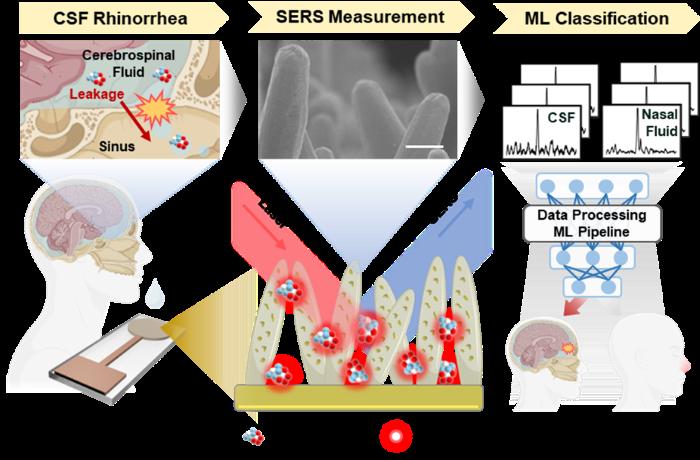
Because the spectral patterns of CSF and nasal secretions are so similar, the team used artificial intelligence to distinguish between them.
They trained machine learning algorithms to analyse the light signals, achieving a 90.8 per cent accuracy rate when tested on patient samples from Samsung Medical Center.
The team developed a specialised algorithm that enables the system to operate on both high-end hospital equipment and compact, portable devices. This means doctors in emergency rooms or small clinics could potentially diagnose a brain fluid leak in about one minute.



