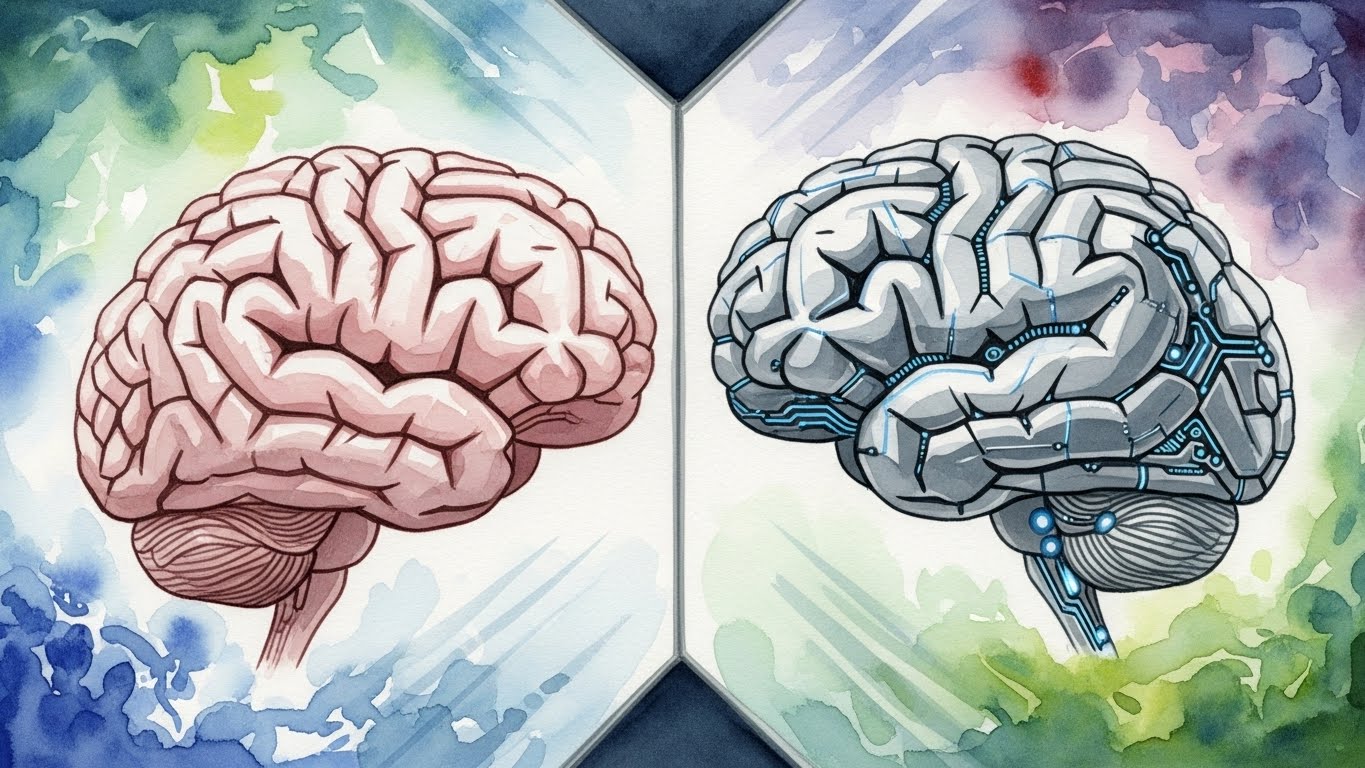

Artificial intelligence is transforming how scientists model the brain by creating “surrogate brains” capable of learning, predicting and interpreting complex neural dynamics directly from data.
A new review by researchers from Southern University of Science and Technology, Huazhong University of Science and Technology and Beijing Institute of Technology presents a unified framework for these next-generation models.
Traditional brain models rely heavily on fixed-form biophysical equations and population-averaged parameters. While mechanistically interpretable, these models often struggle to capture the nonlinear, high-dimensional and context-dependent activity of real neural systems.
In contrast, modern AI — including recurrent neural networks, neural ordinary differential equations, graph-based architectures and transformer models — can learn rich temporal and spatial patterns from large-scale neural recordings.
Virtual experiments
The researchers propose a surrogate brain framework that integrates three interconnected components: constructing neural dynamical models, solving the inverse problem to infer parameters and evaluating predictive performance.
The authors highlight that surrogate brains enable multiple applications, including predicting future whole-brain activity, performing dynamical systems analysis and conducting virtual perturbation experiments. These capabilities make the models valuable tools for guiding neurostimulation strategies in both basic neuroscience and translational neuroengineering.
A significant challenge in such modelling is the “ill-posed” nature of inverse problems, including issues of existence, uniqueness and stability of solutions.
The review details mathematical and neuroscience-informed regularisation techniques — such as sparsity constraints, anatomical priors and physical-law constraints — to ensure solutions remain reliable even in the presence of noise and limited data.
The researchers envision that these systems will play an increasingly central role in future neuroscience, serving as personalised computational counterparts of the human brain to support individualised diagnostics.
“This framework provides a systematic bridge between theoretical neuroscience and clinical applications,” the authors conclude. “AI-based surrogate brains offer a powerful path toward individualised, interpretable, and predictive models of brain function.”



