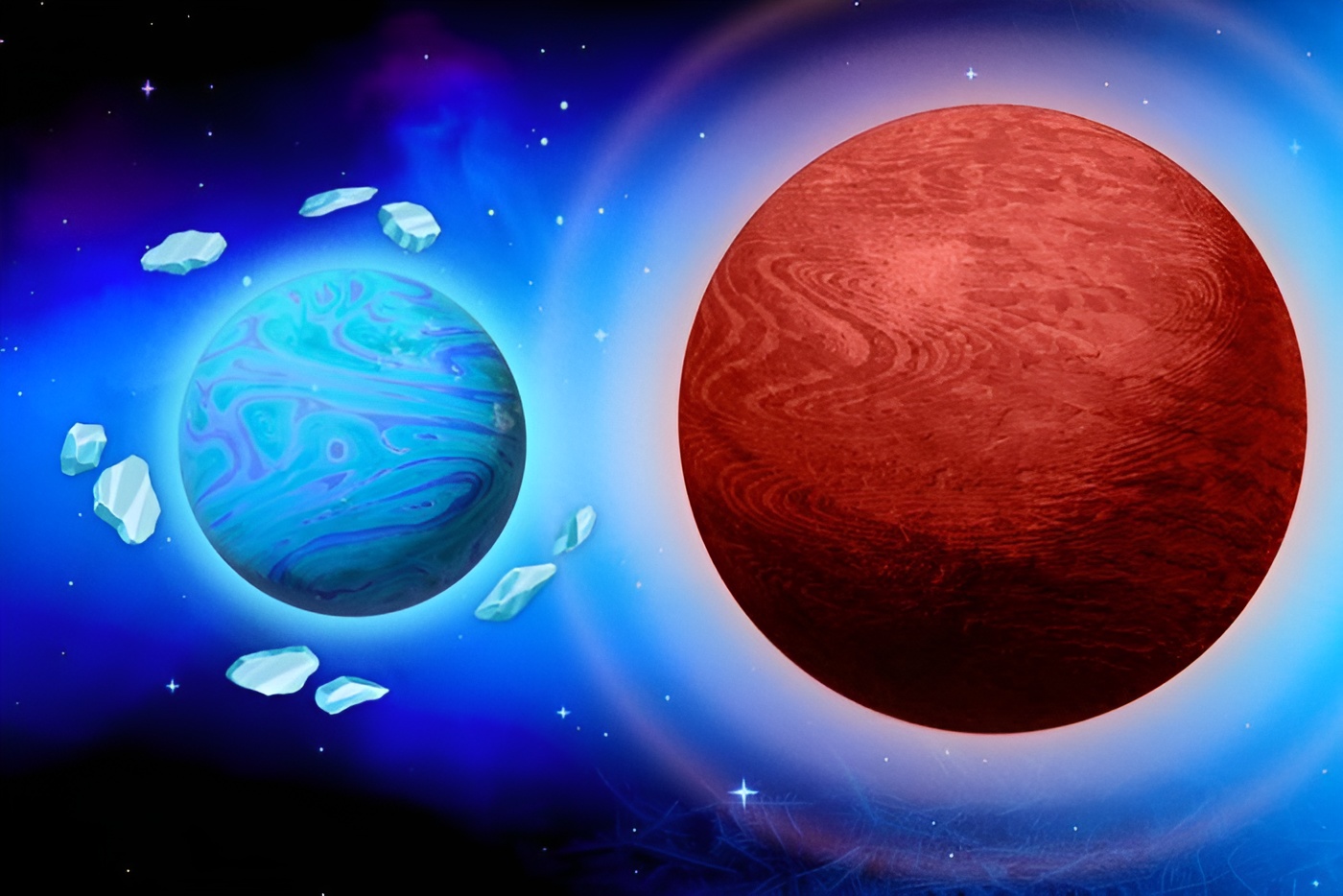

A normally “lonely” hot Jupiter sharing its immediate orbital space with a mini-Neptune companion has provided researchers with a rare window into exoplanet formation. New measurements of the system, located 190 light-years from Earth, suggest that both worlds formed in the icy outskirts of their stellar system before migrating inward together.
The study, appearing in Astrophysical Journal Letters, marks the first time astronomers have successfully measured the atmospheric composition of a mini-Neptune residing inside the orbit of a hot Jupiter. Utilising NASA’s James Webb Space Telescope (JWST), an international team led by MIT scientists detected a “heavy” atmosphere rich in water vapour, carbon dioxide, and sulfur dioxide.
Such a chemical signature is physically inconsistent with planets formed in close proximity to their host star. Instead, the presence of these volatile molecules confirms that the mini-Neptune, TOI-1130b, originated beyond the “frost line”, the celestial boundary where temperatures are low enough for water to condense into solid ice.
“This measurement tells us this mini-Neptune indeed formed beyond the frost line, giving confirmation that this formation channel does exist,” said Saugata Barat, a postdoc at MIT’s Kavli Institute for Astrophysics and Space Research and lead author of the study.
Massive gravitational influence
The system, known as TOI-1130, was first identified in 2020 by Chelsea Huang using data from the Transiting Exoplanet Survey Satellite (TESS). It immediately stood out as an orbital anomaly. Hot Jupiters are typically solitary; their massive gravitational influence usually scatters or consumes any smaller planets attempting to orbit closer to the star.
TOI-1130 challenged this “lonely” hot Jupiter paradigm by maintaining a mini-Neptune on a four-day orbit, while the Jupiter-sized giant follows an eight-day circuit. This proximity raised fundamental questions about how such a delicate architectural balance could survive the violent processes of planetary birth.
Mini-Neptunes are common throughout the Milky Way — despite being absent from our own solar system — and are typically described as gas dwarfs featuring rocky cores enveloped by thick gaseous layers. However, finding one paired with a hot Jupiter is described by researchers as “one-of-a-kind”.
Predicting the tug-of-war
Capturing the data required near-perfect timing due to a phenomenon called “mean motion resonance”. Because the two planets are so close, they exert a constant gravitational tug on one another, slightly altering their orbital periods. Unlike the clockwork regularity of most transiting planets, the transit times for TOI-1130b varied, making it difficult to schedule JWST observations.
To solve this, a team led by Lund University’s Judith Korth synthesised years of prior observations into a predictive model. “It was a challenging prediction, and we had to be spot-on,” Barat noted.
The resulting JWST snapshot allowed the team to observe the specific wavelengths of light absorbed by the planet’s atmosphere. While astronomers previously assumed mini-Neptunes formed near their stars would possess light atmospheres dominated by hydrogen and helium, TOI-1130b proved to be unexpectedly “heavy”.
Ice line migration
The researchers conclude that TOI-1130b likely accumulated its atmosphere by drawing in icy pebbles and dust in the outer reaches of the protoplanetary disk. As the planet migrated toward its star, the ice evaporated into the heavy steam and gas detected by the telescope.
This gradual inward migration allowed the hot Jupiter and the mini-Neptune to move toward the star in tandem, preserving their rare orbital configuration and preventing the smaller world from being scattered into deep space.
“This system represents one of the rarest architectures that astronomers have ever found,” said Barat. The findings provide the first definitive evidence that mini-Neptunes formed beyond the water/ice line are not just theoretical models, but “indeed present in nature”.



